Sep 4, 2026Technical Articles & Engineering Insights
How to Select an On-Board Charger for Electric Utility Vehicles
A practical guide to selecting an OBC for electric utility vehicles, covering battery voltage, charging power, CAN communication, thermal performance and integration.
How to Select an On-Board Charger for Electric Utility Vehicles
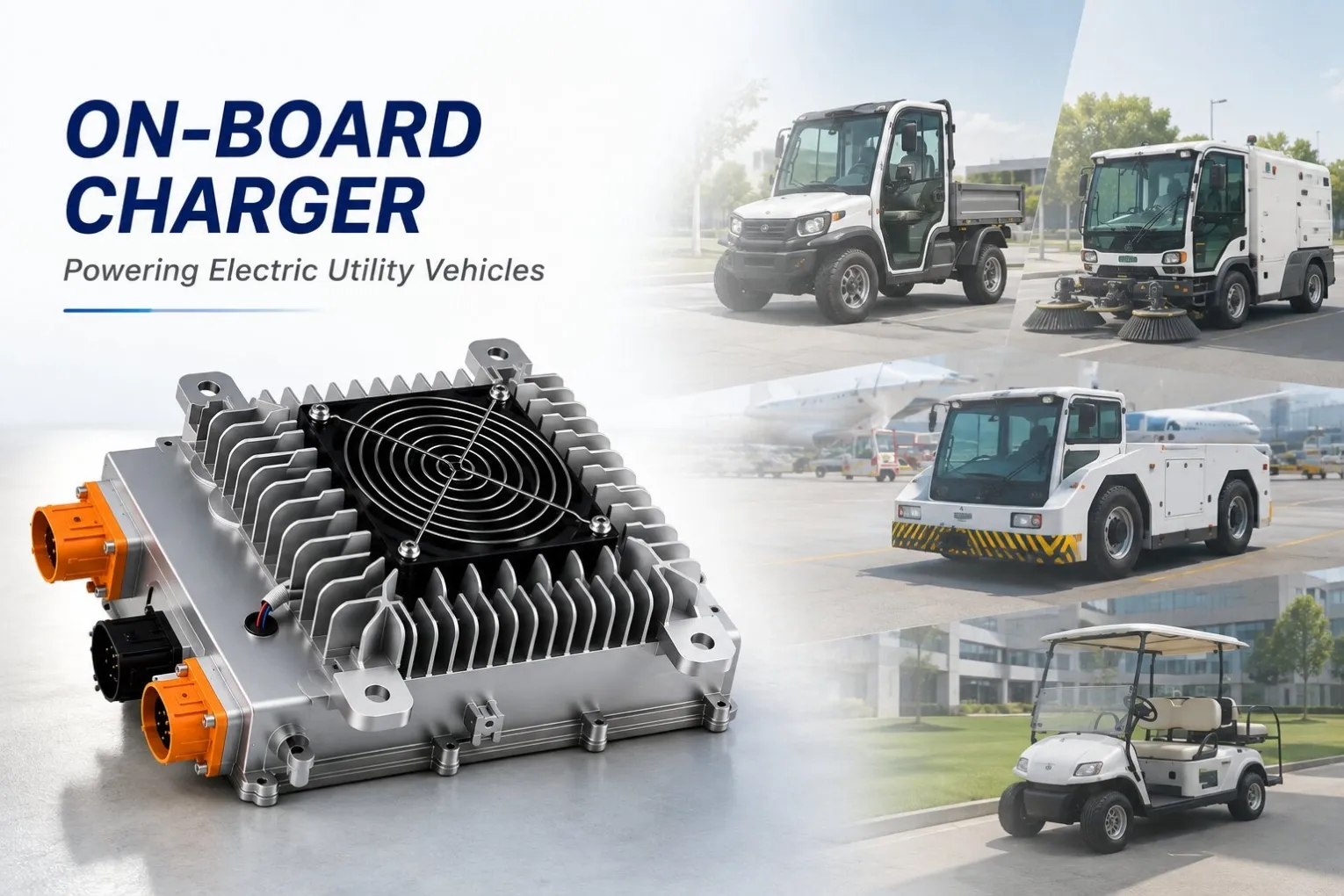
Electric utility vehicles are used in a wide range of applications, from industrial parks and campuses to municipal services, logistics, agriculture, airports and ground support operations.
Although these vehicles may look simple compared with passenger cars, their charging requirements are often very specific.
They may operate for long hours, charge frequently, work outdoors, or use different battery platforms across vehicle models.
For vehicle manufacturers, selecting the right on-board charger is therefore not just about choosing a power rating.
The OBC needs to match the battery system, vehicle architecture, communication requirements and actual operating environment.
Here are the main points worth evaluating.
1. Start With the Battery Voltage Range
The first step is to confirm the battery system.
Do not look only at the nominal battery voltage.
For example, a vehicle may be described as a 72 V or 96 V platform, but the actual battery voltage changes during charging and discharging.
The OBC output range needs to cover the real charging voltage required by the battery pack.
Vehicle manufacturers should confirm:
- Battery chemistry
- Nominal voltage
- Maximum charging voltage
- Battery capacity
- Required charging current
These parameters determine whether the charger is actually compatible with the battery.
2. Choose Charging Power Based on Vehicle Duty Cycle
Electric utility vehicles can have very different daily operating patterns.
Some vehicles work only a few hours per day and can charge overnight.
Others operate in multiple shifts and need shorter charging windows.
This directly affects the required OBC power.
For example, a lower-power charger may be sufficient when the vehicle has long overnight charging time.
A higher-power OBC may be more suitable when the vehicle needs faster turnaround between operating shifts.
Instead of asking only:
“Should we use 3.3 kW or 6.6 kW?”
the better question is:
“How much charging time is available between vehicle operations?”
3. Confirm AC Input Conditions
Utility vehicles may be sold in different countries or used in facilities with different AC power conditions.
The charger should support the required AC input range for the target market.
This may include differences in:
- Input voltage
- Input frequency
- Available current
- Charging connector requirements
If the vehicle platform will be exported to multiple regions, these requirements should be considered early in the design stage.
4. CAN Communication May Be Required
Many modern electric utility vehicles use CAN communication between the OBC, BMS and VCU.
The charger may need to receive charging commands and provide operating status or fault information.
Important communication parameters may include:
- CAN baud rate
- Message IDs
- Charging enable commands
- Voltage and current feedback
- Charging status
- Fault reporting
If the vehicle manufacturer already has an existing CAN protocol, the OBC supplier should confirm whether software adaptation is required.
This should be discussed before vehicle integration begins.
5. Thermal Performance Matters in Real Operation
Utility vehicles often work outdoors, in warehouses, factories or agricultural environments.
Ambient temperature and installation conditions can therefore vary significantly.
A charger may perform normally during a short laboratory test but behave differently during long charging cycles or high-temperature operation.
Vehicle manufacturers should consider:
- Continuous-load performance
- Charger temperature
- Power derating
- Cooling method
- Installation airflow
- Nearby heat sources
Thermal performance is especially important when the OBC is installed in a compact vehicle compartment.
6. Consider Dust, Water and Harsh Environments
Many electric utility vehicles operate outside normal passenger-car environments.
They may be exposed to:
- Dust
- Water
- Mud
- Vibration
- High humidity
The charger enclosure and connector design should be suitable for the intended application.
Protection level, sealing structure and connector arrangement should therefore be evaluated together with the vehicle installation environment.
7. Mechanical Integration Should Be Checked Early
Even when the electrical specification is correct, installation can still become a problem.
Before confirming an OBC, vehicle manufacturers should review:
- Overall dimensions
- Mounting points
- Connector direction
- Cable routing
- Cooling space
- Installation accessibility
This is particularly important for compact utility vehicles where space is limited.
A charger that fits the electrical system but does not fit the vehicle layout can create unnecessary redesign work.
8. Decide Whether a Separate or Integrated Solution Is Better
Some electric utility vehicles use a separate OBC and DC/DC converter.
Others use an integrated OBC + DC/DC solution.
Both architectures can work well.
A separate configuration may offer more flexibility.
An integrated solution can help reduce:
- Component count
- Wiring
- Installation space
- Assembly complexity
The right choice depends on the vehicle platform, available space and power requirements.
9. Check Testing Before Vehicle Validation
Before installing the charger into a vehicle, manufacturers should understand how the product has been tested.
Useful testing may include:
- Functional testing
- Charging performance testing
- CAN communication verification
- Protection testing
- Thermal testing
- Aging testing
- Final inspection
For utility vehicles, continuous-load and thermal testing are particularly useful because these vehicles may charge frequently or operate in demanding environments.
10. Think Beyond the First Sample
A sample charger may work well during initial testing.
But vehicle manufacturers should also consider what happens when the project moves into production.
Questions worth asking include:
- Can the supplier maintain consistent performance?
- Can software changes be controlled?
- Can connectors or cable configurations be customized?
- Can the supplier support future vehicle variants?
- Can production volume increase when the project grows?
For commercial vehicle projects, long-term engineering and production support can be just as important as the initial product specification.
Final Thoughts
Selecting an on-board charger for an electric utility vehicle requires more than matching voltage and power.
The charger should fit the battery system, charging schedule, CAN communication, installation space and real operating environment of the vehicle.
A practical starting point is to prepare the following information before contacting an OBC supplier:
Vehicle type, battery chemistry, battery voltage range, battery capacity, required charging power, AC input conditions, CAN requirements and expected production volume.
At Echelon Energy Technology, we develop on-board chargers, DC/DC converters and integrated power solutions for commercial and specialty electric vehicles.
For electric utility vehicle projects, we can support different battery voltage platforms, CAN communication and project-specific integration requirements from sample validation to production.