Aug 30, 2026Technical Articles & Engineering Insights
How Heat Dissipation Affects On-Board Charger Performance Under Continuous Load
Learn how heat dissipation affects on-board charger performance, efficiency and reliability during continuous-load operation in commercial electric vehicles.
How Heat Dissipation Affects On-Board Charger Performance Under Continuous Load
An on-board charger may perform well during a short bench test, but continuous operation can tell a different story.
When an electric vehicle is charged for an extended period, power components inside the OBC continuously generate heat. If this heat cannot be transferred away efficiently, internal temperatures rise. Over time, this can affect charging power, efficiency, component life and overall system reliability.
For EV manufacturers, thermal performance therefore becomes particularly important when evaluating an OBC for vehicles that operate and charge frequently, such as utility vehicles, electric tractors, low-speed vehicles and commercial EVs.
Where Does Heat Come From Inside an On-Board Charger?
An OBC converts AC power from the grid into controlled DC power for the vehicle battery.
This conversion is not 100% efficient. Power losses in switching devices, magnetic components, rectification stages, PCB conductors and other components are eventually converted into heat.
For example, even an OBC operating above 93% efficiency still needs to dissipate the losses generated during power conversion.
The challenge becomes greater when the charger operates close to rated power for a long period.
A charger that operates normally for ten minutes does not necessarily have the same thermal behavior after one or two hours of continuous charging. This is why continuous-load testing is important during OBC validation.
Heat Dissipation Is More Than Choosing a Fan
Cooling is sometimes simplified to one question:
Does the charger use air cooling or liquid cooling?
But effective OBC thermal management involves much more than the cooling method itself.
The complete thermal path needs to be considered:
Heat-generating component → thermal interface → housing → cooling surface → surrounding environment
If any part of this path has excessive thermal resistance, heat can accumulate around critical components.
This means the housing design, component placement, thermal interface materials, potting materials and airflow path can all influence the final operating temperature.
Housing Design Plays an Important Role
The aluminum housing of an on-board charger is not only a mechanical enclosure.
It can also act as an important part of the heat dissipation system.
Good thermal contact between internal heat-generating components and the housing helps transfer heat away from sensitive components. Housing geometry and heat-dissipation structures can then increase the effective surface area available for cooling.
At the same time, mechanical and environmental requirements cannot be ignored.
For chargers used in commercial vehicles, the enclosure may also need to withstand vibration, dust, water, mud and changing ambient temperatures.
This is why thermal design and mechanical design should be considered together rather than as two independent issues.
What Happens When OBC Temperature Becomes Too High?
A properly designed OBC should monitor its internal temperature and protect itself when operating conditions exceed safe limits.
Depending on the control strategy, excessive temperature may result in power derating or, under more severe conditions, thermal protection and shutdown.
This protects the charger, but from the vehicle manufacturer's perspective, frequent thermal derating is not ideal.
Imagine an OBC rated at 6.6 kW.
If the charger can provide 6.6 kW at the beginning of charging but has to reduce its output after prolonged operation because internal temperature continues rising, the practical charging performance will be different from the rated specification.
Therefore, rated power alone does not tell the complete story.
The ability to maintain stable output under continuous load is equally important.
Ambient Temperature Changes the Thermal Challenge
OBC performance should also be evaluated under realistic environmental conditions.
A charger installed in a laboratory at 25°C faces a very different thermal environment from one installed underneath a commercial vehicle operating during summer.
Vehicle installation can further affect cooling.
Limited installation space, nearby heat-generating components, restricted airflow or mud accumulation around cooling surfaces may all influence heat dissipation.
For this reason, EV manufacturers should consider not only the charger's nominal operating temperature range, but also how the OBC behaves at high ambient temperature and under sustained charging load.
Why Component Layout Matters
Two chargers using similar power components can still have very different thermal performance.
One reason is component layout.
High-loss components concentrated in a small area may create local hot spots. Even when the average internal temperature appears acceptable, individual components can operate at considerably higher temperatures.
Thermal design therefore needs to consider where heat is generated and how efficiently it can move from those locations to the housing or cooling structure.
PCB layout, component spacing and thermal interface design all contribute to this process.
Potting Materials Can Affect Both Protection and Heat Transfer
Potting is often used in automotive power electronics to improve resistance to vibration, moisture and environmental contamination.
But potting material also becomes part of the thermal path.
Its thermal conductivity, thickness and application consistency can influence how effectively heat moves away from components.
This creates an important engineering balance.
Potting should provide the required mechanical and environmental protection without unnecessarily trapping heat around temperature-sensitive components.
For this reason, potting design should be evaluated together with the complete OBC thermal structure.
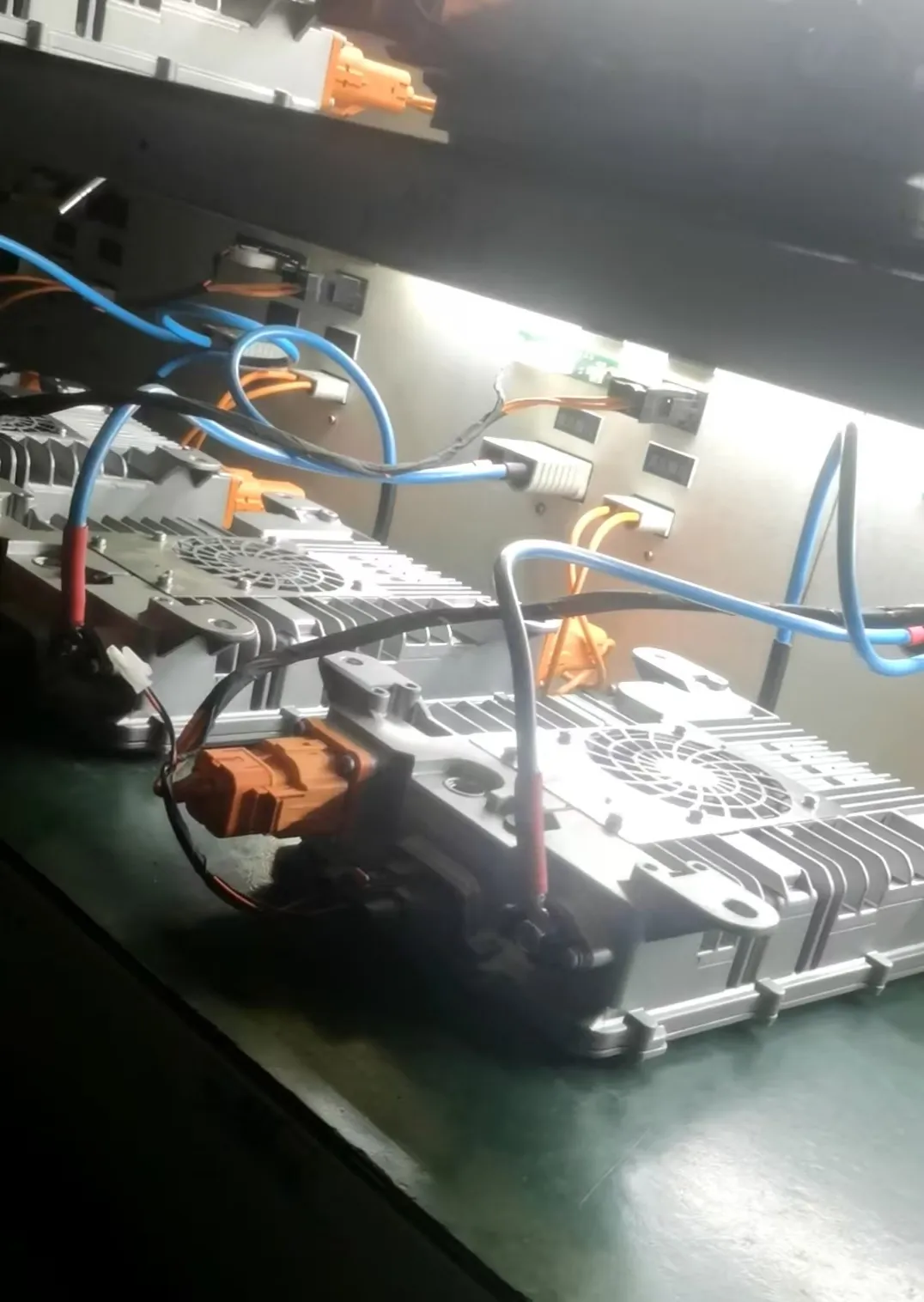
Continuous-Load Testing Provides More Useful Information
For EV manufacturers evaluating an OBC, short functional testing is only the beginning.
Continuous-load testing can help engineers observe how temperature develops after the charger approaches thermal equilibrium.
Useful parameters to monitor include:
- output power stability;
- conversion efficiency;
- temperatures at critical components and housing locations;
- fan or cooling-system behavior;
- thermal derating;
- protection activation;
- recovery behavior after temperature decreases.
The purpose is not simply to confirm that the charger turns on and reaches rated power.
The more important question is:
Can it maintain the required performance over the complete charging cycle under realistic operating conditions?
Thermal Performance Should Be Considered During Vehicle Integration
Even a well-designed charger can experience thermal problems if the vehicle installation restricts its cooling capability.
When integrating an OBC, vehicle engineers should consider installation orientation, surrounding clearance, airflow, nearby heat sources and exposure to road debris.
This is particularly relevant for commercial EVs and special-purpose vehicles, where packaging space can be limited and operating conditions can be demanding.
OBC selection and vehicle integration therefore need to be considered together.
What Should EV Manufacturers Evaluate?
When comparing OBC solutions, looking only at voltage and rated power is not enough.
It is also useful to ask:
Can the charger maintain rated output during extended operation?
How does output power change as temperature increases?
What cooling method is used?
How is heat transferred from critical components to the housing?
What happens at high ambient temperature?
Has the charger been tested under continuous load?
These questions can reveal much more about real-world charging performance than the rated power printed on a specification sheet.
Conclusion
Heat dissipation directly influences how an on-board charger performs during continuous operation.
Good thermal design is not simply about preventing overheating. It helps the charger maintain stable power output, operate efficiently and protect critical components throughout repeated charging cycles.
For commercial EV applications, where vehicles may operate frequently and experience demanding environmental conditions, evaluating thermal performance under continuous load can therefore be an important part of OBC selection and vehicle validation.