Sep 25, 2026EV Industry Insights & Market Trends
CKD vs Finished OBC & DC-DC Units: What EV Manufacturers Should Consider Before Local Assembly
Compare CKD local assembly and finished OBC/DC-DC procurement, including production equipment, testing requirements, investment and localization considerations.
A practical guide to CKD local assembly versus finished OBC and DC-DC units, covering production equipment, testing, investment and localization.
Introduction
As electric vehicle manufacturing expands in India and other markets, more EV manufacturers are exploring the possibility of importing CKD (Completely Knocked Down) kits and assembling on-board chargers (OBCs) and DC-DC converters locally.
Localization requirements, potential import-duty benefits and long-term manufacturing strategies are common reasons for considering this approach.
However, local assembly of EV power electronics requires more than purchasing components and installing an assembly line. Production processes, electrical testing, calibration, quality control and trained personnel must all be considered.
For vehicle manufacturers evaluating CKD assembly, the key question is whether the expected production volume and localization benefits justify the required investment.
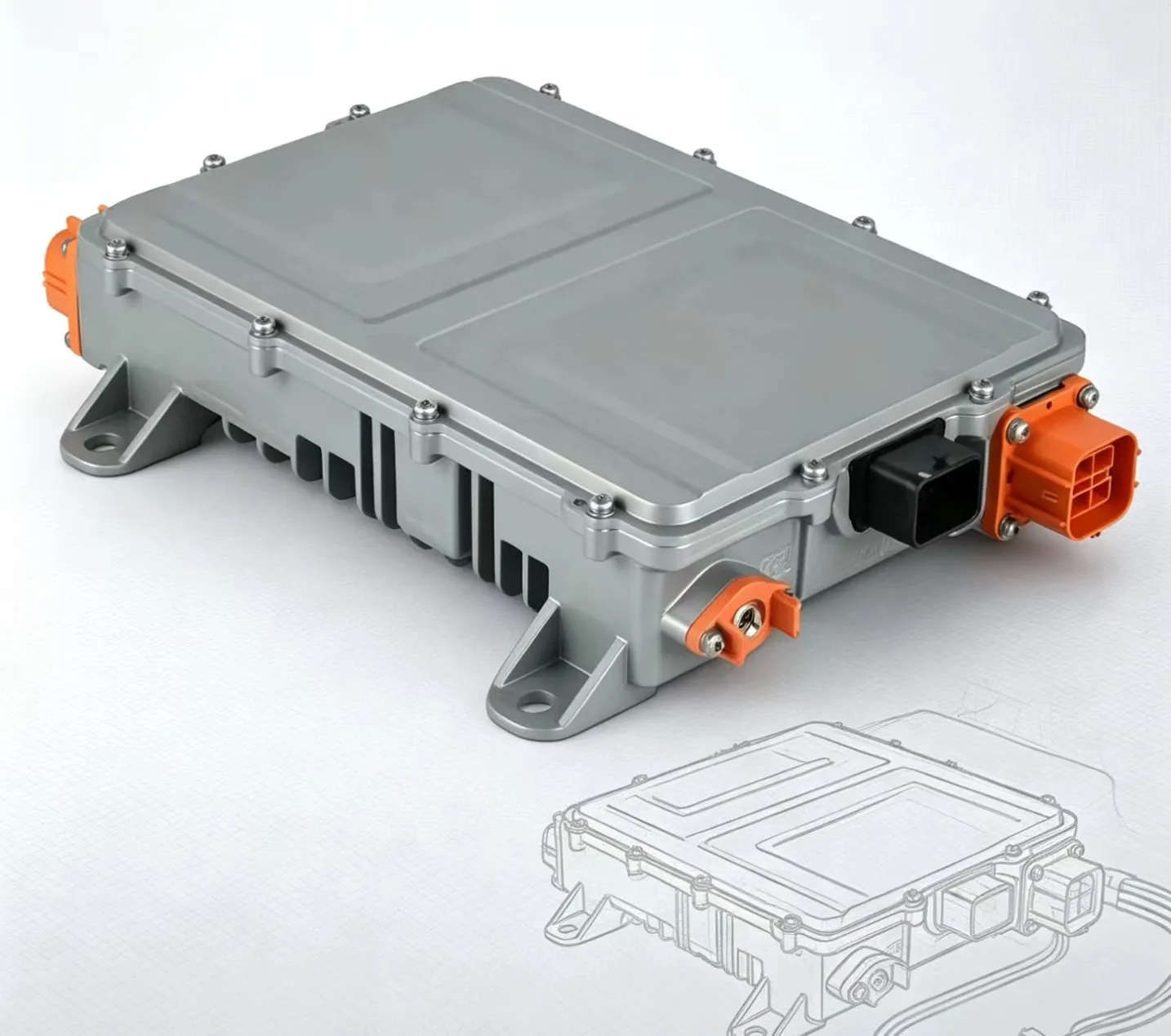
This article compares the practical requirements of local assembly with purchasing fully assembled OBC and DC-DC units.
1. What Does Local Assembly of an OBC or DC-DC Converter Involve?
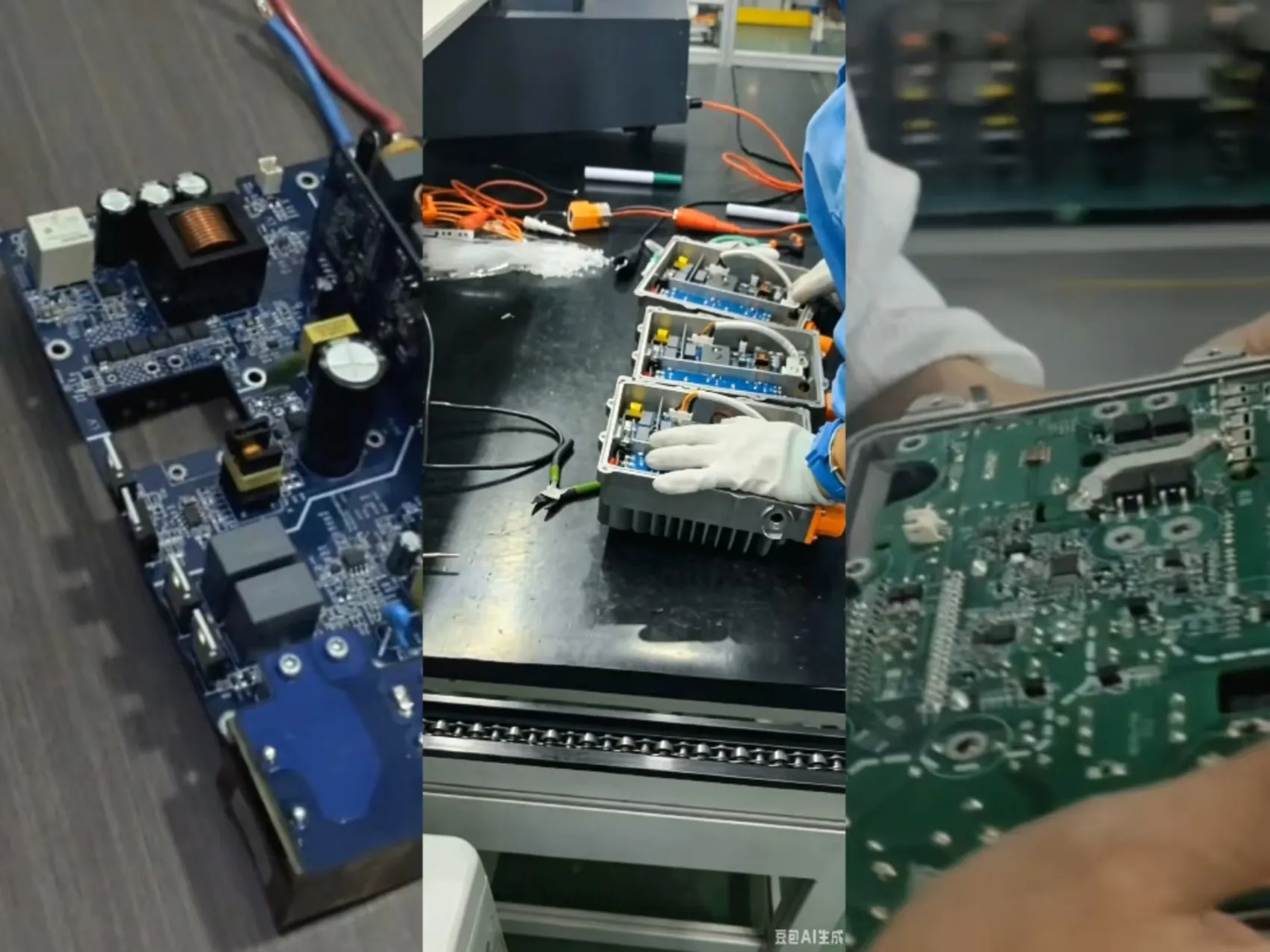
An OBC or DC-DC converter contains power electronics that require controlled manufacturing processes and electrical validation.
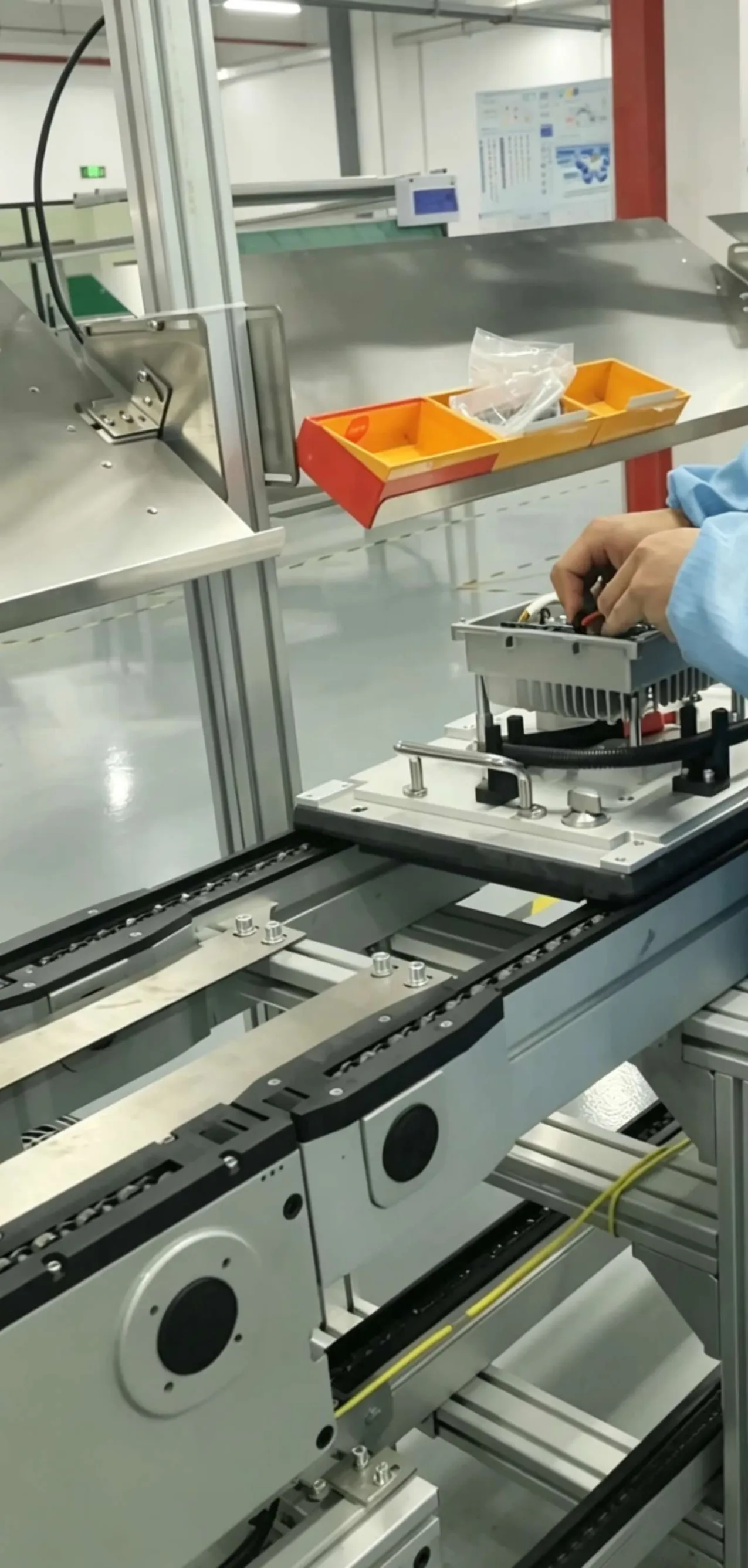
Depending on the product and agreed assembly scope, local production may involve the following operations.
Production stage | Main requirements |
|---|---|
Mechanical assembly | Housing installation, component positioning and fastening |
Electrical assembly | Power connections, wiring and connector installation |
Potting and sealing | Application-specific sealing and protection processes |
Calibration | Verification and adjustment of electrical output parameters |
Electrical safety testing | Insulation and withstand-voltage verification |
Functional testing | Output performance and relevant protection functions |
Aging testing | Operation under defined test conditions |
Final inspection | End-of-line testing and quality records |
A factory planning to assemble OBCs locally needs to evaluate which of these processes it can perform internally and which require additional equipment, technical support or training.
2. Production Equipment Required for CKD Local Assembly
The following equipment list is based on preliminary production-line planning for 3.3 kW standalone OBCs, 6.6 kW standalone OBCs and 6.6 kW OBC + DC-DC integrated units.
Important
Equipment quantities and lead times below are planning references, not a final factory design or contractual quotation. Actual requirements depend on the product, production capacity and agreed localization scope.
2.1 Production-line and process equipment
Equipment | Specification / Function | Reference quantity | Reference lead time |
|---|---|---|---|
Assembly conveyor line | Customized production line | 1 set | 100 working days |
Potting machine | Customized potting process | 1 unit | 2–4 weeks |
Aging test equipment | Mass-production aging | 2 units | 4–6 weeks |
Air-tightness tester | Including testing tooling | 2 units | 2–4 weeks |
Final-test station | Customized end-of-line testing | 1 set | 6–8 weeks |
Electric screwdrivers | Assembly and fastening | 5 units | 2–3 weeks |
The assembly conveyor and final-test station are customized equipment. Their design and delivery schedules should be considered early in the project.
2.2 Electrical safety testing equipment
Equipment | Specification / Function | Quantity | Lead time |
|---|---|---|---|
Hipot tester | LK3672X | 1 unit | 2 weeks |
Withstand-voltage tester | Electrical safety testing | 1 unit | 2 weeks |
Safety compliance tester | Electrical safety validation | 2 units | 2–4 weeks |
The exact safety-test configuration should be determined according to the product specification and applicable project requirements. Equipment functions may overlap and should be reviewed before purchasing.
2.3 Electrical performance and calibration equipment
Equipment | Function | Quantity | Lead time |
|---|---|---|---|
Multimeter | General electrical measurement | 1 unit | 1 week |
Digital multimeter | Precision measurement | 1 unit | 2 weeks |
LCR digital bridge | Component parameter testing | 1 unit | 1 week |
Calibration equipment | Product performance calibration | 1 unit | 2–3 weeks |
2.4 Mechanical inspection and workshop tools
Equipment | Specification | Quantity | Lead time |
|---|---|---|---|
Digital push-pull gauge | SF-5 | 1 unit | 1 week |
Torque wrench | 3/8", 5–60 Nm | 1 pc | 1 week |
Cross-hatch tester | QFH-A | 1 unit | 1 week |
Temperature-humidity meter | RC812 | 1 unit | 1 week |
Digital vernier caliper | 150 / 300 / 500 mm | 1 pc each | 1 week |
Feeler gauge | 0.02–1.0 mm | 1 set | 1 week |
Thread ring gauges | M12 specifications | 1 pc each | 1 week |
Go/No-Go thread plug gauges | M3–M25 specifications | 1 pc each | 1 week |
These tools support mechanical inspection, dimensional verification and workshop monitoring.
Beyond the hardware, a production-ready facility also needs suitable test software, operating procedures, operator training, calibration management and test-recording systems.
3. Why Testing Capability Matters as Much as Assembly Capability
A factory may have the equipment required to assemble an OBC but still lack the capability to verify its performance consistently.
The following testing requirements should be considered during local production planning.
Testing area | What needs to be verified | Why it matters |
|---|---|---|
Output performance | Voltage, current and specified operating range | Confirms electrical performance |
Electrical safety | Insulation and withstand voltage | Verifies specified safety requirements |
Protection functions | Relevant voltage, current, short-circuit and thermal protections | Checks product protection behavior |
Sealing | Leakage and air-tightness, where applicable | Verifies sealing quality |
Aging | Operation under defined test conditions | Helps identify production-related issues |
End-of-line testing | Final functional and electrical checks | Confirms conformity before shipment |
Testing procedures and acceptance criteria must be defined for the specific product and project. Simply purchasing the equipment does not establish a complete production quality system.
For manufacturers evaluating localization, testing capability should be included in the initial investment calculation, not treated as an additional expense after assembly begins.
4. CKD Local Assembly vs Finished Units
The two models involve different investments, responsibilities and project timelines.
Comparison | CKD local assembly | Finished OBC / DC-DC units |
|---|---|---|
Initial equipment investment | Requires assembly and testing resources | No dedicated local assembly line required |
Production preparation | Line setup, process validation and training | Primarily vehicle integration and incoming inspection |
Technical personnel | Local assembly, test and quality teams | Vehicle integration and supplier-quality personnel |
Quality responsibility | Shared according to agreed supply and assembly scope | Supplier manages finished-unit manufacturing; buyer manages integration |
Localization | May support qualifying local-manufacturing programs | Depends on applicable import and localization rules |
Project launch | Requires additional preparation | Generally simpler for prototype and early production |
Scalability | Depends on line capacity and utilization | Depends on supplier capacity and delivery arrangements |
Cost considerations | Equipment, tooling, labor, scrap and testing | Unit price, logistics, duties and supplier management |
Neither model should be evaluated on purchase price alone. A lower component price does not automatically result in a lower total manufacturing cost.
5. How Production Volume Affects the Decision
The expected annual order volume is one of the most important inputs when evaluating CKD assembly.
A manufacturer with established electronics production capability and stable high-volume demand may be able to distribute the initial investment across a large number of units.
A manufacturer developing a new vehicle platform may face a different situation, particularly when production forecasts are still uncertain.
Cost category | CKD local assembly | Finished-unit procurement |
|---|---|---|
Components or finished products | CKD kit cost | Finished-unit purchase price |
Assembly equipment | Required according to scope | Not required for the buyer |
Testing equipment | Required according to scope | Incoming and vehicle-level testing still required |
Tooling | Product-specific tooling | Primarily vehicle integration tooling |
Labor | Local assembly and testing | Incoming inspection and vehicle integration |
Training | Production and test personnel | Product integration and maintenance |
Rework and scrap | Local process responsibility | Depends on warranty and supply agreement |
Logistics and import duties | CKD-specific arrangements | Finished-product arrangements |
A realistic cost comparison should include the full investment and operating costs over the expected production period.
For projects with uncertain volumes, it may be useful to evaluate finished-unit supply first and revisit localization when demand becomes clearer.
6. India Localization: What Should Be Confirmed?
For Indian EV manufacturers, CKD assembly may form part of a broader localization strategy. However, the applicable requirements depend on the specific product, vehicle category and government program.
Before committing to a local-assembly project, the buyer should clarify the following.
Item | Questions to confirm |
|---|---|
Applicable program | Which localization or manufacturing program applies to the vehicle or component? |
Required local content | What value addition or manufacturing activities are required? |
CKD eligibility | Does the proposed component sourcing and assembly arrangement qualify? |
Documentation | What records, declarations and supporting documents are required? |
Production capability | Does the local factory have the required assembly and testing resources? |
Implementation timeline | Can the production line be established before the planned start of production? |
CKD procurement alone should not be assumed to satisfy a particular localization requirement or guarantee eligibility for incentives.
The final arrangement should be reviewed against the applicable Indian requirements and the buyer's actual manufacturing plan.
7. An Alternative: Start with Finished Units and Evaluate CKD Later
For manufacturers developing a new EV platform, localization does not necessarily have to begin at the prototype stage.
One possible approach is to separate vehicle validation from the decision to invest in local production.
- Stage 1 — Prototype validationEvaluate finished OBC or OBC + DC-DC units in the vehicle. Confirm electrical compatibility, communication and installation requirements.
- Stage 2 — Small-batch productionValidate the vehicle platform and establish a more reliable production forecast.
- Stage 3 — Localization assessmentCompare expected annual volume, required local content, production investment and project timing.
- Stage 4 — CKD implementation, where justifiedDefine the commercial agreement, technical support scope, equipment requirements and quality responsibilities.
This is one possible project path rather than a requirement. Projects with mandatory localization from the outset will need a different implementation plan.
8. Technical Documentation and Cooperation Scope
CKD technical support is project-specific and should be defined through a formal commercial agreement.
Documentation / Support | Availability |
|---|---|
Assembly instructions | Subject to agreed project scope |
Equipment and tooling reference lists | Subject to agreed project scope |
Basic work instructions | Subject to agreed project scope |
BOM-related information | Subject to agreed project scope |
Mass-production test requirements | Subject to agreed project scope |
Confidential internal process diagrams | Not included |
Proprietary manufacturing drawings | Not included |
Echelon's confidential manufacturing information and proprietary process documentation are protected. The exact technical deliverables, responsibilities and intellectual-property boundaries should be confirmed before a CKD project begins.
9. Information Required for a CKD Project Assessment
To evaluate whether local assembly is technically and commercially practical, the following information is useful.
Project information | Details required |
|---|---|
Vehicle application | Vehicle type and intended use |
Required product | Standalone OBC, DC-DC or integrated unit |
Battery system | Nominal voltage and charging voltage range |
Required power | OBC and DC-DC power requirements |
Annual quantity | Estimated annual demand |
Project stage | Prototype, validation or mass production |
Localization | Required local manufacturing scope |
Existing facilities | Available assembly and test equipment |
Timeline | Target start of production |
Providing this information at the beginning of a project helps both parties assess the necessary equipment, technical support and commercial arrangements.
Conclusion
CKD local assembly and finished-unit procurement serve different manufacturing strategies.
Local assembly requires investment in production equipment, testing, technical personnel and quality systems. Finished units can simplify the initial manufacturing requirements, particularly during vehicle development and early production.
For EV manufacturers considering localization, the decision should be based on production volume, factory capability, applicable requirements, total cost and project timing.
The objective is to establish a manufacturing and supply arrangement that supports consistent product quality and the vehicle manufacturer's long-term production plans.
Discuss Your OBC / DC-DC Project
Echelon Energy Technology supplies finished OBC and DC-DC units and can discuss project-specific CKD cooperation.
Share your vehicle application, battery voltage, required power, expected annual quantity and localization requirements with our team.