Sep 26, 2026Technical Articles & Engineering Insights
How to Choose an On-Board Charger Supplier for Commercial EV Projects
Learn how to evaluate an on-board charger supplier for commercial EV projects, including voltage compatibility, CAN communication, thermal performance, testing, customization and production support.
How to Choose an On-Board Charger Supplier for Commercial EV Projects
Selecting an on-board charger for a commercial electric vehicle is not simply a matter of finding a charger with the right voltage and power.
For vehicle manufacturers, the charger has to work reliably with the battery system, vehicle controller, charging interface, thermal environment and operating conditions of the vehicle.
This becomes especially important for commercial EVs such as utility vehicles, electric tractors, low-speed vehicles, delivery vehicles, airport vehicles and other specialty electric vehicles. These vehicles may operate for long hours, experience frequent charging cycles, or work in demanding environments.
Before choosing an on-board charger supplier, there are several areas worth checking carefully.
- Start With the Vehicle Requirements, Not Only the Charger Power A common starting point is to ask for a 3.3 kW or 6.6 kW charger. But power alone does not determine whether an OBC is suitable for the vehicle. The supplier should first understand the basic vehicle and battery information, including battery chemistry, nominal voltage, maximum charging voltage, battery capacity, target charging current, AC input conditions and expected charging time. For example, two vehicles may both use a 6.6 kW OBC but have very different battery voltage ranges and charging strategies. A supplier that understands the complete charging requirement can help confirm whether the charger fits the battery system rather than simply recommending a product based on rated power.
- Check the Actual Input and Output Voltage Range The nominal battery voltage does not tell the whole story. A 72 V or 96 V battery system, for example, normally operates across a wider voltage range during charging and discharging. The OBC output range should therefore cover the actual charging voltage required by the battery pack. The AC input range also needs to match the markets where the vehicle will operate. If a vehicle will be sold in multiple countries, the manufacturer should confirm whether the charger can support the required AC input conditions without changing the complete charging system. These details should be confirmed early in the project because voltage mismatch can create unnecessary redesign work later.
- Evaluate Thermal Performance Under Continuous Load A charger may perform well during a short bench test but behave differently after operating continuously at high power. For commercial vehicles, continuous-load performance is particularly important. During validation, manufacturers should pay attention to charger temperature, power derating, output stability and component temperature under realistic operating conditions. Vehicle installation also matters. Airflow around the charger, mounting position, nearby heat sources and ambient temperature can all influence thermal performance. This is why a supplier should be able to discuss not only rated power, but also how the charger behaves during extended operation.
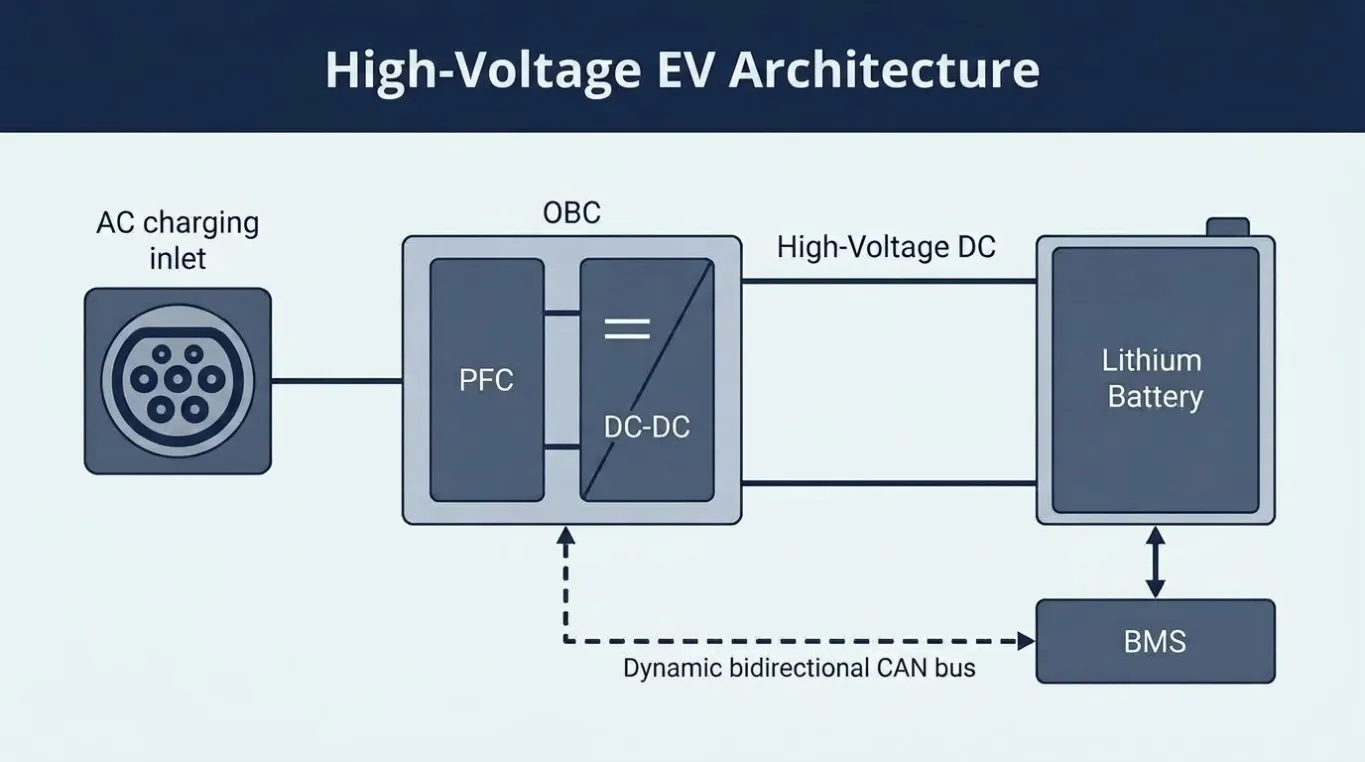
- Confirm CAN Communication Before Vehicle Integration For many modern EV platforms, the OBC is part of the vehicle communication network. Before selecting a charger, manufacturers should confirm whether the supplier can support the vehicle's CAN communication requirements. This normally includes CAN baud rate, message IDs, charging commands, charger status, voltage and current feedback, fault information and communication timing.
If the vehicle already has an established VCU or BMS communication protocol, the OBC may need software adaptation.
It is much easier to confirm this during the early engineering stage than after the charger has already been installed in the vehicle.
A capable OBC supplier should therefore be able to work with the vehicle manufacturer's CAN protocol rather than treating communication as a separate issue after hardware selection.
- Review Protection Functions and Fault Handling Protection functions are essential, but simply seeing a long protection list in a specification sheet is not enough. Typical OBC protections may include input over-voltage and under-voltage, output over-voltage, over-current, short circuit and over-temperature protection. Vehicle manufacturers should also understand what happens when one of these conditions occurs.
Does the charger reduce power?
Does it stop charging immediately?
Can it recover automatically?
Is the fault reported through CAN?
These behaviors can affect the way the BMS and VCU respond to charger faults.
For commercial EV projects, protection strategy should therefore be considered as part of system integration rather than only as a product feature.
- Consider Mechanical Integration Early Electrical compatibility is only one part of OBC integration. The manufacturer should also confirm dimensions, mounting points, connector direction, cable routing, cooling requirements and available installation space. This becomes even more important when several power electronics components are installed in the same vehicle.
A charger that fits electrically but creates problems with connectors, harness routing or installation space can delay the vehicle project.
Sharing vehicle layout information or installation constraints with the charger supplier early can reduce this risk.
- Decide Whether a Separate or Integrated Power Solution Is Better Some vehicle platforms use a separate OBC and DC/DC converter. Others prefer an integrated OBC + DC/DC solution. Neither architecture is automatically better. Separate units may offer more flexibility when different vehicle models use different power configurations. An integrated solution can reduce component count, wiring and installation space. The right choice depends on the vehicle platform, available space, power requirements, service strategy and production plan. A supplier that offers both separate and integrated solutions can usually discuss the architecture more objectively instead of forcing the vehicle into one product configuration.
- Ask How the Charger Is Tested Before Shipment For EV manufacturers, the important question is not only whether a charger sample works. The bigger question is whether production units can perform consistently. It is worth asking the supplier about functional testing, aging or burn-in testing, thermal testing, protection verification, communication testing and final inspection.
For commercial EV applications, continuous-load testing can also be particularly useful because it helps identify thermal or component issues that may not appear during short functional tests.
The supplier's testing process gives vehicle manufacturers a better understanding of how product consistency is controlled before mass production.
- Check Whether Customization Is Really Supported Many commercial EV projects cannot use a completely standard charger. The vehicle may require a different charging voltage, CAN protocol, connector, cable length, mounting arrangement or mechanical interface. Some projects may also require changes to software logic or charging behavior. Therefore, when a supplier says customization is available, it is worth asking what can actually be changed and how those changes are validated. The ability to adapt a charger is useful, but engineering control is equally important. Every change should be clearly defined, tested and reflected in the final specification.
- Look Beyond the Sample Stage A successful sample test does not automatically mean the supplier is ready for mass production. Before making a long-term decision, EV manufacturers should also consider production capacity, component supply, quality control, change management and technical support. Commercial vehicle projects often continue for several years.
For projects considering local production, manufacturers should also evaluate whether CKD local assembly or finished OBC and DC-DC units better fit their production volume, testing capability and localization plan.
During that time, the vehicle manufacturer may need software updates, connector changes, different battery configurations or additional vehicle variants.
A reliable supplier should therefore support the project beyond the first sample order.
Price Matters, but It Should Not Be the Only Decision
OBC pricing is naturally part of supplier selection.
However, the lowest unit price does not always result in the lowest project cost.
If the charger requires repeated software changes, causes thermal problems, does not communicate correctly with the vehicle, or needs mechanical redesign after testing, the additional engineering time can easily outweigh the initial price difference.
For a commercial EV manufacturer, a better comparison is often:
product cost + engineering support + integration risk + validation effort + production consistency.
This gives a more realistic picture of the total cost of working with an OBC supplier.
Choosing an on-board charger supplier is ultimately an engineering and supply decision, not just a purchasing decision.
The charger needs to match the battery, communicate correctly with the vehicle, operate reliably under real working conditions and remain consistent when the project moves from prototype to production.
Before requesting a quotation, vehicle manufacturers can save considerable time by preparing the key vehicle information first: battery voltage range, battery capacity, required charging power, AC input, communication protocol, installation constraints and expected production quantity.
If you are evaluating an OBC for a new vehicle platform, share your project requirements with our engineering team to discuss a suitable charging solution.