Oct 21, 2026EV Industry Insights & Market Trends
CE Certification for Echelon 3.3kW OBC + 1kW DC-DC 2-in-1 Integrated Power Unit
Echelon's 3.3kW OBC + 1kW DC-DC 2-in-1 has achieved CE attestation under LVD 2014/35/EU and EMC 2014/30/EU, covering 72 V to 540 V light EV platforms.
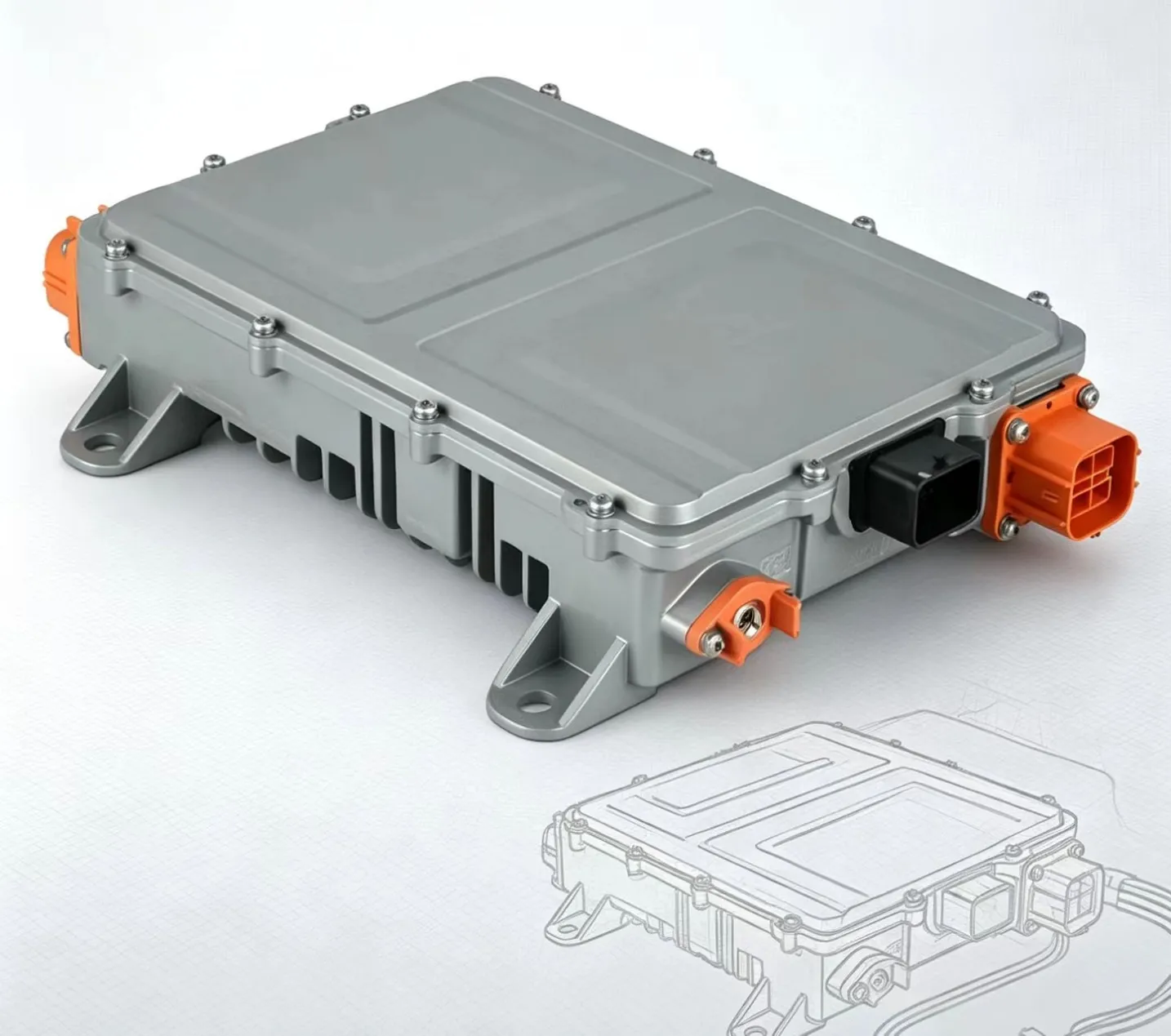
Echelon Energy's 3.3 kW on-board charger integrated with a 1 kW DC-DC converter has received a third-party Attestation of Conformity covering the EU Low Voltage Directive (2014/35/EU) and the Electromagnetic Compatibility Directive (2014/30/EU). The attestation was issued by UDEM, an independent conformity assessment body, under certificate number M.2026.206.C148238, registered on 23 Sept 2026 and valid until 22 Sept 2031.
The certified hardware is the 2-in-1 unit that combines AC charging and high-voltage-to-low-voltage conversion in a single IP67 housing. It covers six battery platform variants from 72 V to 540 V, which extends the range previously published for this model family.
What exactly was certified?
The scope of the attestation is a component, not a vehicle. It confirms that this specific power unit was tested against the harmonised standards listed below and found to conform. The certificate details are summarised here so that a vehicle program can cite them directly in its own documentation.
Item | Detail |
Certificate holder | Echelon Energy Technology (Hangzhou) Co., Ltd. |
Assessment body | UDEM (UdEM Uluslararasi Belgelendirme Denetim ve Teknik Gozetim ve Kontrol A.S.), Ankara, Turkiye |
Certificate number | M.2026.206.C148238 |
Directives covered | 2014/35/EU Low Voltage Directive (Annex III); 2014/30/EU Electromagnetic Compatibility Directive (Annex II) |
Harmonised standards | EN 62368-1:2020; EN 55032:2015/A11:2020; EN 55035:2017/A11:2020; EN 61000-6-3:2019; EN 61000-3-3:2013/A2:2021 |
Product | 2 in 1 Integrated 3.3 kW OBC + 1 kW DC-DC |
Test reports | JAT26091802749SR-1 and JAT26091802749ER-1 |
Registration date | 23 September 2026 |
Expiry date | 22 September 2031 |
Verification | Certificate validity can be checked at udem.com.tr |
What the standards cover, in practical terms: EN 62368-1 is the electrical safety standard for audio/video, information and communication technology equipment, which is the reference safety standard applied to this class of power converter. EN 55032 and EN 55035 set emission and immunity limits for multimedia equipment. EN 61000-6-3 sets emission limits for equipment used in residential, commercial and light-industrial locations, and EN 61000-3-3 limits voltage fluctuations and flicker on the AC supply.
Which battery platforms does the certified unit cover?
The certificate lists six model variants rather than the three that appear on the current product page. The additional 144 V, 360 V and 540 V classes matter for programs that were previously outside this platform's published range.
Model | Nominal battery platform | Notes |
OD-CE-3D1A-72Y | 72 V | Light electric vehicles, low-speed platforms |
OD-CE-3D1A-96Y | 96 V | Light commercial EVs, utility vehicles |
OD-CE-3D1A-144Y | 144 V | Added to the certified scope |
OD-CE-3D1A-320Y | 320 V | Commercial EV platforms |
OD-CE-3D1A-360Y | 360 V | Added to the certified scope |
OD-CE-3D1A-540Y | 540 V | Added to the certified scope |
All six variants share the same integrated architecture, so a program moving up or down the voltage range does not need a different charger topology. Full electrical detail is on the 3.3 kW OBC + 1 kW DC-DC 2-in-1 product page.
What this means for an OEM - and what it does not
The attestation removes a piece of work from the vehicle program, but it does not replace the vehicle's own conformity assessment. The distinction matters, because a component attestation and a whole-vehicle CE marking are two different legal acts.
What it does: provides a documented, third-party-verified basis for the charger's electrical safety and EMC behaviour, which the vehicle manufacturer can reference as part of its own technical file.
What it does not do: it does not exempt the vehicle from whole-vehicle type approval, and it does not transfer the charger's conformity to other components or to a different enclosure.
What changes in practice: the charger no longer needs to be characterised from zero during vehicle-level EMC work. Test data and the applied standards are available up front, which shortens the fault-finding loop when the unit is installed in a new vehicle.
For a program manager, the practical saving is time and iterations rather than the elimination of testing. A component that has already been characterised against EN 55032 and EN 55035 gives the vehicle EMC team a known starting point.
Electrical specifications of the certified unit
Parameter | Value |
AC input | 90-264 Vac |
Rated OBC output | 3300 W at 220 Vac; 1650 W at 110 Vac |
OBC efficiency | at least 93% |
DC-DC output | 14 V dc, 72 A, 1000 W rated |
DC-DC efficiency | at least 91% |
Cooling | Forced air |
Ingress protection | IP67 |
Communication | CAN bus |
Protections | Input and output over/under voltage, over current, short circuit, over temperature (both stages) |
The integrated format removes one converter, one harness run and one CAN node from the vehicle. For a light EV with a tight packaging envelope, that is usually the deciding factor. If a program needs more charging power, the 6.6 kW OBC + 1.5 kW DC-DC 2-in-1 covers 96 V and 320 V platforms, and the 11 kW bidirectional unit adds V2L and V2G for three-phase sites.
Where the integrated format pays off
Fewer interfaces to validate. One supplier, one CAN matrix, one set of connector definitions, instead of two components that must be matched and jointly debugged.
Lower part count. Connectors, brackets and harness segments for a second converter disappear from the bill of materials.
Smaller installation footprint. Two functions share one housing and one cooling path.
One qualified platform across models. The six voltage variants let one power architecture serve several vehicles in a product line, which reduces spares variety and engineering overhead.
Programs that also need on-board power distribution protection can consider the 3-in-1 OBC + DC-DC + PDU unit, which adds that stage in the same housing format.
How to use the certificate in your own documentation
A vehicle program that adopts this charger usually needs three things from the supplier: the certificate copy, the test reports behind it, and confirmation that the specific model variant ordered falls inside the certified scope.
Request the certificate and both test reports for the model variant you intend to order
Confirm the variant code matches the certificate list, since the 144 V, 360 V and 540 V models were added to the scope
Keep the certificate with your own technical file as supporting evidence
The OEM/ODM page describes how custom variants are handled, and the RFQ checklist lists the inputs that let us confirm quickly whether your platform falls inside the certified range.
FAQ
Does this CE attestation cover the whole vehicle?
No. It covers the charger as a component. The vehicle manufacturer remains responsible for the whole-vehicle conformity assessment and CE marking.
Which model variants are inside the certified scope?
Six: OD-CE-3D1A-72Y, -96Y, -144Y, -320Y, -360Y and -540Y, covering 72 V to 540 V nominal battery platforms.
How can a customer verify the certificate?
The certificate states that its validity can be checked through udem.com.tr. The number to quote is M.2026.206.C148238.
Does a certified charger remove the need for vehicle-level EMC testing?
No. Vehicle-level EMC testing is still required as part of the vehicle's own approval. What changes is the starting point: the charger's emission and immunity behaviour is already characterised against EN 55032 and EN 55035, so fault-finding during vehicle integration starts from known data.
What about ingress protection in service?
The unit is rated IP67. For installation and sealing practice in commercial vehicles, see why IP67 rating matters.
About Echelon Charger
Echelon Energy Technology specializes in onboard chargers, DC/DC converters, and integrated EV power solutions for commercial and specialty electric vehicles.
For technical discussions, product selection, or OEM/ODM cooperation:
Email: nancy@tici-energy.com
WhatsApp: +86 18114665311
For the certificate copy, test reports or a project-specific requirement discussion, use our contact page.