Jul 18, 2026
How Commercial EV Chargers Are Designed for Reliable Vehicle Integration
Learn how commercial EV chargers are designed for reliable vehicle integration, including power selection, battery compatibility, communication, protection, and application requirements.
How Commercial EV Chargers Are Designed for Reliable Vehicle Integration
Introduction
For commercial electric vehicles, a charger is more than a power conversion device.
Unlike passenger EVs, commercial vehicles often operate under demanding conditions, including longer working hours, frequent charging cycles, and different operating environments.
Therefore, selecting and designing the right EV charging solution requires careful consideration of vehicle requirements, battery systems, power levels, communication protocols, and environmental conditions.
A well-designed charging system helps vehicle manufacturers achieve better reliability, easier integration, and improved overall vehicle performance.
1. Understanding Vehicle Requirements Before Designing a Charging Solution
The first step in developing a suitable EV charging system is understanding the vehicle application.
Different commercial EV platforms have different charging requirements.
For example:
- Electric cargo vehicles require reliable charging solutions for daily delivery operations.
- Utility vehicles need stable power systems for continuous working conditions.
- Agricultural EVs require chargers that can operate in outdoor environments.
- ATV and specialty vehicles may require compact and durable charging solutions.
Before selecting a charger, manufacturers should evaluate:
- Vehicle operating environment
- Battery voltage platform
- Required charging time
- Available installation space
- Communication requirements
A charging solution should be designed around the vehicle, not selected separately from the vehicle system.
2. Selecting the Right Charging Architecture
Commercial EV manufacturers typically choose between different charging architectures depending on their vehicle design.
Onboard Charger (OBC)
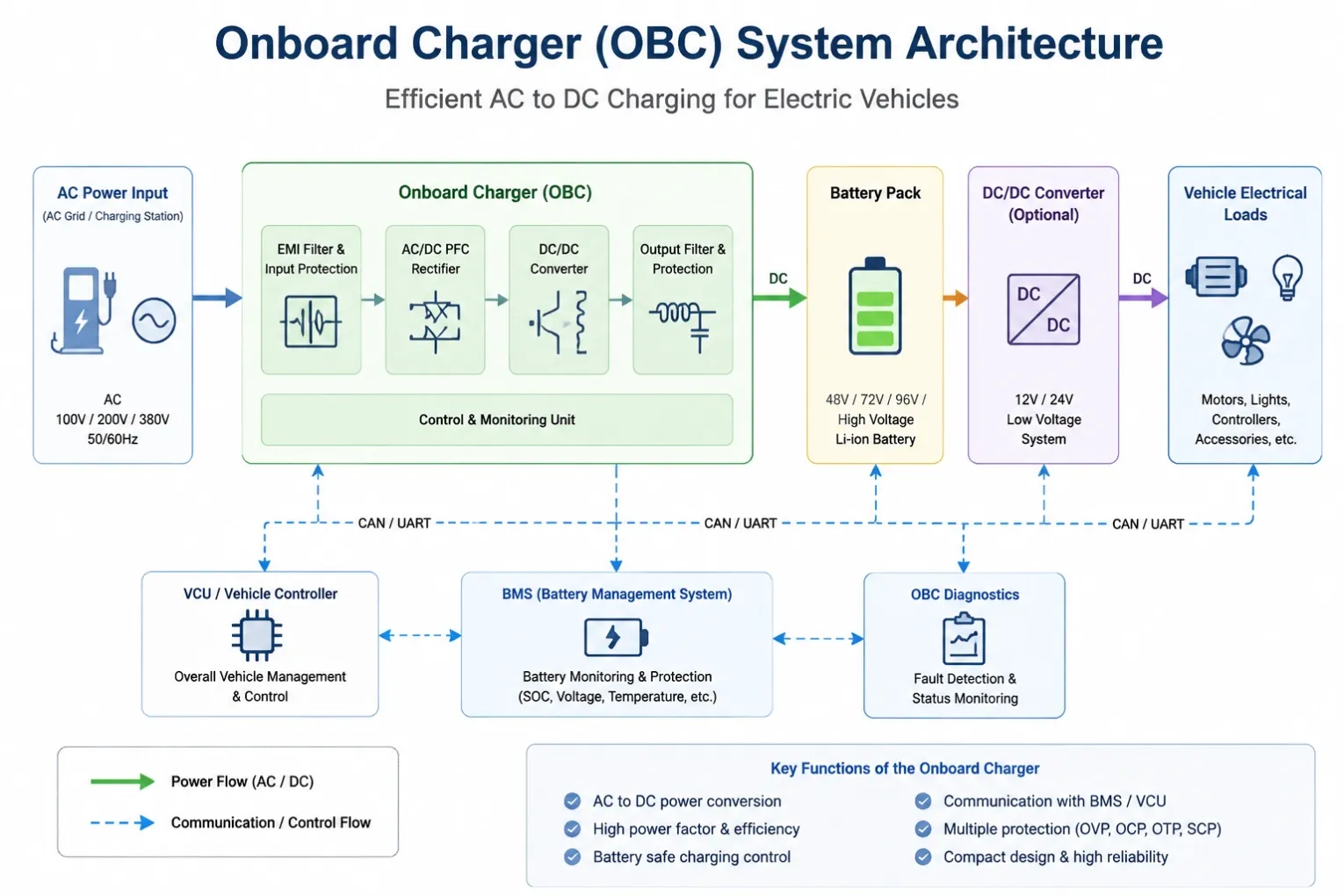
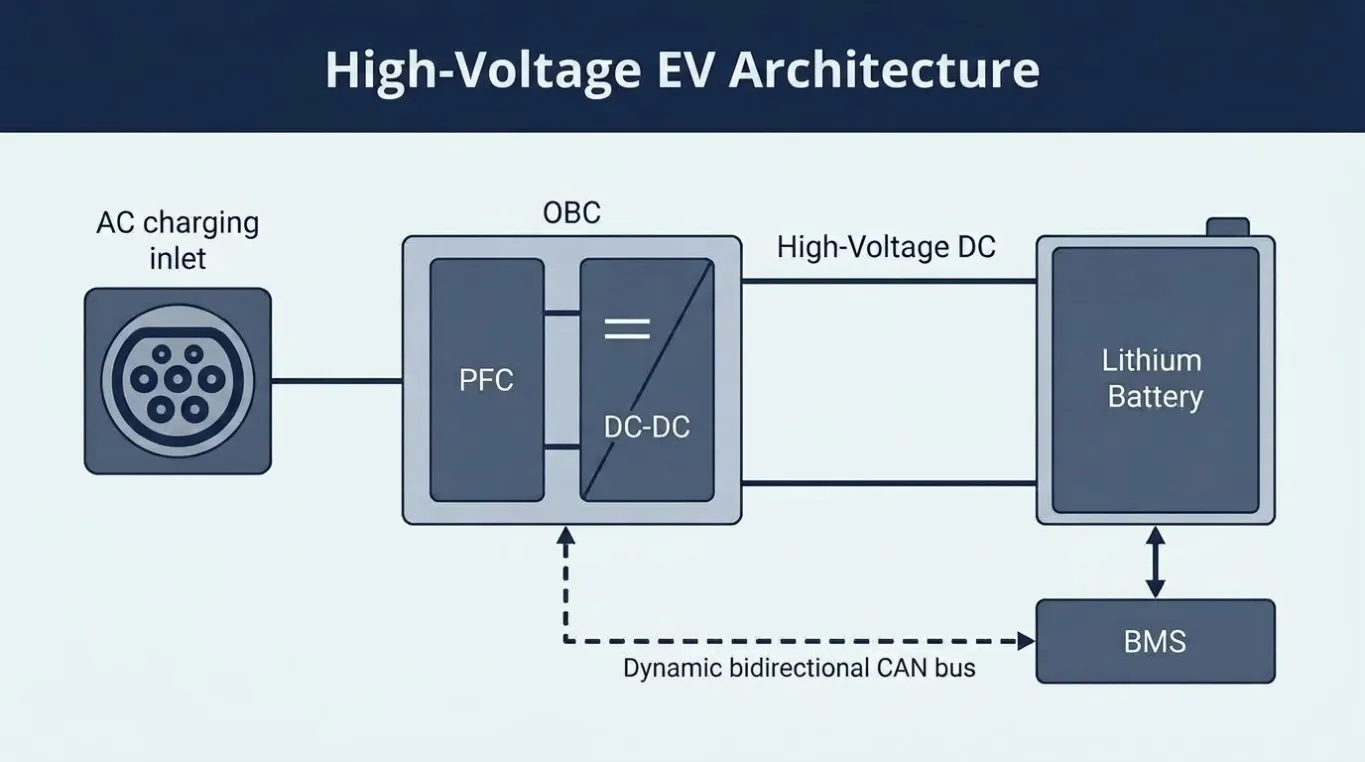
An onboard charger is installed directly on the vehicle and converts AC power from the grid into DC power for battery charging.
Advantages include:
- Integrated vehicle design
- Convenient charging operation
- Reduced external charging equipment requirements
OBC solutions are commonly used in:
- Electric cargo vehicles
- Utility vehicles
- Low-speed commercial EVs
- Specialty vehicles
Portable Charger
Portable chargers provide flexibility for vehicles that require convenient charging in different locations.
They are suitable for applications where:
- Vehicle space is limited
- Charging flexibility is important
- Different charging environments are expected
Integrated OBC + DC/DC Solutions
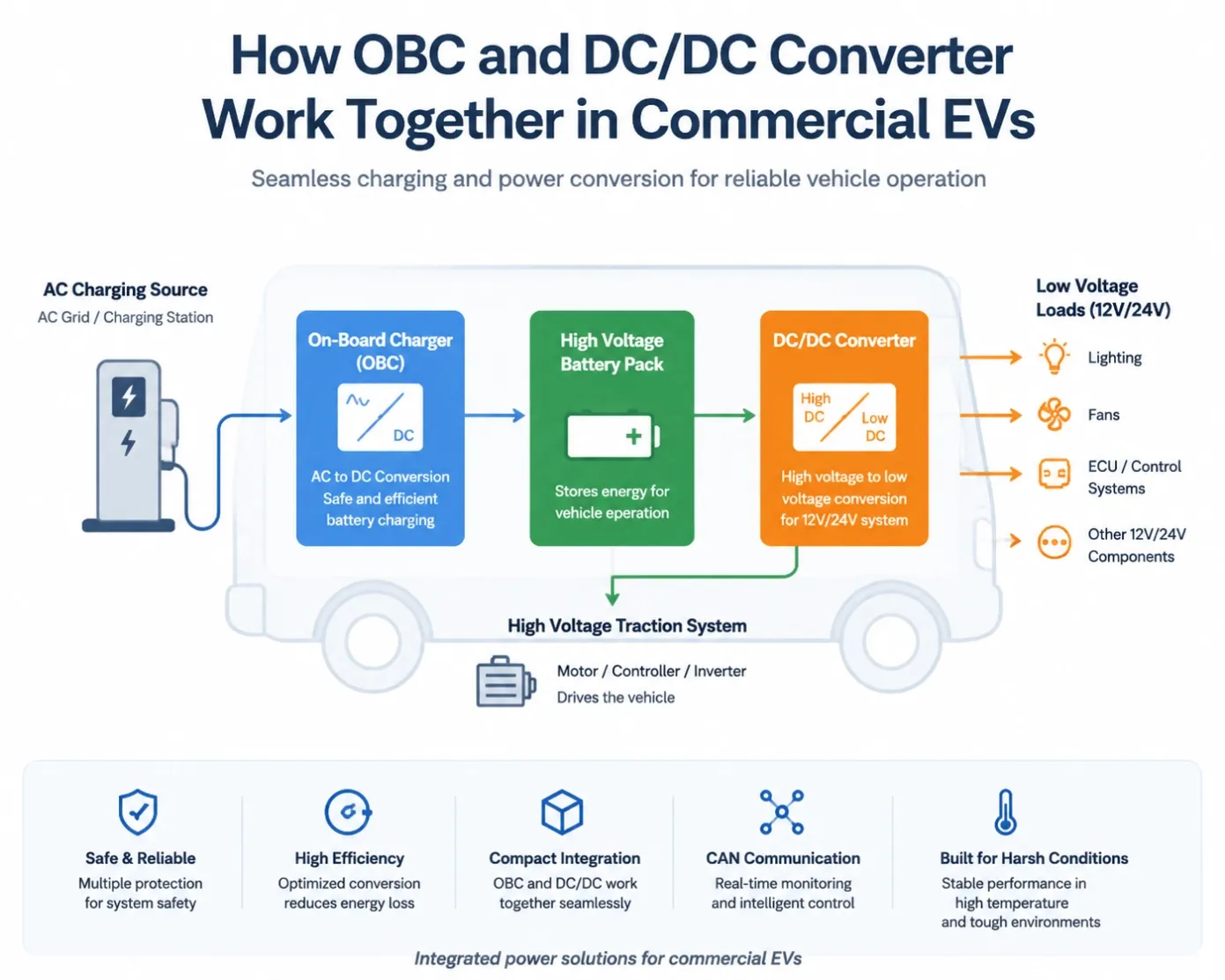
For some commercial EV platforms, integrating the onboard charger and DC/DC converter into one system can help simplify vehicle design.
Benefits include:
- Reduced wiring complexity
- Space saving
- Easier system integration
- Improved power management
This type of solution is increasingly used in commercial EV platforms where efficiency and compact design are important.
3. Matching Charger Power with Vehicle Requirements
Choosing the correct charging power is another important part of EV charger design.
A higher power charger does not always mean a better solution.
The appropriate power level depends on:
- Battery capacity
- Required charging time
- Vehicle usage pattern
- Electrical system design
For example:
Lower power chargers may be suitable for smaller commercial vehicles with longer charging periods.
Higher power chargers can support vehicles that require faster turnaround times.
Commercial EV manufacturers should balance charging speed, system cost, thermal management, and vehicle requirements.
4. Ensuring Compatibility with Battery and Vehicle Systems
A reliable EV charging system must work correctly with the complete vehicle architecture.
Important factors include:
Battery Voltage Matching
Chargers need to be compatible with different battery platforms, such as:
- 48V
- 60V
- 72V
- 96V
- Higher voltage EV platforms
Incorrect voltage matching may affect charging performance and system reliability.
Communication Integration
Modern EV charging systems often require communication between:
- Charger
- Battery Management System (BMS)
- Vehicle Control Unit (VCU)
CAN communication helps achieve:
- Charging parameter adjustment
- System monitoring
- Fault communication
- Better vehicle integration
5. Designing for Real-World Operating Conditions
Commercial EVs are often used in environments that are more demanding than passenger vehicles.
Charging systems may need to handle:
- Dust
- Moisture
- Temperature changes
- Vibration
- Outdoor operation
Therefore, charger design should consider:
- Protection level
- Thermal management
- Mechanical structure
- Reliability testing
For vehicles operating in harsh environments, protection features such as IP-rated designs can help improve long-term reliability.
6. Testing and Validation Before Vehicle Deployment
Before a charging solution is integrated into a commercial EV platform, proper testing is essential.
Typical validation includes:
- Charging performance testing
- Communication testing
- Protection function testing
- Thermal testing
- Reliability testing
Testing helps identify potential issues before mass production and supports more stable vehicle operation.
Conclusion
Designing a reliable commercial EV charging solution requires more than selecting a charger with the right power rating.
Vehicle manufacturers need to consider the complete system, including:
- Vehicle application
- Battery platform
- Charging architecture
- Communication requirements
- Operating environment
By choosing a charging solution designed for real vehicle integration, EV manufacturers can build more reliable and efficient electric vehicle platforms.