Jul 14, 2026
How to Choose the Right On-board Charger (OBC) for Commercial EVs
Learn how EV manufacturers can select the right on-board charger based on vehicle architecture, battery requirements, charging performance, reliability, and long-term application needs.
How to Choose the Right On-board Charger (OBC) for Commercial EVs
As commercial electric vehicles continue to expand across different industries, selecting the right charging system has become an important decision for vehicle manufacturers.
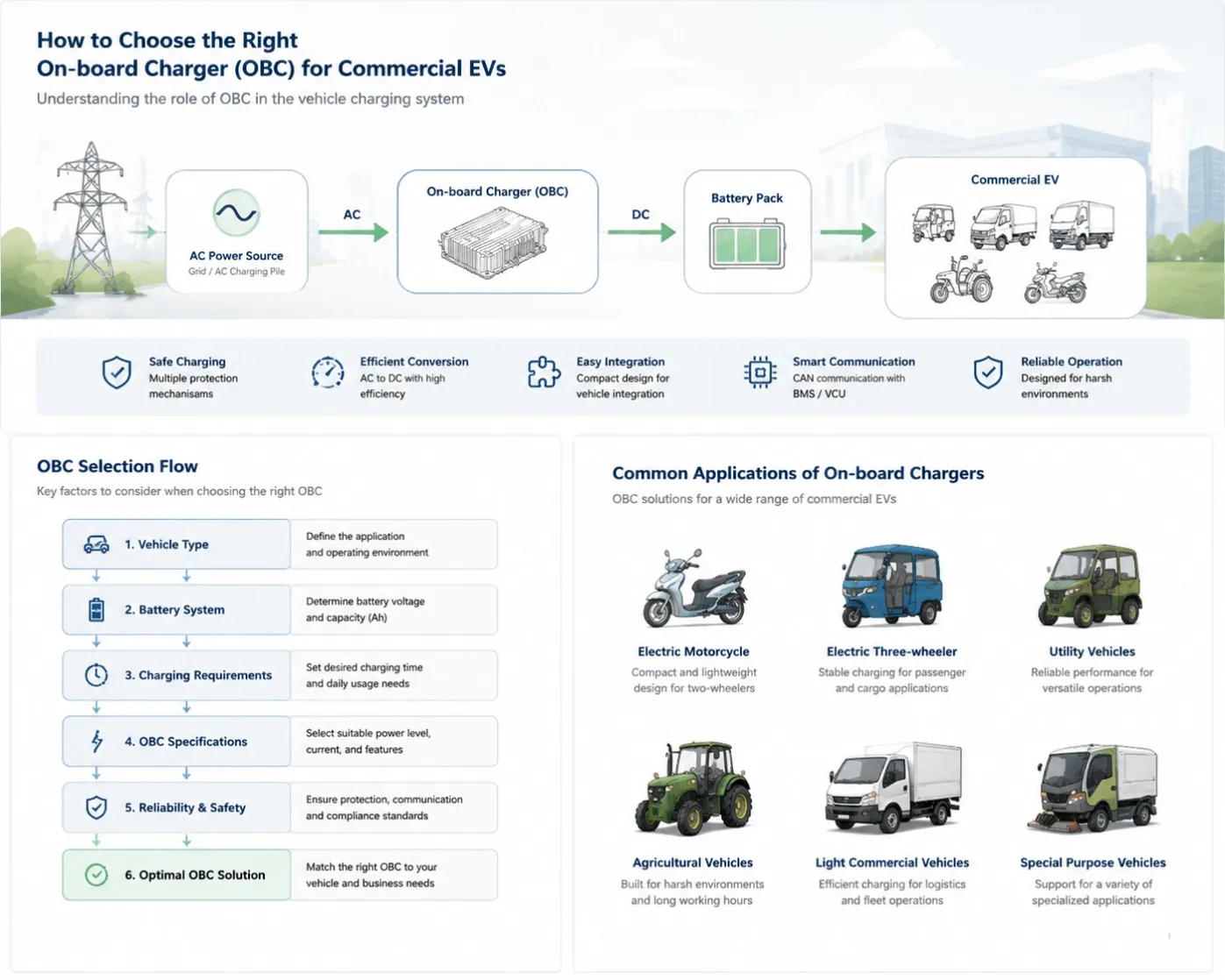
Unlike passenger cars, commercial EV platforms such as electric motorcycles, three-wheelers, agricultural vehicles, utility vehicles, and light commercial vehicles often operate in more demanding environments. Their charging systems need to balance efficiency, reliability, integration flexibility, and cost.
The on-board charger (OBC) is a key component that directly affects the daily usability and long-term performance of an electric vehicle.
So, how should EV manufacturers choose the right OBC for their vehicle platform?
1. Understand Your Vehicle Charging Architecture
The first step is understanding how the charger will be integrated into the vehicle.
An on-board charger is installed directly on the vehicle and converts AC power from the grid into DC power to charge the battery.
Compared with external chargers, OBC solutions provide:
- More convenient charging experience
- Cleaner vehicle integration
- Reduced external equipment dependency
- Better protection for vehicle applications
For commercial EV manufacturers, the decision depends on:
- Vehicle structure
- Available installation space
- Charging environment
- Customer usage requirements
Different vehicles may require different charging approaches. A compact electric motorcycle may prioritize size and weight, while an agricultural EV may require stronger environmental protection and durability.
2. Match the OBC with Battery Voltage and Capacity
Choosing an OBC is not only about power rating.
The charger must match the battery system.
Important parameters include:
Battery Voltage
Common commercial EV platforms include:
- 48V
- 60V
- 72V
- 96V
- 320V
Battery Capacity
Battery capacity (Ah) determines the charging time requirement.
For example:
A higher-capacity battery may require a higher current charger to achieve reasonable charging time.
Charging Current
The charging current should balance:
- Charging speed
- Battery lifespan
- Thermal management
- Vehicle operating conditions
A suitable OBC should be selected according to the complete battery system rather than choosing the highest power option.
3. Consider Power Level and Charging Time Requirements
Different commercial EV applications require different charging speeds.
Typical OBC power ranges include:
- 1kW class chargers for compact EV platforms
- 3.3kW chargers for commercial vehicles
- 6.6kW chargers for higher-power applications
The right power level depends on:
- Daily operation hours
- Vehicle usage frequency
- Available charging time
- Battery capacity
For fleet vehicles, faster charging can improve vehicle utilization. However, higher power also requires proper thermal design and electrical integration.
4. Reliability Is More Important Than Just Specifications
Commercial EVs often operate:
- Longer hours
- More frequently
- In outdoor environments
Therefore, reliability becomes a critical factor.
A reliable OBC should include:
- Over-voltage protection
- Under-voltage protection
- Over-current protection
- Short-circuit protection
- Over-temperature protection
- Communication capability such as CAN Bus
Protection design and validation testing are important to ensure stable operation throughout the vehicle lifecycle.
5. Consider Vehicle Integration Capability
For modern EV manufacturers, the charger is not an independent component.
It needs to communicate with:
- Battery Management System (BMS)
- Vehicle Control Unit (VCU)
- Display systems
- Other vehicle electronics
Features such as CAN communication allow better system integration and smarter vehicle management.
For OEM customers, choosing a supplier with customization capability can reduce development risks during vehicle design.
6. Choose a Supplier Who Understands Commercial EV Applications
A charger supplier should provide more than hardware.
Important factors include:
- Experience with different EV platforms
- Engineering support
- Customization capability
- Quality control process
- Long-term technical support
A suitable OBC supplier should understand how the charger works together with the entire vehicle system.
Conclusion
Selecting the right on-board charger is an important step in developing reliable commercial electric vehicles.
The best solution is not always the highest power charger. It is the charger that matches the vehicle architecture, battery system, operating environment, and long-term application requirements.
By considering charging performance, reliability, integration capability, and supplier support, EV manufacturers can build more efficient and dependable electric vehicle platforms.