Jul 16, 2026
Why IP67-Rated Onboard Chargers Matter for Commercial EVs in Harsh Environments
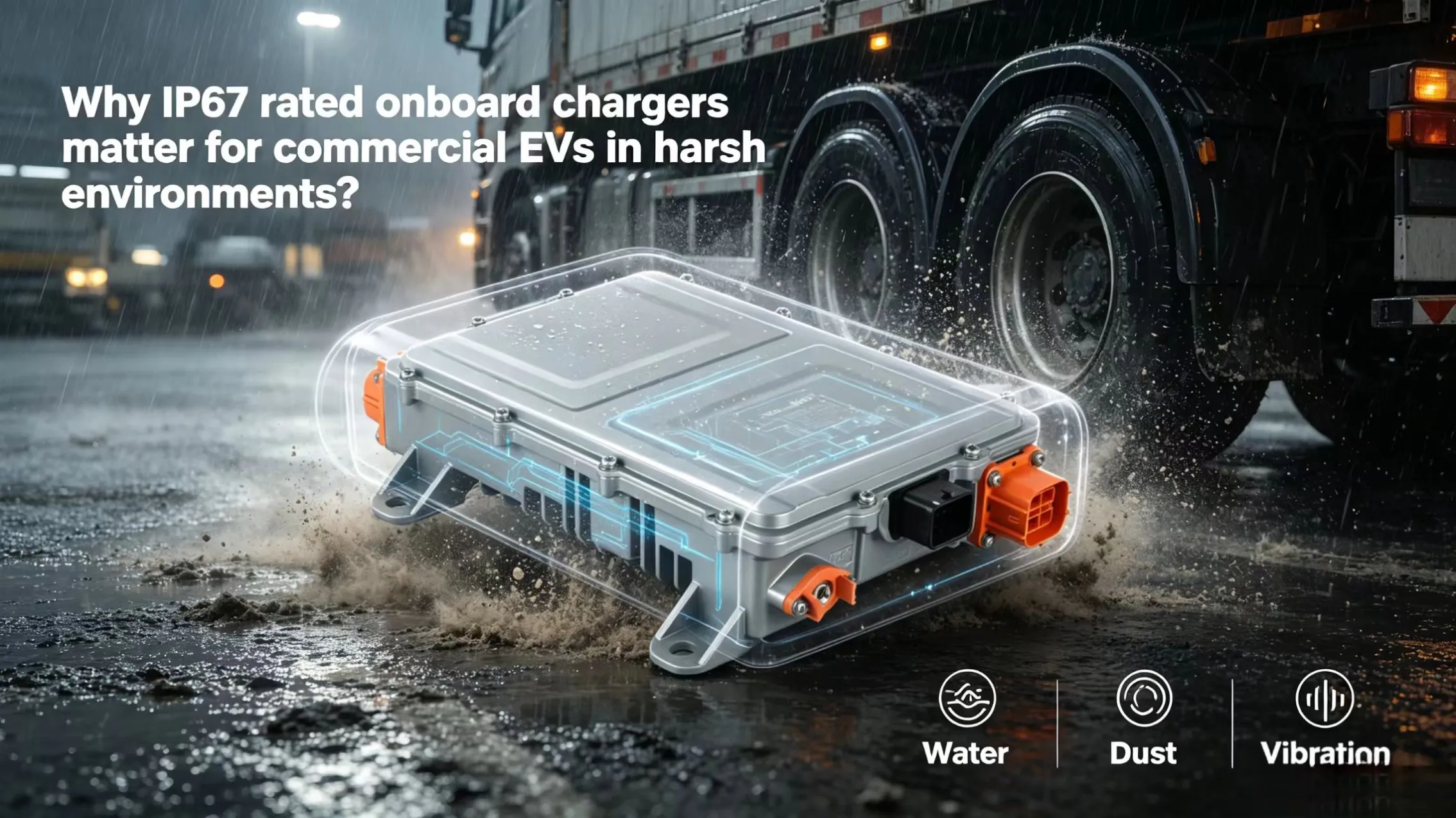
Rain, dust, and mud are not unusual for many commercial EVs. But they can become serious challenges for onboard chargers. That’s why protection rating matters. IP67 is not just a number
Introduction
Electric vehicles used in commercial applications often face environments that passenger cars rarely experience.
From dusty agricultural fields to rainy delivery routes and outdoor working conditions, EV power components must maintain stable performance over long periods.
For onboard chargers, protection against water, dust, and environmental stress is not only about durability — it directly affects charging reliability and vehicle uptime.
That is why IP67 protection has become an important consideration for EV manufacturers.
What Does IP67 Mean?
IP67 is an international protection rating that defines how well an electronic device is protected against solid particles and water.
The rating consists of two numbers:
6 — Dust Tight
The highest level of dust protection. No dust can enter the enclosure and affect internal components.
7 — Water Protection
The device can withstand temporary immersion in water under specified conditions.
For EV chargers installed on vehicles, this protection helps prevent failures caused by rain, mud, dust, and accidental water exposure.
Why EV Chargers Need IP67 Protection?
1. Outdoor Working Conditions Create More Challenges
Many commercial EVs operate outdoors:
- Electric agricultural vehicles
- Utility vehicles
- Electric delivery vehicles
- Electric three-wheelers
- Low-speed commercial vehicles
These vehicles may experience:
- Heavy rain
- Dust and sand
- Muddy roads
- Temperature changes
- High humidity
Without sufficient protection, moisture and particles can affect charging performance and long-term reliability.
2. Better Reliability During Daily Operation
For commercial EV users, vehicle downtime means productivity loss.
A charger failure can interrupt:
- Delivery schedules
- Farm operations
- Fleet availability
An IP67-rated onboard charger helps reduce environmental risks and supports stable operation in demanding applications.
3. Protection of Internal Electronic Components
Inside an onboard charger are sensitive components:
- Power modules
- Capacitors
- Control boards
- Communication circuits
Dust and moisture can lead to:
- Corrosion
- Short circuits
- Reduced component lifespan
- Charging interruptions
A sealed enclosure provides an additional layer of protection.
IP67 vs Lower Protection Ratings
Protection Level | Suitable Application |
|---|---|
IP54 | Indoor or protected environments |
IP65 | Outdoor applications with dust and water resistance |
IP67 | Harsh outdoor environments requiring higher protection |
For commercial EV platforms operating in challenging conditions, IP67 provides an extra safety margin.
How Echelon Charger Supports Harsh Environment Applications
At Echelon Charger, our onboard chargers and DC-DC converters are designed for commercial electric vehicle applications requiring reliable power solutions.
Our solutions support:
- Dust and water protection
- CAN communication
- Multiple voltage platforms
- OEM customization
- Long-term vehicle operation
Applications include:
- Electric cargo vehicles
- Electric tricycles
- Utility vehicles
- Agricultural EVs
- Light commercial EVs
Conclusion
Choosing an onboard charger is not only about charging power.
For EVs working in real-world environments, protection level, reliability, and durability are equally important.
An IP67-rated onboard charger helps vehicle manufacturers build EV platforms that can perform consistently — even in challenging conditions.