Jul 21, 2026
How to Select the Right Onboard Charger for Commercial Electric Vehicles
Choosing the right onboard charger is critical for commercial electric vehicles. Learn how voltage, power, communication, protection and application requirements
How to Select the Right Onboard Charger for Commercial Electric Vehicles
As electric vehicles continue to expand into commercial applications, choosing the right onboard charger (OBC) has become an important part of vehicle system design.
For commercial EVs, the onboard charger is not simply a device that converts AC power into DC power. It needs to work reliably with the battery system, vehicle controller and operating environment.
Different vehicle platforms require different charging solutions. Selecting the correct OBC requires consideration of several key factors.
1. Match the OBC with Battery Voltage and Power Requirements
The first step when selecting an onboard charger is understanding the battery system.
Important parameters include:
- Battery voltage platform
- Battery capacity
- Required charging time
- Charging power demand
For example, low-speed vehicles, electric three-wheelers and utility vehicles may use different voltage platforms compared with larger commercial vehicles.
Choosing an OBC with suitable voltage and power capability helps achieve stable charging performance without unnecessary system complexity.
2. Consider Vehicle Application Conditions
Commercial electric vehicles often operate in challenging environments.
Applications such as:
- Electric cargo vehicles
- Agricultural vehicles
- Utility vehicles
- Electric three-wheelers
- Special-purpose vehicles
may experience:
- Outdoor exposure
- Temperature variations
- Dust and moisture
- Long operating hours
Therefore, the OBC design should consider protection level, thermal management and mechanical installation requirements.
3. Communication and Vehicle Integration
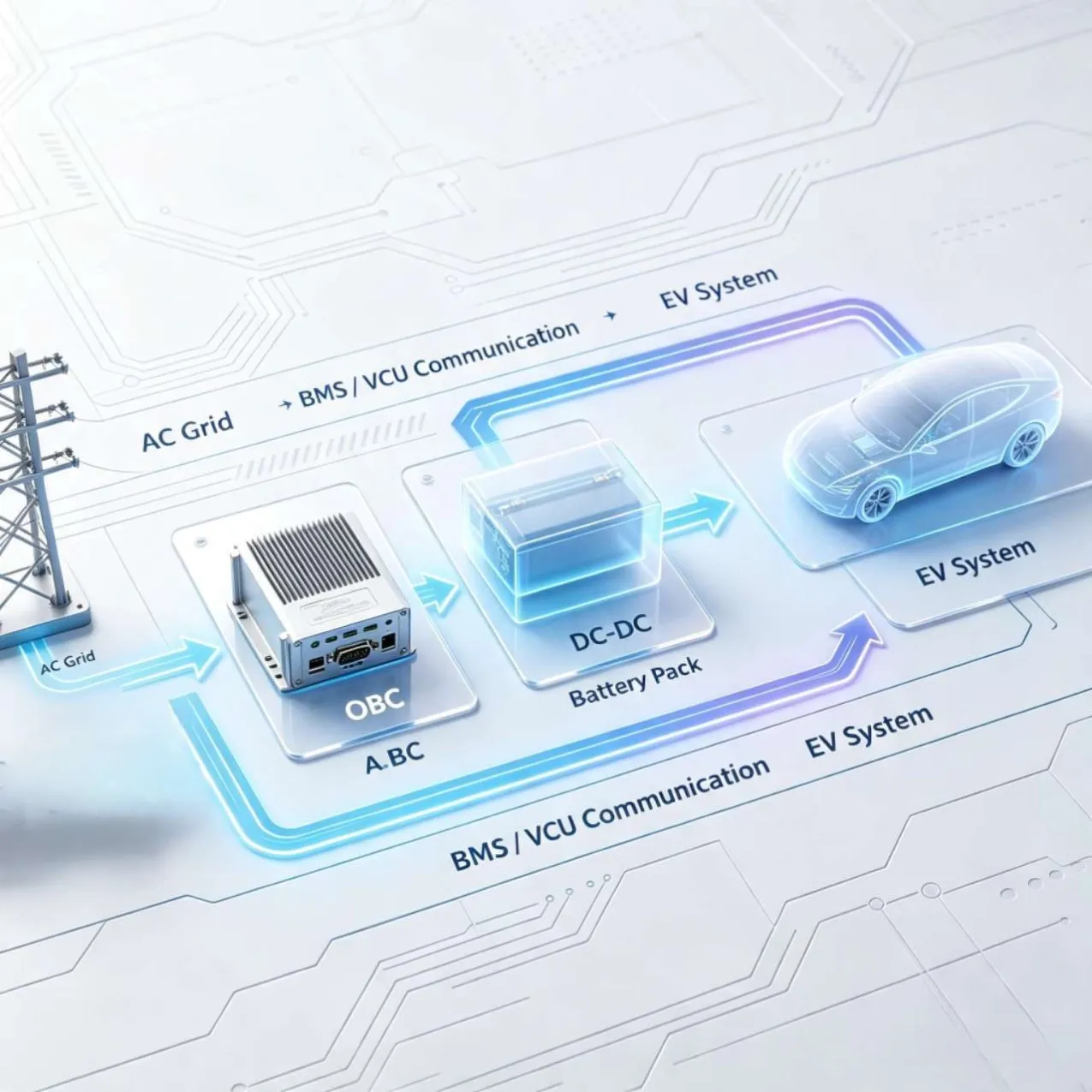
Modern commercial EVs require communication between the charger and vehicle control system.
CAN communication allows the OBC to exchange information with:
- Battery Management System (BMS)
- Vehicle Control Unit (VCU)
- Other vehicle controllers
Through communication protocols, the vehicle system can manage:
- Charging status
- Output current
- Protection response
- Fault information
A well-integrated OBC helps improve system reliability and user experience.
4. Protection and Reliability Requirements
A reliable onboard charger should include multiple protection functions, such as:
- Over voltage protection
- Over current protection
- Short circuit protection
- Over temperature protection
- Input and output monitoring
For commercial vehicles that operate daily, long-term reliability is often more important than maximum charging speed.
5. Future Expansion and System Flexibility
Vehicle manufacturers often need solutions that can adapt to different models and future development.
Factors to consider include:
- Different voltage platforms
- Power expansion capability
- Software adjustment
- Custom communication requirements
A flexible OBC platform can help manufacturers reduce development time for different vehicle projects.
Conclusion
Selecting the right onboard charger requires a complete understanding of the vehicle system, not only the charger specifications.
Voltage compatibility, charging power, communication capability, protection functions and operating environment all influence the final solution.
For commercial electric vehicle manufacturers, a suitable OBC can improve charging reliability and support long-term vehicle performance.