Technical Articles & Engineering Insights
Understanding OBC+DC-DC+PDU Integration. When Does an EV OEM Need a 3-in-1 Power System?
When should EV OEMs choose a 3-in-1 power system? Learn how OBC, DC-DC converters and PDUs work together, with key considerations for commercial and specialty EV integration.
As electric commercial vehicles become more specialized, their electrical systems are also becoming more demanding.
A vehicle may need an onboard charger for battery charging, a DC-DC converter for low-voltage electrical systems, and a Power Distribution Unit (PDU) to manage high-voltage power distribution.
For vehicle manufacturers, these functions raise an important design question:
Should the OBC, DC-DC converter and PDU be installed as separate components, or integrated into one 3-in-1 power system?
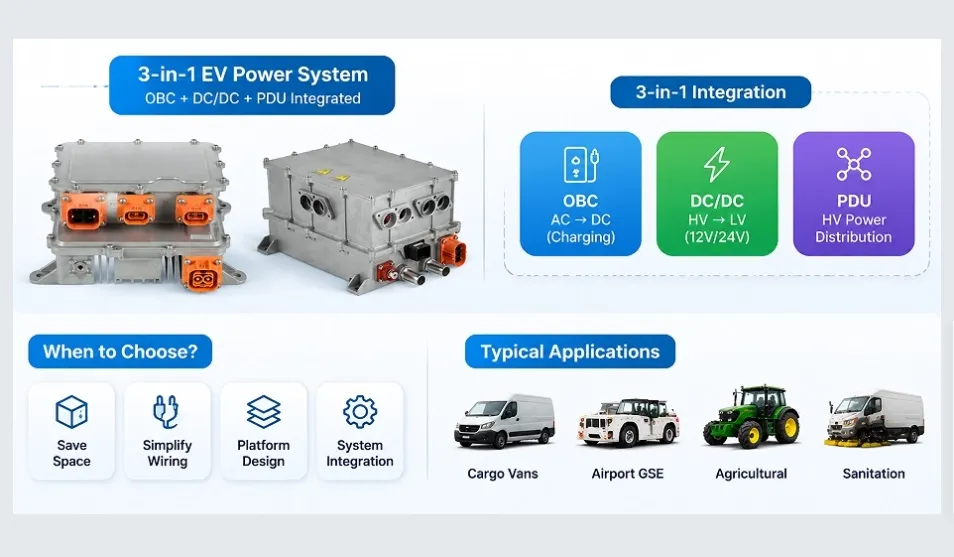
A 3-in-1 integrated power system combines these three functions within a single assembly. It can simplify vehicle packaging and reduce the number of separately installed power modules.
However, integration is not automatically the right choice for every electric vehicle.
The decision depends on the vehicle's electrical architecture, installation space, power requirements, operating environment and service strategy.
This article explains when EV OEMs should consider a 3-in-1 power system and what engineering teams should evaluate before selecting one.
1. What Is a 3-in-1 EV Power System?
A 3-in-1 EV power system integrates three power electronics functions into one unit:
- Onboard Charger (OBC)
- DC-DC Converter
- Power Distribution Unit (PDU)
Each component performs a different function within the vehicle's electrical architecture.
Onboard Charger (OBC): AC Battery Charging
The onboard charger converts external AC electricity into DC power to charge the vehicle's high-voltage battery.
When selecting an OBC, vehicle manufacturers need to consider:
- AC input voltage and frequency
- Battery voltage range
- Rated charging power
- Charging current
- Charging control and communication requirements
The appropriate OBC configuration depends on the vehicle's battery system and intended charging infrastructure.
DC-DC Converter: Low-Voltage Power Supply
The DC-DC converter converts high-voltage battery power into a lower DC voltage for vehicle auxiliary systems.
Depending on the vehicle design, these systems may include:
- Vehicle control units
- Lighting systems
- Instrumentation
- Electronic control modules
- Other low-voltage electrical loads
The DC-DC converter should be selected according to the required output voltage, continuous current and total auxiliary load.
Power Distribution Unit (PDU): High-Voltage Power Distribution
The PDU distributes high-voltage electrical power to different components throughout the vehicle.
Typical connections may include:
- Motor controller
- Electric air-conditioning compressor
- PTC heater
- Other high-voltage auxiliary equipment
Its configuration depends on the vehicle's high-voltage electrical architecture, branch requirements and protection strategy.
By combining these three functions, a 3-in-1 integrated unit brings charging, low-voltage power conversion and high-voltage distribution into one assembly.
2. When Should an EV OEM Consider a 3-in-1 Solution?
A 3-in-1 power system is particularly worth evaluating when the vehicle requires all three functions and the electrical architecture can accommodate an integrated configuration.
There are several situations where this approach may be beneficial.
Limited Installation Space
Commercial vehicles, utility vehicles and specialty EVs often have limited space available for electrical components.
Installing separate OBC, DC-DC and PDU enclosures can make vehicle packaging more complicated.
An integrated 3-in-1 unit can consolidate these functions into one enclosure, potentially simplifying mounting arrangements and cable routing.
Reducing Separate Components and Wiring
When three individual power modules are installed separately, the vehicle may require additional mounting brackets, cable connections and assembly operations.
An integrated system can reduce the number of separately installed components.
However, the actual reduction in wiring and assembly work depends on the product's connector configuration and the vehicle's electrical design.
Simplifying Vehicle Electrical Integration
When the OBC, DC-DC converter and PDU are designed as one system, their interfaces and mechanical arrangement can be considered together.
This can help OEM engineering teams coordinate:
- Power connections
- Signal interfaces
- Mounting arrangements
- Cooling requirements
- Vehicle-level control
The objective is not simply to combine three products, but to make their integration into the vehicle more manageable.
Developing a Standardized Vehicle Platform
For OEMs developing a vehicle platform that will be used across multiple configurations, an integrated power unit may help standardize the power electronics layout.
This is particularly relevant when the vehicle architecture, electrical interfaces and power requirements are sufficiently defined.
3. Which Commercial and Specialty EV Applications May Benefit?
The suitability of a 3-in-1 system depends on the actual vehicle requirements rather than its vehicle category alone.
Several commercial and specialty EV applications may be worth evaluating.
Electric Cargo Vehicles and Delivery Vans
Electric cargo vehicles often need onboard battery charging, low-voltage auxiliary power and high-voltage distribution.
For vehicles with limited installation space, an integrated power unit may help simplify the electrical layout.
Electric Agricultural Vehicles
Electric tractors and agricultural utility vehicles may require power for traction systems and multiple auxiliary electrical loads.
When selecting an integrated system, engineers should pay particular attention to battery voltage, environmental conditions, cooling and connector protection.
Airport Ground Support Equipment (GSE)
Electric baggage tractors, airport tow tractors and other ground support vehicles operate with specific charging and auxiliary power requirements.
An integrated OBC, DC-DC and PDU configuration may be considered when the vehicle architecture requires all three functions within a compact installation space.
Electric Utility and Sanitation Vehicles
Electric utility vehicles, street sweepers and sanitation vehicles may contain several auxiliary electrical systems.
Before selecting a 3-in-1 unit, OEMs should confirm the number of high-voltage branches, the required current ratings and the possibility of future equipment changes.
For vehicles with frequently changing auxiliary configurations, the PDU design deserves particular attention.
4. Seven Engineering Factors to Check Before Selecting a 3-in-1 Unit
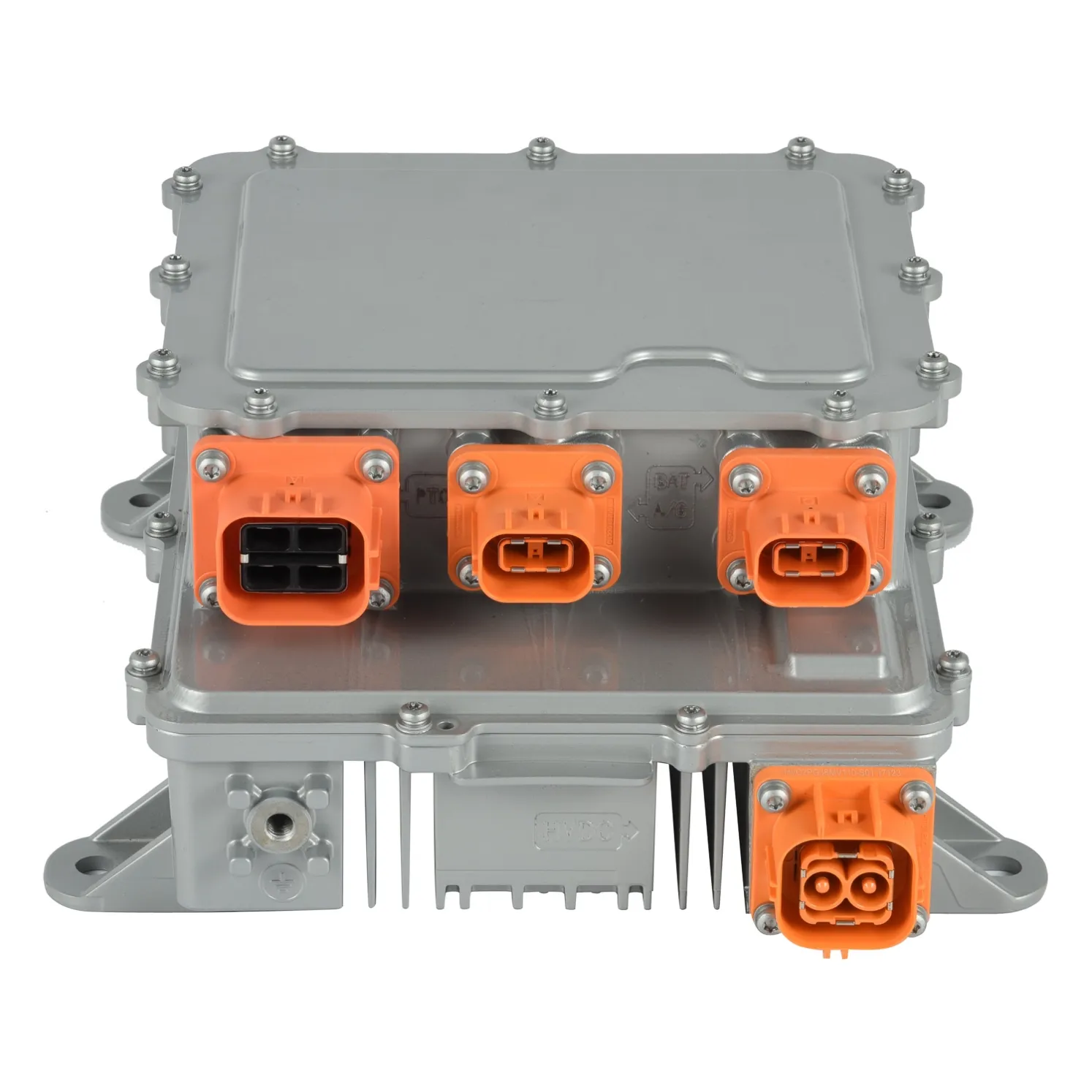
Choosing an integrated power system requires more than checking its total rated power.
The following seven areas should be reviewed during the OEM design and supplier evaluation process.
1. Battery Voltage Platform
Confirm the vehicle's nominal battery voltage and actual operating voltage range.
The OBC output voltage and DC-DC input voltage must match the battery system.
Do not select a model based only on a nominal voltage label.
2. OBC Charging Requirements
Confirm the required charging power, AC input voltage, input frequency and charging control requirements.
If the vehicle is intended for a particular charging infrastructure, the relevant AC interface and control architecture should also be reviewed.
3. DC-DC Output Requirements
Calculate the vehicle's total low-voltage electrical load.
Check the required output voltage, continuous current and peak current.
A DC-DC converter should be evaluated against the actual auxiliary load profile rather than its rated power alone.
4. PDU Branch Configuration
Identify all high-voltage loads and their electrical requirements.
Confirm the number of branches, current ratings, switching arrangements and protection requirements.
The PDU must match the vehicle's electrical distribution design.
5. CAN Communication and Control
Review the communication interface between the integrated unit and the vehicle controller.
Important items include:
- CAN communication protocol
- Message IDs and signal definitions
- Charging control commands
- Operating status feedback
- Fault reporting
- Communication loss response
The complete CAN protocol should be reviewed before vehicle prototype integration.
6. Thermal and Environmental Requirements
The integrated unit must operate within the vehicle's actual thermal and environmental conditions.
Consider ambient temperature, cooling airflow, simultaneous OBC and DC-DC operation, vibration, dust and water exposure.
The enclosure's IP rating and environmental test results should be checked against the intended installation conditions.
7. Mechanical Installation and Serviceability
Before finalizing the vehicle layout, review:
- Product dimensions
- Mounting points
- Connector positions
- Cable routing
- Installation clearance
- Maintenance access
- Replacement procedures
Requesting mechanical drawings and STEP files early can help identify potential installation problems before prototype assembly.
5. Is a 3-in-1 System Suitable for Every EV Project?
Not necessarily.
An integrated power system offers packaging and integration advantages, but it also requires the vehicle architecture to accommodate the combined configuration.
A separate or partially integrated arrangement may be worth considering when:
- The vehicle requires frequent changes to high-voltage distribution.
- Different vehicle variants need significantly different PDU configurations.
- Individual components must be replaced independently.
- The available installation space does not suit the integrated enclosure.
- The project requires specific electrical or mechanical interfaces that are not available in the standard configuration.
For some OEM programs, integrating the OBC and DC-DC converter while retaining a separately configured PDU may be a practical alternative.
The best architecture is the one that meets the complete vehicle's electrical, mechanical, operational and service requirements.
6. Echelon 3-in-1 Integrated Power Solutions for EV OEMs
Echelon Energy Technology develops onboard charging and power conversion solutions for commercial and specialty electric vehicles.
Our 3-in-1 integrated power solution combines:
- 3.3kW Onboard Charger (OBC)
- 1kW DC-DC Converter
- Power Distribution Unit (PDU)
The solution is available for 96V and 320V-class battery platforms, with configurations designed for OEM vehicle integration.
By integrating onboard charging, auxiliary DC power conversion and high-voltage distribution, the system provides an alternative to installing three separate power modules.
For vehicle manufacturers evaluating an integrated power architecture, relevant electrical specifications, communication interfaces, connectors and mechanical arrangements should be reviewed according to the specific vehicle project.
7. Frequently Asked Questions
What does 3-in-1 mean in an electric vehicle power system?
A 3-in-1 EV power system integrates an onboard charger, a DC-DC converter and a power distribution unit into one assembly.
What is the difference between a 2-in-1 and a 3-in-1 power system?
A 2-in-1 system typically combines an OBC and a DC-DC converter. A 3-in-1 system adds a PDU for high-voltage power distribution.
Does a 3-in-1 system reduce vehicle wiring?
It can reduce separate enclosures and some external connections. The actual wiring arrangement depends on the integrated unit's interfaces and the vehicle's electrical architecture.
What information is required to select a 3-in-1 power system?
OEMs should provide battery voltage range, OBC charging power, AC input requirements, DC-DC output requirements, PDU branch specifications, CAN communication requirements and installation conditions.
Can a 3-in-1 system be customized for different EV applications?
Customization feasibility depends on the specific project. Electrical specifications, connectors, CAN communication, mechanical interfaces and PDU configuration should be reviewed with the engineering team.
Discuss Your 3-in-1 EV Power System Requirements
Selecting a 3-in-1 power system is a vehicle-level engineering decision.
The right configuration should match the battery platform, charging requirements, auxiliary electrical loads, high-voltage distribution architecture and installation environment.
If your team is developing an electric commercial vehicle or specialty EV, share your project requirements with Echelon Energy Technology.
Our team can review the required OBC power, DC-DC output, PDU configuration and communication interfaces to discuss a suitable integrated power solution.