Technical Articles & Engineering Insights
Evaluating an OBC or DC-DC Sample: What the First 72 Hours Should Prove
A sample that works is not yet a supplier you can scale with. What should arrive with the unit, what 72 hours of testing should prove, and what to settle before a batch order.
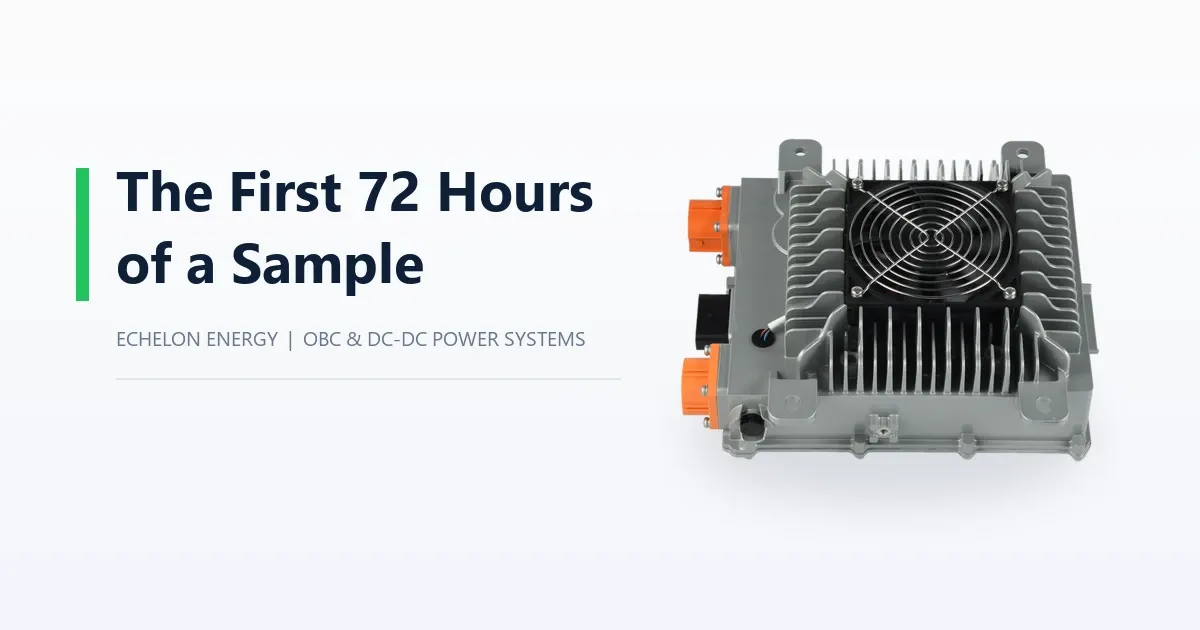
A sample order is a milestone, not a result. What it establishes is narrow and specific: that one unit, built under one set of conditions, behaves as described. Whether the ten thousandth unit behaves the same way depends on facts that the sample itself cannot demonstrate - and the window to establish those facts is before the batch order, not after.
Most of the guidance about evaluating chargers covers what to measure. This article covers the other half: what has to be in the box, what to do in the first three days, and how to tell a design problem from an integration problem before you spend a month on the wrong one.
What "Sample" Actually Means
Ask the question explicitly, because the answer changes everything that follows: is this an engineering sample or a production-equivalent unit?
An engineering sample may be hand-assembled, may use a substitute component where the series part is not yet on the line, may run prototype firmware, and may be built by the design team rather than on the production line. That is normal and useful. It is also not evidence about series capability.
A production-equivalent sample is built on the same line, with the same process, materials and firmware revision intended for series supply. It costs more and takes longer, and it is the only artefact that supports a production decision.
Whichever you receive, ask for the differences in writing. A short list - "this unit uses the rev-B control board; series will use rev-C; firmware is 1.4 where series is 1.5" - is worth more than a page of assurances, because it tells you exactly which findings you can trust.
What Should Arrive With the Unit
A unit in a box with a datasheet is not a complete delivery. The list below is the minimum for an evaluation that can be concluded rather than restarted.
Item | Why it is needed |
Test report against this unit's serial number | A type report proves a design; a serialized report proves this unit |
Build configuration record | Which revisions of board, firmware and key components are inside |
Mating connector part numbers, with manufacturer | Without these, you cannot make a harness and cannot test at all |
Pin definition table | Wiring, and the basis of your harness drawing |
CAN matrix or DBC file at the stated revision | Bench bring-up and controller testing |
Outline drawing at the build revision | Mounting, and confirmation the unit matches the model you designed around |
Protection and derating behaviour description | What the unit does at limits, not only what the limits are |
Firmware version and update path | Whether a behaviour can be fixed without a hardware change |
Two of these are worth insisting on. The serialized test report separates suppliers who test from suppliers who document. And the firmware update path decides whether an interface mismatch three months from now is a setting or a redesign.
If the mating connector part numbers are missing, stop there. A sample you cannot connect is not a sample - and a supplier who ships one has not thought about what the customer does next.
The First 72 Hours
The order of work matters, because each step isolates a different class of problem. Running them in the wrong order means every failure looks like the same failure.
Hours 0-4: visual and document check before power. Confirm the unit matches the drawing and the model, check the serial against the report, record the firmware version from the label or the tool, and photograph the unit as received. Record the connector part numbers actually fitted - not the ones on the drawing.
Hours 4-24: bring-up on the bench, not in the vehicle. Battery simulator on the DC side, programmable AC source on the input. Power up, confirm standby current, confirm CAN communication at the specified bitrate, and confirm the state machine reaches ready without a fault. Any problem found here is a unit or document problem, and it is cleanly separable from the vehicle.
Hours 24-48: steady-state at rated conditions. Rated AC input, rated output, until thermal equilibrium. Record efficiency at 25%, 50%, 75% and 100% load rather than a single point, and record case temperature at each. A unit that meets efficiency at full load and misses it at half load has a different problem than one that misses everywhere.
Hours 48-72: the continuous run at worst case. Full load, maximum rated ambient, uninterrupted. This is the single most informative test of the three days, and it is the one most often shortened. A unit that survives 24 hours at 100% load and 45 °C has demonstrated something no datasheet can. A unit that derates at hour four has told you the derating curve was measured under conditions your vehicle will not reproduce.
Then, and only then, integrate into the vehicle.
Separating Design Fault From Integration Fault
When a sample misbehaves in the vehicle, the useful question is not "is the charger broken" but "what is the smallest configuration in which the fault still occurs".
Work inward:
• Does it fail with a resistive load instead of the battery? If yes, the problem is in the charger or its control, not in the battery's response.
• Does it fail at nominal input voltage from a stiff source? If it only fails on the vehicle's supply, the input is the variable - a weak supply, a long cable, a shared circuit.
• Does it fail with the supplier's bench harness? If it works there and fails on yours, the harness is the variable: length, cross-section, shield termination, connector pinning.
• Does it fail with CAN disconnected and hardware enable forced? This isolates the communication interface from the power stage in one move.
Each of these four tests takes minutes and eliminates a whole category. Without them, the conversation with the supplier becomes an exchange of opinions, and the weeks pass.
Keep a log with timestamps from the first minute. A fault that occurred at 61 °C case temperature after 40 minutes is a different fault from one at 32 °C after two minutes, and the difference is only recoverable if it was recorded at the time.
What the Sample Cannot Tell You
Some of the important properties are structurally unobservable from one unit, and no amount of testing will produce them:
• Unit-to-unit consistency. One sample has no variance. Ask for the production test limits and, where possible, data from a small pilot batch.
• Component substitution risk. Whether a second-source part will be used, and whether it has been qualified.
• Process capability at volume. A hand-built sample says nothing about a line running at rate.
• Long-term behaviour. 500 hours of ageing on one unit is a signal; it is not a lifetime prediction.
The way to close these gaps is not more testing of the sample. It is a conversation about the production plan, and a supplier who can describe their production test limits and their change-notification process is answering the question the sample cannot.
Before the Batch Order
Four things should be settled while the sample evaluation is still fresh.
Freeze the configuration. The exact revision you approved - board, firmware, connectors, mounting - is the reference for series supply. Any change after approval should come to you as a notification, not as a discovery at incoming inspection.
Retain a golden sample. Keep one unit, sealed, labelled with its build record, as the physical reference for future disputes. In a programme that runs for years across several builds, it is the only artefact that settles "what did we approve" without argument.
Agree the acceptance criteria for incoming inspection. Which parameters will be checked on receipt, at what limits, on what sample size. If the answer is "we will check it works", the first disagreement at volume has no basis for resolution.
Agree what happens when a unit fails in the field. Who performs root-cause analysis, in what timeframe, and what the replacement path is. This is the item most often left to the contract, and the item that decides whether a field failure costs you a week or a quarter.
For the measurement side - which parameters to check and what each proves - see what to check during on-board charger performance testing. For evaluating the supplier rather than the unit, see how to choose an on-board charger supplier.
Frequently Asked Questions
How many samples should I order for a first evaluation?
Two, at minimum. One to test to destruction or to the thermal limit, and one to keep in known-good condition as a reference. A single sample forces you to choose between learning how it fails and having a working unit, and the choice is always made badly under schedule pressure.
The sample works but arrived without documentation. Should I proceed?
Proceed with the bench bring-up if the mating connectors are known, and hold the evaluation conclusion until the documents arrive. Without a serialized test report, a build configuration record and the DBC at a stated revision, you cannot tell what you tested - and a result you cannot attribute is not a result.
Can I approve series production based on a good sample?
Not on the sample alone. A good sample justifies moving to a pilot batch. Approving series needs three more things: production test limits, a change-notification process, and agreement on incoming inspection criteria. None of them is visible in a unit that works.
Conclusion
A sample proves one unit, under one set of conditions, with one set of documents. Make the delivery complete, run the 72 hours in the right order so that each failure is attributable, isolate design faults from integration faults with four short tests, and settle configuration, retention, acceptance and field-failure ownership before the batch order.
Planning a sample evaluation on a 72 V or 96 V platform? Our 3.3 kW OBC, 2 kW OBC with 1 kW DC-DC, 6.6 kW standalone charger and 1 kW DC-DC converter are available for engineering evaluation. Send your test plan and we will confirm the documentation set that ships with each unit.
About Echelon Charger
Echelon Energy Technology specializes in onboard chargers, DC/DC converters, and integrated EV power solutions for commercial and specialty electric vehicles.
For technical discussions, product selection, or OEM/ODM cooperation:
✉️ Email: nancy@tici-energy.com 💬 WhatsApp: +86 18114665311