Oct 14, 2026Technical Articles & Engineering Insights
Custom Automotive DC/DC Converters: An OEM Sourcing Guide
Custom automotive DC/DC converters are rarely off-the-shelf. This guide covers what to specify, why CAN-bus control and efficiency matter, and how to source a converter matched to your vehicle.
An automotive DC/DC converter looks like a simple component: it steps high-voltage battery power down to 12 V or 24 V for lights, controllers, pumps and instrumentation. In practice, almost every vehicle program needs a converter that is customized in some way - output current, mounting, connectors, or CAN control.
This guide covers what to specify when sourcing a custom automotive DC/DC converter, why efficiency and CAN-bus integration matter, and how to find a factory that can actually engineer to your requirements.
What Custom Actually Means for a DC/DC Converter
A custom automotive DC/DC converter is not a different device - it is the same conversion topology configured for your vehicle. The customization typically touches:
- Input voltage range, matched to your high-voltage platform (48 V, 72 V, 96 V, 320 V and higher).
- Output current, sized to the auxiliary load, with headroom for inrush.
- CAN control, so the converter is managed by the vehicle controller instead of running open-loop.
- Connectors and enclosure, matched to your harness and mounting location.
- Cooling method, air or liquid, depending on the vehicle's thermal budget.
A supplier that can only offer a fixed catalog is not offering customization - it is offering a plug-in part that may or may not fit.
Why Efficiency Is Not a Datasheet Number
Conversion efficiency matters because every watt lost becomes heat inside the unit. In commercial vehicles that run long duty cycles, a converter that is 90% efficient at rated power but drops sharply at partial load will run hotter than its spec sheet suggests. When comparing suppliers, ask for:
- Efficiency across the load range, not just at rated power.
- Thermal behavior under continuous load, since auxiliary loads in a working vehicle are not intermittent.
- Protection behavior: over-voltage, over-current, over-temperature and short-circuit response.
High efficiency is a design outcome - wide-bandgap components, a properly sized magnetic design and a cooled layout - not a marketing claim.
CAN-Bus Enabled DC/DC Converters
A CAN-bus enabled converter is managed by the vehicle controller: it reports status, accepts enable and setpoint commands, and reports faults. This turns the converter from a passive power supply into an integrated node in the vehicle electrical architecture. Two things to confirm when specifying CAN control:
- Protocol and message set. Most commercial vehicles use a CAN 2.0 based protocol; some programs need J1939 or UDS. The supplier must be able to match message formats, as covered in what EV manufacturers should confirm before integrating an OBC with CAN communication.
- Fault and status reporting. The controller needs to know when the converter derates or faults, not just that it stopped.
For a wider discussion of matching power electronics to a pack, see the companion guide on battery matching - the same voltage-window discipline applies to DC/DC sizing.
Combined OBC + DC/DC Units vs Standalone Converters
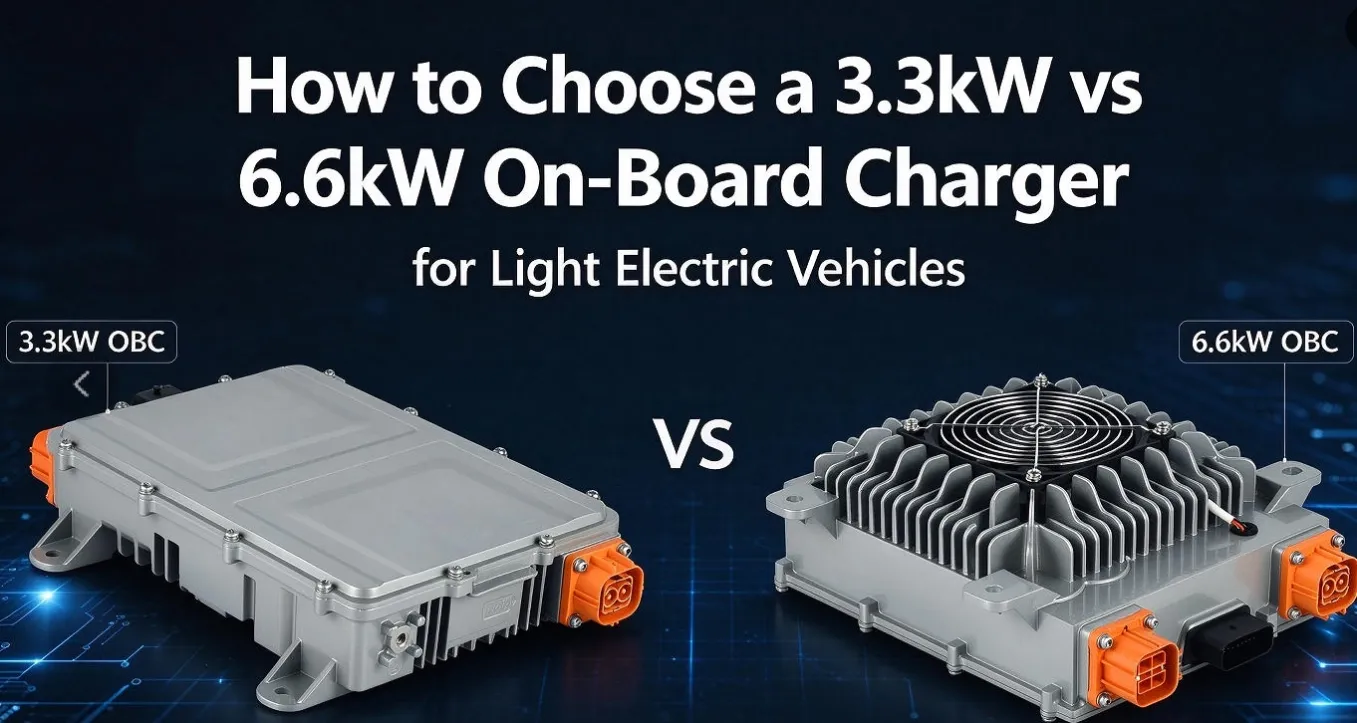
Many commercial vehicle programs now combine the on-board charger and DC/DC converter in one housing. The advantages are practical: fewer components to order, wire and mount; shared cooling and enclosure; and less installation time on the line.
A combined unit is usually the right choice when the vehicle needs both charging and a 12 V or 24 V auxiliary supply - which is most commercial and specialty EVs. A standalone converter still makes sense when the charging and auxiliary loads are far apart, or when the vehicle needs a redundant supply.
Sourcing a Custom Converter from a Chinese Factory
When evaluating Chinese DC/DC converter factories, apply the same criteria you would to any power-electronics supplier: IATF 16949 certification at the production site, in-house design of the magnetic and control stages rather than assembly alone, a test scope covering functional, thermal, protection and aging, and customization depth across electrical parameters, CAN, connectors and enclosure. A factory that designs and tests its own converters can engineer to your voltage and load profile. One that only assembles cannot.
Where Echelon Fits
Echelon Energy Technology manufactures DC/DC converters and combined OBC + DC/DC units for commercial and specialty electric vehicles, on 72 V to 320 V platforms. The range covers a 3.3 kW OBC with a 1 kW DC/DC converter and a 6.6 kW OBC with a 1.5 kW DC/DC converter, with CAN communication, air or liquid cooling, and OEM/ODM customization of electrical parameters, connectors and configuration. The full converter range is listed under DC/DC converters.
Conclusion
A custom automotive DC/DC converter is defined by its input range, output current, CAN control and cooling - not by its label. Specify those four clearly and confirm your supplier designs and tests in-house, and the converter will fit the vehicle rather than the other way around. Sourcing a DC/DC converter for an EV program? Share your platform voltage, auxiliary load and CAN requirements with our engineering team for a technical evaluation.
About Echelon Charger
Echelon Energy Technology specializes in onboard chargers, DC/DC converters, and integrated EV power solutions for commercial and specialty electric vehicles.
For technical discussions, product selection, or OEM/ODM cooperation:
Email: nancy@tici-energy.com
WhatsApp: +86 18114665311