Oct 14, 2026Technical Articles & Engineering Insights
OBC + DC/DC 2-in-1 Integrated Power Modules: IP67, CAN and Sourcing
An OBC + DC/DC 2-in-1 module replaces two components with one. This guide covers what to verify on integrated power modules, why IP67 matters, and how to source them from an OEM supplier.
Vehicle programs increasingly replace a separate on-board charger (OBC) and DC/DC converter with a single integrated module. The logic is simple: one housing, one cooling circuit, one harness, one component to procure and mount. For commercial and specialty EVs, where installation time and space are real constraints, the 2-in-1 module is often the default rather than the exception.
This guide covers what an integrated OBC + DC/DC module does, what to verify before sourcing one, how IP67 rating should be read, and how to evaluate a supplier.
What an OBC + DC/DC 2-in-1 Module Does
The module combines two functions in one enclosure: on-board charging, converting AC from the grid to DC to charge the traction battery, and DC/DC conversion, stepping high-voltage battery power down to 12 V or 24 V for the vehicle's auxiliary loads. Sharing an enclosure and cooling circuit removes a second component from the bill of materials and a second mounting point from the chassis. On the production line, that translates directly into lower installation time.
What to Verify Before Sourcing an Integrated Module
Integration is convenient, but it also couples two functions - so the specification has to be read carefully.
- Power balance: confirm both the charging power and the DC/DC output current, and make sure the DC/DC side has headroom for the vehicle's auxiliary load spikes.
- Cooling architecture: a combined unit dissipates the heat of both functions, so the cooling design must be validated under simultaneous worst-case operation, not each function alone.
- CAN control: both functions should be controllable and observable over CAN, with clear status and fault reporting.
- Serviceability: if one function fails, can it be diagnosed without replacing the whole module? Ask how the supplier handles field failure.
For a full review of integrated power units, including three-in-one designs, see what OBC and integrated power systems Echelon manufactures.
Reading IP67 Correctly
IP67 means the enclosure is dust-tight and protected against temporary immersion (up to 1 m for 30 minutes). For an on-board charger or integrated module, this rating matters because the component lives under the vehicle, exposed to spray, washdown and road debris. Two cautions when a supplier claims IP67: the rating applies to a tested configuration, so an enclosure rated IP67 with one connector type may not be IP67 with another - ask for the tested build; and IP rating is not a temperature or vibration rating, so a sealed unit still has to survive thermal cycling and chassis vibration. Check all three.
A supplier that can explain how its IP67 rating was tested - and what configuration it applies to - is more credible than one that simply prints IP67 on a datasheet.
2-in-1 vs 3-in-1: Which to Choose
The next step up integrates the Power Distribution Unit as well, combining OBC, DC/DC and PDU in a single housing. The 2-in-1 (OBC + DC/DC) is the common choice for most commercial and specialty EVs - simpler, lower cost, easier to service. The 3-in-1 (OBC + DC/DC + PDU) offers the highest integration, best for space-constrained platforms and programs that want the fewest possible components. Both are available on 96 V to 320 V platforms, which is where most commercial vehicle programs sit.
Sourcing Integrated Modules from an OEM Supplier
When shortlisting suppliers for an integrated OBC + DC/DC module, the evaluation is the same as for any power-electronics partner - with extra weight on integration engineering: IATF 16949 certification at the production site, in-house design of both the charging and conversion stages, a test scope covering functional, CAN, thermal, protection and aging, and customization of electrical parameters, CAN, connectors and enclosure. The broader supplier checklist is covered in how to choose an OBC manufacturer in China.
Where Echelon Fits
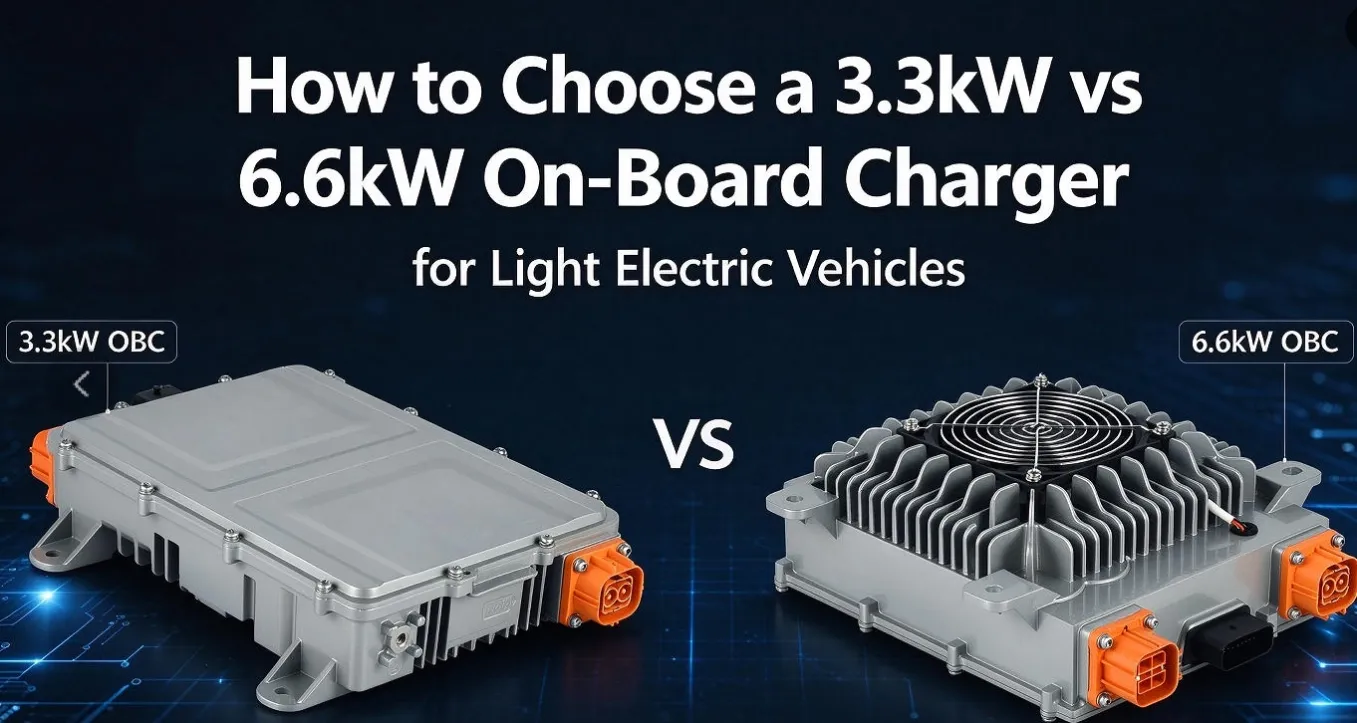
Echelon Energy Technology manufactures integrated power modules for commercial and specialty electric vehicles. The 2-in-1 range covers a 3.3 kW OBC + 1 kW DC/DC unit and a 6.6 kW OBC + 1.5 kW DC/DC unit on 72 V to 320 V platforms, with CAN communication and air or liquid cooling. A three-in-one OBC + DC/DC + PDU unit is available for space-constrained platforms.
Conclusion
An integrated OBC + DC/DC module is only an advantage if both functions are specified and validated together. Confirm the power balance, the cooling design, the CAN interface and the meaning of the IP67 claim - and source from a factory that designs both stages in-house. Sourcing an integrated power module? Share your battery voltage, charging power and auxiliary load with our engineering team for a technical evaluation.
About Echelon Charger
Echelon Energy Technology specializes in onboard chargers, DC/DC converters, and integrated EV power solutions for commercial and specialty electric vehicles.
For technical discussions, product selection, or OEM/ODM cooperation:
Email: nancy@tici-energy.com
WhatsApp: +86 18114665311