Oct 14, 2026Technical Articles & Engineering Insights
How to Choose an OBC Manufacturer in China: 2026 Buyer's Checklist
Buying an on-board charger from China? A ranked top 10 list will not tell you who can deliver. Here are the five criteria that separate a qualified OBC manufacturer from a trading company.
Sourcing an on-board charger (OBC) from China is one of the most common procurement tasks in the EV industry - and one of the most confusing. Buyers search for the top 10 OBC manufacturers in China and receive lists that mix factories, trading companies and brand names with no way to tell them apart.
A ranking is the wrong tool. What you need is a set of criteria you can verify. This guide covers the five qualifications that matter when evaluating an on-board charger manufacturer in China, how to cover 3.3 kW to 22 kW platforms, and how to tell a real factory from a reseller.
Why a Top 10 List Will Not Help You Choose
Lists of manufacturers are usually assembled from marketing copy, not from factory audits. They rarely answer the questions that decide whether your project succeeds:
- Can the supplier actually engineer a charger to your battery voltage, or only resell a fixed catalog?
- Does it control its own production, or outsource it?
- Will it still be there when you move from samples to series production?
Those questions are answerable - but only with criteria, not with a ranking.
The Five Qualification Criteria That Actually Matter
1. Automotive quality certification. For any vehicle program, the supplier's production site should hold IATF 16949, the automotive quality management standard. It is the fastest filter: factories without it are usually not set up for automotive-grade consistency.
2. In-house R&D, not reselling. A qualified OBC manufacturer designs the charging circuit, integrates CAN communication, and supports the product through its life. Ask what share of the team is in engineering. A company where the majority of staff are technical is a manufacturer; one where most are sales is a distributor.
3. In-house testing. Samples should ship with test data, and the factory should run functional testing, CAN validation, protection checks, aging tests and thermal assessment before units leave. If a supplier cannot describe its test scope, it is not testing.
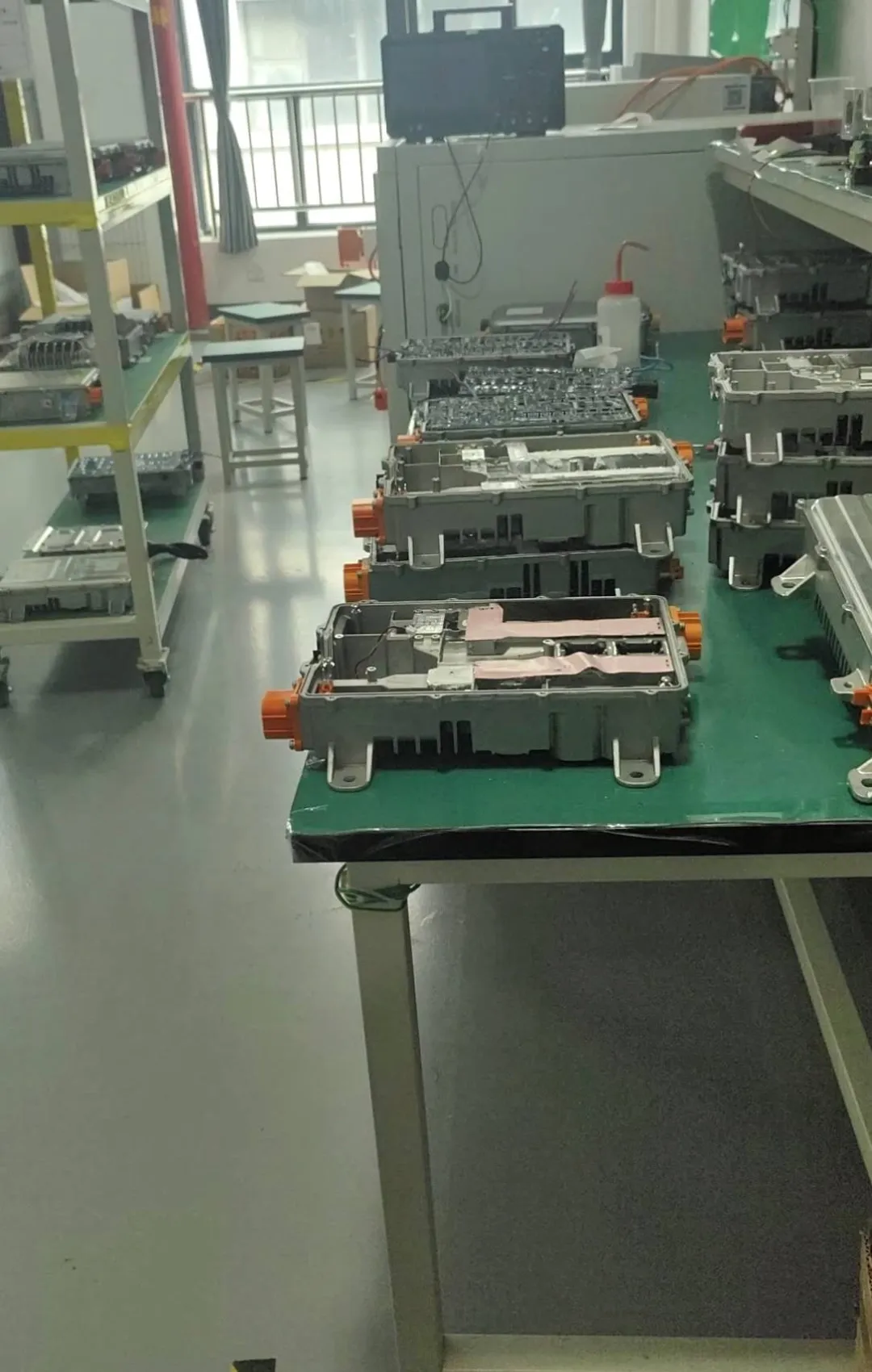
4. Production capacity and control. Dedicated production lines and an ERP-based digital production management system indicate a factory that can scale from samples to series production without changing hands.
5. Customization scope. The clearest dividing line between a manufacturer and a trading company is what can be customized: electrical parameters, CAN protocol, connectors, enclosures and branding. A trading company can only change the label.
Voltage and Power Coverage: 3.3 kW to 22 kW
A manufacturer worth shortlisting should cover the platforms your vehicle program actually uses. In commercial and specialty EVs, that usually means:
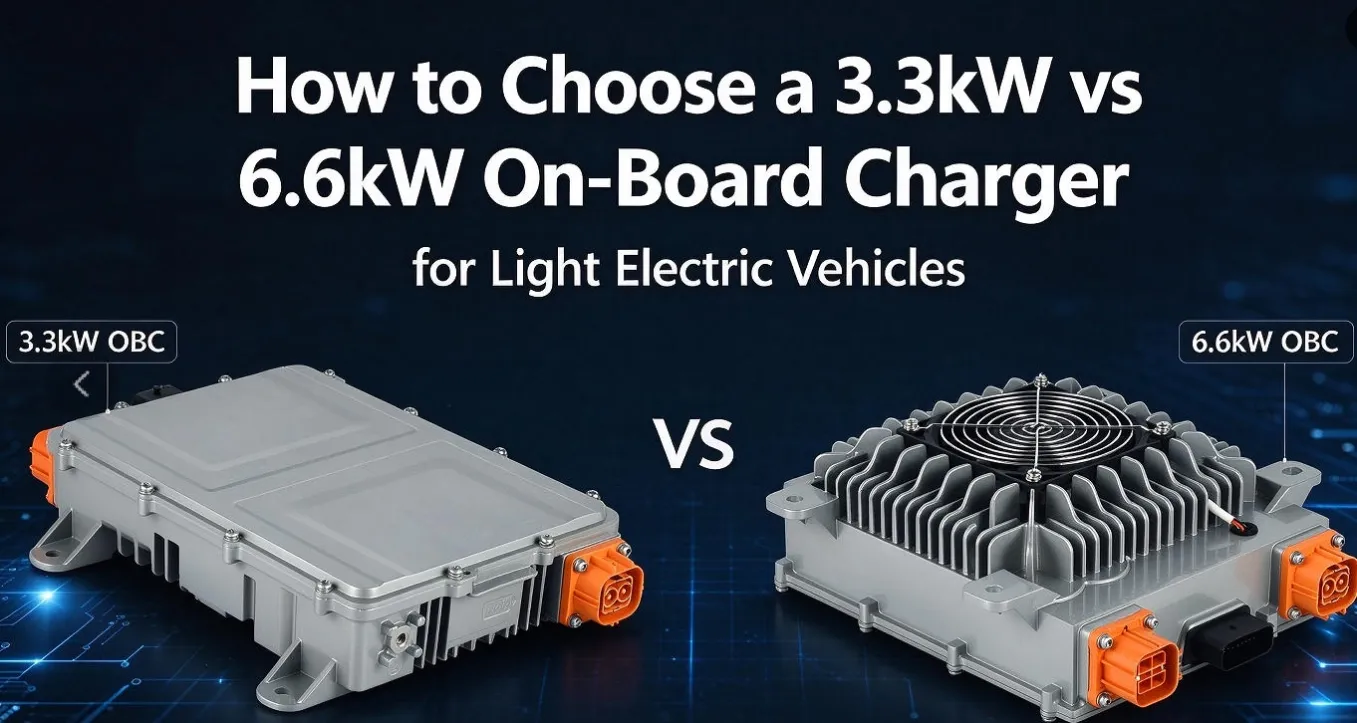
- 3.3 kW and 6.6 kW OBC on 48 V to 320 V platforms, for light commercial, low-speed and utility vehicles.
- 11 kW class bidirectional OBC on 320 V to 360 V platforms, for fast turnaround and V2G/V2L.
- Combined OBC + DC/DC units, which cut wiring and installation time.
If your program needs 22 kW, confirm the supplier can engineer beyond its standard catalog rather than simply offering a fixed model.
Liquid-Cooled DC/DC Converters for New Energy Vehicles
Higher power brings higher heat. Liquid-cooled DC/DC converters and OBCs are standard for new-energy commercial vehicles that run long duty cycles, because air cooling cannot hold temperature under sustained load. Ask specifically whether the cooling design was validated under continuous operation - not just at rated power on a bench.
OEM or Trading Company? How to Tell the Difference
Three questions separate the two:
- Can I see the production line? A factory will show you, or send recent footage. A trading company will deflect.
- What is your firmware and CAN customization process? A manufacturer has an engineering answer; a reseller has none.
- What happens if a unit fails in the field? A manufacturer owns the root-cause analysis; a trading company forwards your complaint.
A Supplier Evaluation Checklist
Before you request a quotation, confirm:
- 1. IATF 16949 certification at the production site.
- 2. In-house R&D and engineering headcount.
- 3. A written test scope (functional, CAN, protection, aging, thermal).
- 4. Production capacity stated in units per month.
- 5. Customization options: electrical, CAN, connectors, branding.
- 6. Whether samples and series production run on the same lines.
- 7. Two recent references in a comparable vehicle class.
Where Echelon Fits
Echelon Energy Technology (Hangzhou) Co., Ltd., founded in 2020, manufactures on-board chargers, DC/DC converters and integrated power systems for commercial and specialty electric vehicles. The production site operates under IATF 16949, with roughly 70% of the team in R&D and technical roles and a capacity of 30,000 units per month.
The product range covers 3.3 kW OBC and 6.6 kW OBC with integrated DC/DC options on 72 V to 320 V platforms, and an 11 kW bidirectional OBC with an integrated 3 kW DC/DC converter on a 360 V platform. A six-step process - requirement review, engineering proposal, prototype development, testing and validation, series production, delivery and support - connects samples to mass production; how Echelon manufactures and tests OBCs explains each step.
Conclusion
Choosing an OBC manufacturer in China is a verification task, not a popularity contest. Check certification, engineering depth, test scope, production control and customization range - and you will separate the factories from the middlemen. Evaluating suppliers for an EV program? Share your battery voltage, power level and CAN requirements with our engineering team for a technical evaluation.
About Echelon Charger
Echelon Energy Technology specializes in onboard chargers, DC/DC converters, and integrated EV power solutions for commercial and specialty electric vehicles.
For technical discussions, product selection, or OEM/ODM cooperation:
Email: nancy@tici-energy.com
WhatsApp: +86 18114665311