Oct 9, 2026Technical Articles & Engineering Insights
How to Choose a 3.3kW vs 6.6kW On-Board Charger for Light Electric Vehicles
Choosing between a 3.3kW and 6.6kW on-board charger for a light electric vehicle? Compare charging time, battery limits, AC infrastructure, weight and fleet cost.
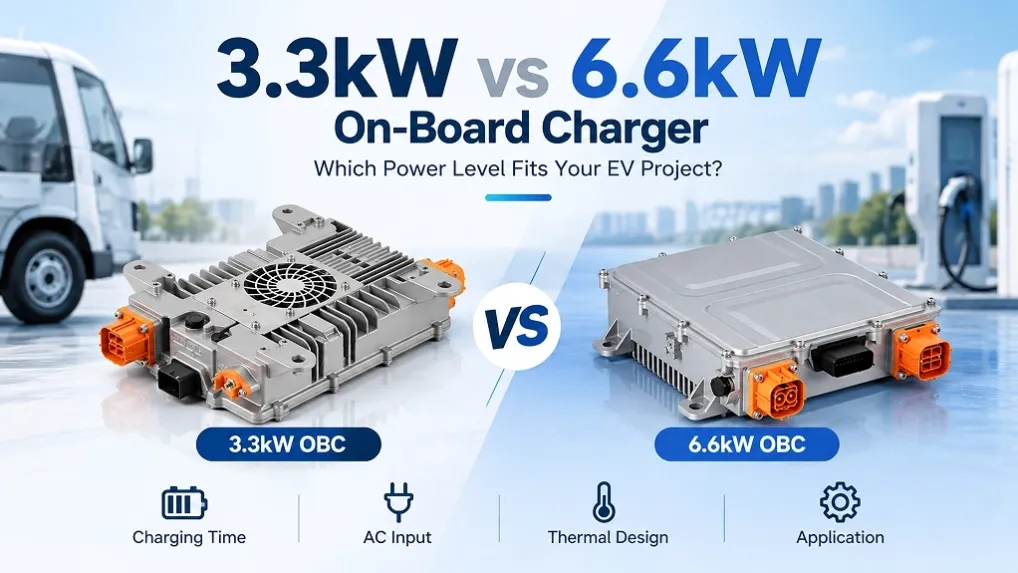
Light electric vehicles - golf carts, low-speed vehicles (LSVs), electric tricycles and small utility platforms - usually charge from a 3.3 kW or 6.6 kW on-board charger (OBC). The two power levels look close on a datasheet, but they lead to different charging times, AC infrastructure, cost and thermal design. This guide explains how to choose between a 3.3kW and a 6.6kW on-board charger for a light electric vehicle, step by step.
What 3.3kW and 6.6kW Mean on a Light Electric Vehicle
The power rating describes how much AC power the OBC converts into DC charging power. On a 72 V battery pack, a 3.3 kW unit delivers roughly 45 A of charging current, while a 6.6 kW unit delivers around 90 A - twice the current, twice the heat, and a different set of requirements for the AC inlet, wiring and cooling.
Start with the Battery Pack, Not the Charger
Charging power only pays off if the battery can absorb it. Check three things before comparing 3.3 kW and 6.6 kW units:
- Maximum charge current the BMS allows across the pack's voltage window.
- Cell chemistry and recommended C-rate: a small LFP pack may accept 0.5C continuous charge, which limits how much of a 6.6 kW charger the pack can actually use.
- Pack voltage platform: most light electric vehicles run 48 V, 72 V or 96 V, and the OBC output range must cover the full charge voltage, not just the nominal value.
A 6.6 kW charger on a pack that can only accept 3 kW of charge current adds cost and weight without shortening the charge session.
Charging Time: The Practical Difference
For a typical 5 kWh light electric vehicle pack, the math looks like this:
- 3.3 kW OBC: roughly 1.5-2 hours from 20% to 100%, including the charge taper.
- 6.6 kW OBC: roughly 45 minutes to 1 hour for the same window, if the BMS allows the higher current.
If the vehicle charges overnight or during long breaks, 3.3 kW is usually enough. If it runs multiple shifts, serves a rental fleet with quick turnaround, or opportunistically charges during short stops, 6.6 kW pays back.
AC Input and Charging Infrastructure
A 3.3 kW charger can draw from a standard household circuit in most markets. A 6.6 kW unit typically needs a dedicated circuit or an industrial socket, and the on-site wiring must carry the higher current. For fleets, check what the depot actually has before specifying the higher power level - infrastructure upgrades can cost more than the price difference between the two chargers.
Weight, Space and Thermal Design
Doubling the power also doubles the dissipation. Compare the units on volume, weight and cooling method: an air-cooled 3.3 kW unit is simpler to package inside a small chassis, while 6.6 kW designs need more airflow or a liquid cooling plate. It is also worth checking whether the OBC integrates a DC/DC converter - a combined unit saves a separate converter, wiring and installation time.
Cost, Fleet Duty Cycles and Combined Units
6.6 kW units cost more upfront, but for multi-shift operations the shorter charging window can reduce the number of vehicles needed to cover the same route. Combined OBC + DC-DC units, which also generate 12 V auxiliary power for lights and controllers, are common on light electric vehicles for exactly this reason.
Quick Selection Checklist
- 3.3 kW fits: overnight charging, single-shift duty, packs up to roughly 6 kWh, standard AC outlets and the lowest system cost.
- 6.6 kW fits: multi-shift or rental fleets, packs above roughly 6 kWh, dedicated AC circuits and fast turnaround requirements.
Conclusion
The right choice comes from the battery pack, the duty cycle and the charging infrastructure - not from the bigger number. Echelon Energy manufactures 3.3 kW and 6.6 kW on-board chargers with integrated DC/DC options for light electric vehicles on 72 V to 320 V platforms, with CAN communication and OEM/ODM customization. Share your battery voltage and charging schedule with our engineering team for a technical evaluation.