
Oct 15, 2026Technical Articles & Engineering Insights
Electric Forklift and AGV Charging: Where On-Board Chargers and DC/DC Converters Fit
Industrial vehicles like forklifts and AGVs have different charging requirements from road EVs. This guide explains when on-board charging makes sense, and how OBCs and DC/DC converters fit industrial
Forklifts, automated guided vehicles (AGVs) and industrial tow tractors are among the hardest-working electric vehicles in any facility. They run multiple shifts, charge in short windows, and stop production when they stop. Yet their charging architecture is often decided by habit rather than by duty cycle - a legacy of lead-acid battery practice.
This guide explains how industrial vehicle charging differs from passenger EVs, when on-board charging is the right choice, and how on-board chargers (OBCs) and DC/DC converters fit industrial fleets.
Why Industrial Vehicle Charging Is Different
Three characteristics separate industrial vehicles from road EVs:
- Shift-based, high-utilization duty: a forklift may run 16 to 24 hours a day, charging only during operator breaks or shift changes.
- Opportunity charging: lithium-powered industrial vehicles often charge in short, frequent bursts rather than one deep cycle, which changes the charger specification.
- Indoor and washdown environments: facilities are dust-laden and frequently hosed down, so sealed construction is essential.
A charger sized for a passenger car's overnight cycle is the wrong tool for a vehicle that charges in 20-minute windows.
On-Board vs Off-Board Charging for Industrial Vehicles
Historically, forklifts used off-board chargers: the truck plugs into a fixed charging station on the wall. This remains the dominant architecture for large lead-acid fleets, and it has real advantages - simple vehicles, centralized charging bays. But two developments are shifting the balance toward on-board charging:
- Lithium batteries: with lithium packs, opportunity charging becomes practical, and an on-board charger lets the vehicle charge wherever an AC outlet exists, with no dedicated charging bay required.
- AGVs and autonomous vehicles: an AGV that charges itself cannot rely on a human plugging it in. On-board charging, triggered automatically at a docking point, is the natural fit.
The choice is architectural: off-board for centralized, manual fleets; on-board for flexible, automated or lithium-based operations.
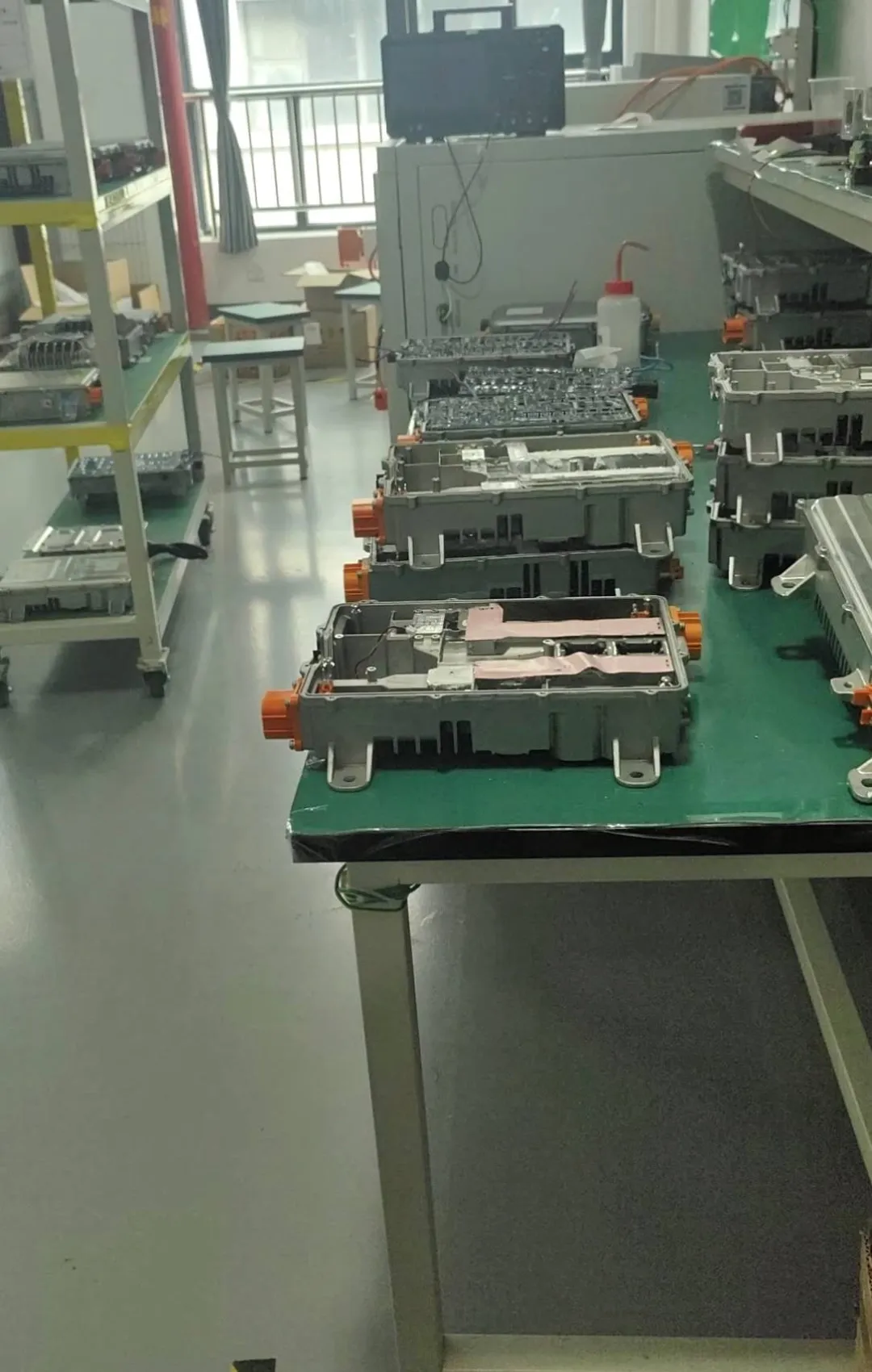
Why AGVs Are a Natural Fit for On-Board Chargers
An AGV's charging is part of its autonomy. It must return to a charge point on its own, initiate charging, and resume work - without an operator. That requires a charger that lives on the vehicle and is controlled over the vehicle's own network: CAN-controlled charging, compact and sealed packaging, and DC/DC conversion for auxiliary power, since AGV control electronics and sensors typically need 12 V or 24 V derived from the traction pack.
An integrated OBC + DC/DC unit covers both functions in one housing - and on a small vehicle, the space saving matters. The functions themselves are explained in what an on-board charger does.
Specifying the Charger for Industrial Duty
Four specification points decide whether an industrial vehicle charger succeeds:
- Power level matched to the charge window: a vehicle that charges in 20-minute breaks needs enough power to add useful energy in that time.
- Sealing and temperature tolerance: industrial washdown and dust make an IP rating and a wide operating temperature range non-negotiable.
- CAN integration: both the OBC and the DC/DC converter should be controllable and observable over CAN.
- Cycle life: industrial vehicles cycle their packs far more often than road vehicles, so charger and thermal design must be built for continuous duty.
The wider fleet picture is covered in OBCs for commercial electric fleets and ground support equipment - industrial vehicles share most of the same constraints.
A Note on Lead-Acid vs Lithium
Many facilities still run lead-acid industrial vehicles, which use off-board chargers and are not candidates for an on-board retrofit. The on-board opportunity is concentrated in new lithium-powered vehicles - forklifts, tow tractors, AGVs and autonomous material handlers - where the pack architecture supports it and the duty cycle benefits from flexible charging.
Where Echelon Fits
Echelon Energy Technology manufactures on-board chargers and DC/DC converters for commercial and specialty electric vehicles, including industrial applications. Relevant units include the 6.6 kW OBC + 1.5 kW DC/DC for larger industrial platforms and the 3.3 kW OBC + 1 kW DC/DC for compact AGVs and light industrial vehicles, with the full converter range under DC/DC converters. All support CAN communication, air or liquid cooling and OEM/ODM customization, produced under IATF 16949.
Conclusion
Industrial vehicles need charging built for shift work, not for overnight parking. For lithium-powered forklifts and autonomous AGVs, an on-board charger - often combined with a DC/DC converter and controlled over CAN - is the architecture that fits the duty cycle. Planning charging for an industrial vehicle program? Share your platform voltage, charge window and vehicle type with our engineering team for a technical evaluation.
About Echelon Charger
Echelon Energy Technology specializes in onboard chargers, DC/DC converters, and integrated EV power solutions for commercial and specialty electric vehicles.
For technical discussions, product selection, or OEM/ODM cooperation:
Email: nancy@tici-energy.com
WhatsApp: +86 18114665311