Sep 28, 2026Technical Articles & Engineering Insights
OBC RFQ Checklist: What EV Manufacturers Should Provide Before Requesting a Quotation
What information should EV manufacturers provide for an OBC quotation? Use this RFQ checklist covering battery, AC input, CAN, installation, quantity and project requirements.
A common OBC inquiry starts with a short request:
“We need a 6.6 kW on-board charger. Please send us a quotation.”
The power rating is important, but it is not enough to select the right charger or prepare an accurate quotation.
Two EV projects may both require a 6.6 kW OBC while using different battery voltage ranges, AC inputs, communication protocols, connectors, installation spaces and vehicle architectures.
Providing the right technical and commercial information at the RFQ stage helps the charger supplier evaluate the application faster and reduces repeated clarification during sample development.
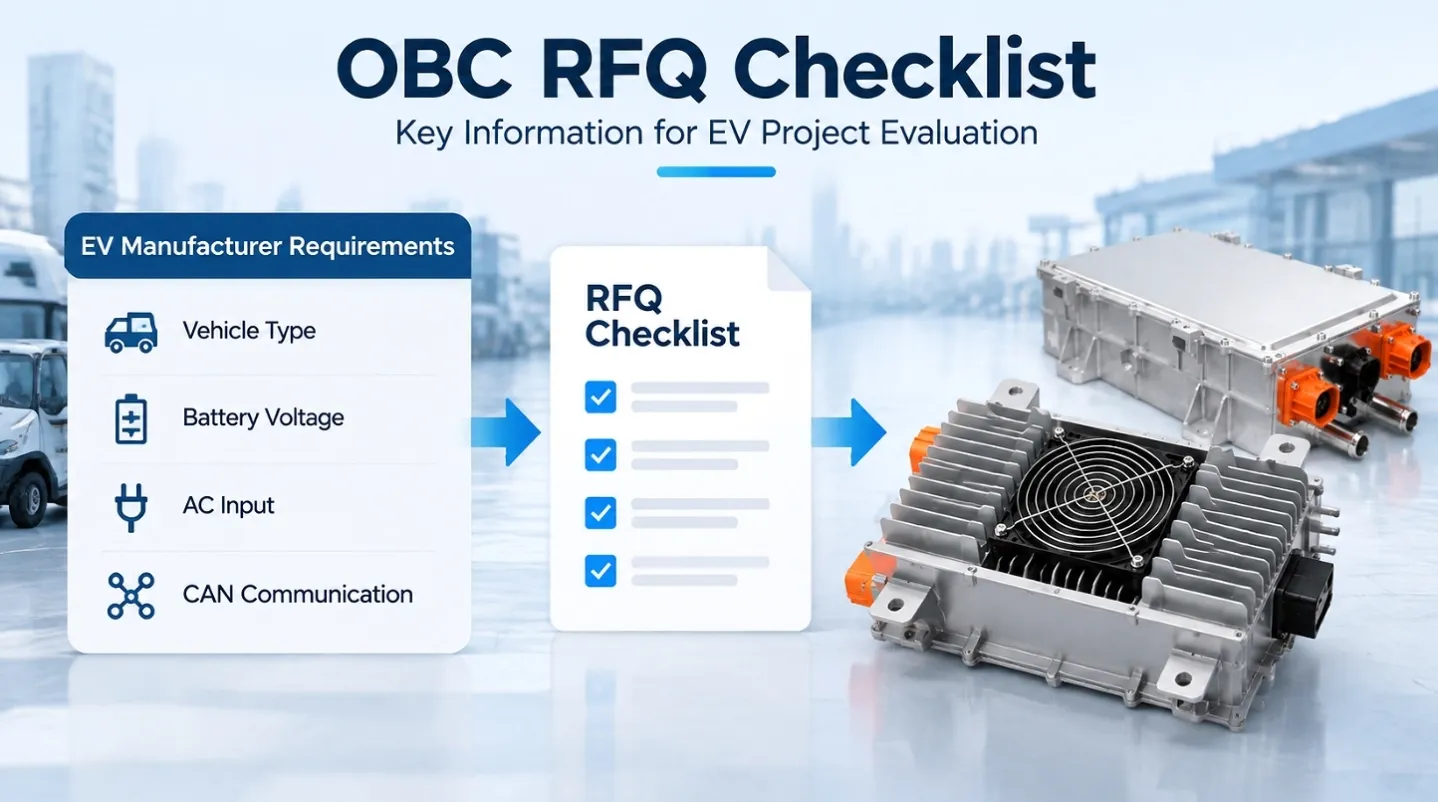
Here is a practical checklist EV manufacturers can prepare before requesting an OBC quotation.
1. Vehicle Application
Start with the type of vehicle in which the charger will be installed.
Examples include:
- Light commercial vehicles
- Electric utility vehicles
- Ground support equipment
- Electric tractors and agricultural vehicles
- UTVs and ATVs
- Low-speed vehicles
- Last-mile delivery vehicles
- Specialty electric vehicles
Vehicle application provides useful context for evaluating installation environment, operating conditions and integration requirements.
Simply stating “EV charger required” provides much less information than identifying the actual vehicle platform.
2. Battery Nominal Voltage and Charging Voltage Range
Do not provide only the nominal battery voltage.
For OBC selection, the required battery charging voltage range is particularly important because the charger output must operate within the voltage range required by the battery system.
For example, instead of providing only:
Battery: 96 V
provide:
Nominal battery voltage: ___ V
Required charging voltage range: ___ V to ___ V
If the charging voltage range has not yet been finalized, battery chemistry, cell configuration and BMS requirements may also need to be discussed.
For a deeper explanation of this topic, see How to Match an On-Board Charger to an EV Battery Pack.
3. Battery Capacity
Provide the battery capacity in Ah.
For example:
Battery capacity: 150 Ah
Battery capacity helps provide context for the expected charging time and whether the requested charger power is appropriate for the vehicle application.
Battery voltage, battery capacity and required charging power should therefore be evaluated together rather than as separate specifications.
4. Required OBC Power
Specify the required charging power, such as:
1.9 kW / 3.3 kW / 6.6 kW
However, the requested power should be considered together with the battery charging voltage and allowable charging current.
A request for a “6.6 kW OBC” does not automatically mean that 6.6 kW can be delivered under every battery voltage and operating condition.
For this reason, providing the complete battery requirements at the RFQ stage is more useful than providing the OBC power alone.
5. AC Input Requirement
Specify the AC power available on the vehicle's target market or charging infrastructure.
Typical information includes:
AC input voltage: ___ VAC
AC frequency: ___ Hz
Single-phase / three-phase: ___
Maximum available input current: ___ A
This is especially important for vehicles intended for different countries or markets.
The requested battery-side charging power must be considered together with the available AC-side input conditions.
6. CAN and Vehicle Communication Requirements
If the OBC needs to communicate with the BMS or VCU, indicate this during the RFQ stage.
Simply writing “CAN required” may not be enough for engineering integration.
Where available, provide the vehicle's CAN protocol or message definition, including information such as:
- CAN baud rate
- Message IDs
- Transmit and receive messages
- Byte/bit definitions
- Factor and offset
- Transmission cycle
- Charger enable commands
- Voltage/current commands
- Charger status and fault feedback
This allows both sides to evaluate communication compatibility before the prototype stage.
7. Mechanical and Installation Requirements
The charger must also physically fit the vehicle.
Useful information includes:
Available installation space: ___ × ___ × ___ mm
Preferred mounting position: ___
Cooling requirement: ___
Connector requirement: ___
Cable length requirement: ___
Environmental/IP requirement: ___
If the vehicle platform already has fixed connector or mechanical-interface requirements, drawings or interface information should be provided when possible.
This can reduce mechanical changes later in the project.
8. Standalone OBC or Integrated Power Solution
The RFQ should also clarify the required system architecture.
Depending on the vehicle platform, the manufacturer may require:
Standalone OBC
or an integrated solution such as:
or
An integrated architecture may affect enclosure size, connectors, thermal design, wiring and vehicle power distribution, so this should ideally be discussed before quotation rather than after sample selection.
9. Prototype Quantity and Estimated Production Volume
Commercial information also affects project evaluation.
Provide both:
Prototype quantity: ___ pcs
Estimated annual volume: ___ pcs/year
A request for five prototype units and a project expected to require several thousand units per year involve different production and commercial considerations.
The estimated volume does not need to be an exact commitment at the early stage. A realistic forecast is usually more useful than no volume information at all.
10. Project Stage and Target Timeline
Tell the supplier where the project currently stands.
For example:
Concept development
Prototype development
Vehicle validation
Pilot production
Mass production
Also provide important timing information:
Prototype required by: ___
Target SOP: ___
This helps determine whether an existing OBC platform can meet the project schedule or whether customization and additional development work need to be evaluated.
11. Certification and Customization Requirements
Certification requirements should be discussed early rather than after the charger has already been selected.
The RFQ can specify:
Target market: ___
Required certification/compliance: ___
Software customization: ___
CAN customization: ___
Connector customization: ___
Mechanical customization: ___
Other project-specific requirements: ___
Not every project requires the same certification or customization scope, so these requirements should be confirmed according to the vehicle and target market.
A Better RFQ Can Shorten the Technical Clarification Process
The purpose of an OBC RFQ is not simply to obtain a price.
It is the starting point for confirming whether the charger can match the vehicle's battery system, AC input, communication architecture, mechanical installation and project schedule.
Providing complete requirements early helps engineering and purchasing teams avoid repeated clarification and makes quotations more relevant to the actual vehicle project.
For a new EV project, the most useful starting information is usually:
Vehicle + Battery + AC Input + Communication + Installation + Quantity + Timeline.
With these details, an OBC supplier can evaluate the application much more effectively than from a power rating alone.
Preparing an OBC RFQ for a new EV project? Share your vehicle, battery and charging requirements with our engineering team.