OEM & EV Application Insights
What to Share With a Charger Supplier Before a Quotation - and What to Hold Back
You do not need to release CAD or vehicle design data to get an accurate charger quotation. This guide lists what to share and what to withhold.
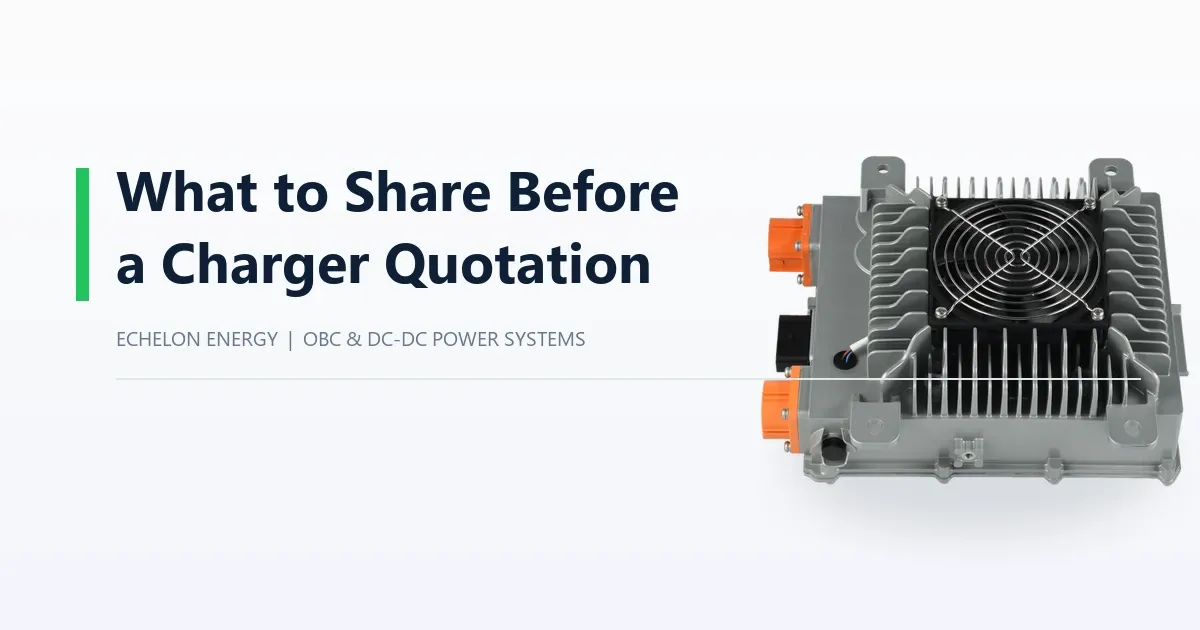
Vehicle teams often delay contacting a charger supplier because they assume a quotation requires releasing design data they are not ready to share. In practice, an accurate charger quotation needs electrical and duty-cycle information, not vehicle styling or full CAD.
This guide separates the information a supplier genuinely needs from the information that can stay inside the program until an architecture and commercial range are agreed.
What a supplier needs to quote accurately
Information | Why it is needed | Level of detail |
Battery nominal voltage and full charge window | Determines whether an existing output range covers the pack | Voltage range, not cell topology |
Pack capacity | Sets the required charge time and power | kWh or Ah |
AC supply at the target site | Determines power at the actual grid voltage | Voltage, phase, current |
Auxiliary load list | Sizes the DC-DC stage | Continuous and peak watts |
Charging duty cycle | Sets thermal and endurance requirements | Hours per day, ambient range |
Target volume and phasing | Sets prototype quantity, MOQ and tooling | P1, pilot, annual volume |
Target markets | Sets the validation scope | Countries and applicable requirements |
None of these items reveals vehicle design. They describe the electrical environment the charger must survive in.
What can stay internal until later
Exterior and interior styling CAD
Full vehicle packaging and body structure models
Detailed battery cell and module design
Powertrain control strategy beyond the charger interface
Supplier and cost breakdowns for other vehicle systems
A charger supplier needs a mounting envelope and a cooling interface, not the whole vehicle model. That can be provided as a simplified envelope drawing or a dimensioned sketch.
Controlled electrical interface information
The electrical interface is the natural boundary for early disclosure: connector type, pin assignment, voltage and current limits, CAN messages and wake-up signals. This is exactly what is needed to confirm compatibility, and it is limited in scope.
A practical sequence is:
Share the voltage window, auxiliary load, duty cycle and target volume for an indicative technical and commercial range.
Agree the preferred architecture and confirm that an existing platform or an adaptation covers it.
Release the controlled electrical interface under an appropriate confidentiality agreement.
Release the mechanical envelope and cooling interface once the architecture is fixed.
Why phased disclosure helps the buyer
Phased disclosure is not only about protecting designs. It also keeps the quotation honest: a supplier who receives complete electrical requirements can quote against a defined scope, and a defined scope is what makes a price comparable with another supplier's price.
Conversely, a quotation based on partial information carries assumptions, and those assumptions show up later as change orders. The cheapest way to avoid change orders is to define the electrical boundary early.
What to put in the first enquiry
A first enquiry can be short and still be useful. A workable structure is:
Vehicle type and intended duty cycle
Battery nominal voltage and full charge window
Required charging power and available AC supply
Auxiliary load estimate
Program phasing: prototype count, pilot count, target annual volume
Target markets and any known validation requirements
That is enough for an indicative architecture recommendation, a reuse assessment and a commercial range. Our RFQ checklist expands each item.
What the shortlist looks like once the boundary is shared
With the voltage window, auxiliary load and mounting envelope known, a supplier can narrow the recommendation to a short list instead of a general discussion. This is the practical outcome of sharing the electrical boundary early.
Platform | DC output window | DC-DC stage | Fits best |
240-480 Vdc, 0-20 A | 9-16 Vdc, 1500 W, 110 A rated / 132 A peak | 400 V class vehicles on forced-air cooling | |
240-480 Vdc, 0-10 A | 14 V, 1000 W, 72 A | Cost-sensitive 400 V programs | |
200-470 Vdc, 0-32 A | 9-32 Vdc auxiliary rail | Three-phase sites, V2L/V2G, liquid cooling | |
64-128 Vdc / 240-480 Vdc | external DC-DC | Where the auxiliary supply already exists |
Share the pack's full charge window and auxiliary load, and the reply can be a specific platform recommendation with a reuse assessment rather than a request for more data.
FAQ
Do I need to send CAD to get a charger quotation?
No. A dimensioned mounting envelope and cooling interface description are sufficient for quotation and for confirming mechanical fit.
Is a confidentiality agreement needed before the first discussion?
Not for the electrical summary. An agreement becomes appropriate when controlled interface documents, drawings or test data are exchanged.
What happens if the battery design is not final?
The supplier can quote against a stated voltage window with the assumption documented. If the window changes later, the quotation is revised - which is why freezing the window early protects the schedule.