OEM & EV Application Insights
OBC MOQ and Payment Milestones for Custom Vehicle Programs
MOQ and payment terms for custom on-board chargers depend on whether the platform is reused or newly developed. This guide explains how both are set.
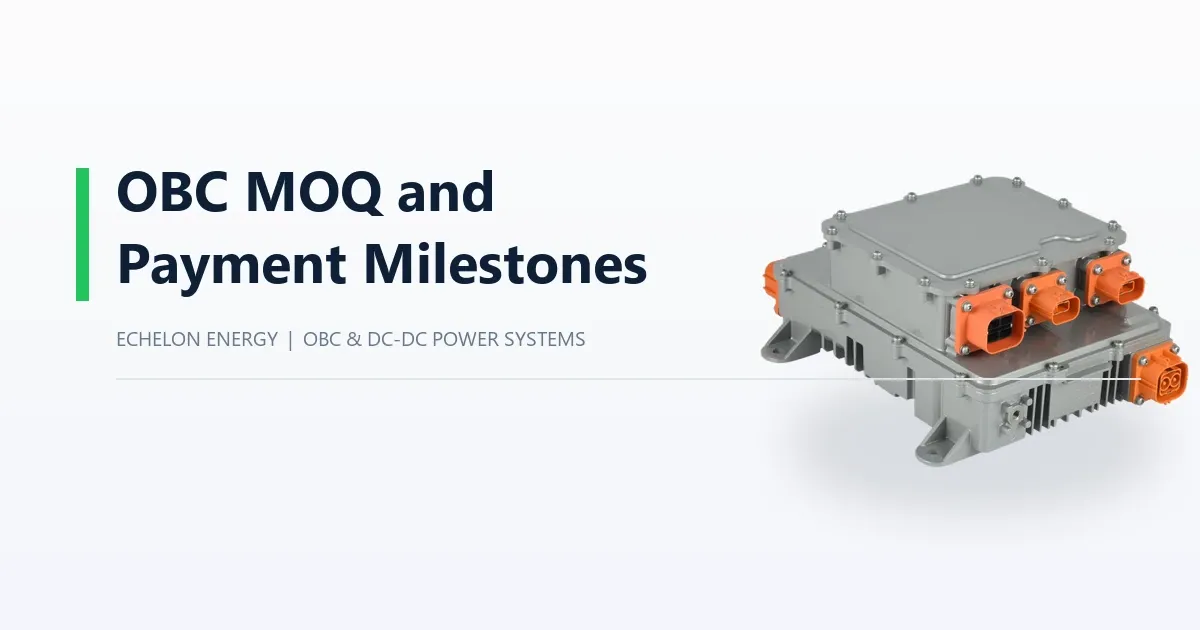
Minimum order quantity and payment milestones are usually the last items in a charger negotiation, and the two that cause the most friction. Both are driven by the same underlying variable: how much of the design is new.
This guide explains how MOQ is determined, how payment milestones usually map to program phases, and what a buyer can do to keep both reasonable.
What sets the MOQ for an OBC
MOQ is not an arbitrary commercial threshold. It reflects the fixed cost of a production run: setup, tooling amortisation, component minimums and test time.
Component minimums. Power semiconductors, connectors and housings often have their own minimum order quantities that set a floor.
Tooling amortisation. A new enclosure tool needs a volume to justify it; reusing an existing housing removes this constraint.
Test economics. Each unit needs end-of-line testing, and small runs carry the same fixture and programming overhead as large ones.
Material procurement. Small batches of long-lead components are priced higher per unit.
This is why MOQ for a reused platform is usually far below MOQ for a new design: the fixed costs are already paid.
Prototype and pilot volumes are a separate category
Prototype and pilot builds sit outside normal MOQ logic. They are engineering builds with engineering oversight, and they are priced per program rather than per unit. A 20-vehicle pilot is a pilot build, not a production order, even though 20 units sounds like a batch.
Companies sometimes try to treat the pilot as the first production order to get a better unit price. That usually backfires: pilot units built on a production line before the design is frozen tend to require rework, and the rework cost exceeds the price difference.
How payment milestones usually map to program phases
Milestone | Typical trigger | What it covers |
Program start | Purchase order for the development phase | Engineering, adaptation, documentation |
Prototype build | Design release and build confirmation | Prototype material and build labour |
Validation complete | Test report accepted | Validation testing and reporting |
Pilot build | Pilot order placed | Pilot material and build |
Production release | Design freeze and tooling release | Tooling, fixtures, end-of-line equipment |
Series delivery | Shipment milestones | Production units |
The exact percentages are commercial and depend on scope, but the sequence matters: each payment should follow a deliverable, not a calendar date. A milestone structure tied to deliverables gives both sides a clear exit condition at each phase.
Payment structures that keep risk balanced
Tie the first payment to a defined scope document, not to the purchase order alone
Tie validation payment to an accepted test report, with a defined acceptance criterion
Keep tooling payment separate from unit price so ownership and amortisation are explicit
Agree the change-order process before the program starts, so design changes have a known price mechanism
The most common dispute in charger programs is not the price but the definition of done. Writing acceptance criteria into the scope removes most of it.
How to lower MOQ and improve terms
Choose a platform whose voltage window already covers the pack
Reuse the existing housing family instead of creating a new enclosure
Keep the CAN mapping within the platform's supported message set
Forecast a realistic volume rather than an optimistic one
Combine several vehicle models onto one charger platform
The last item is often the most effective. A single charger qualified for two or three vehicle variants spreads NRE and tooling across a larger volume, which improves both unit price and MOQ.
How platform reuse lowers MOQ
MOQ is driven by fixed cost: tooling, component minimums and test setup. A charger that reuses an existing housing and power stage removes most of that fixed cost, which is why its MOQ can sit far below a new design.
Platform | DC output window | DC-DC stage | Fits best |
240-480 Vdc, 0-20 A | 9-16 Vdc, 1500 W, 110 A rated / 132 A peak | 400 V class vehicles on forced-air cooling | |
240-480 Vdc, 0-10 A | 14 V, 1000 W, 72 A | Cost-sensitive 400 V programs | |
200-470 Vdc, 0-32 A | 9-32 Vdc auxiliary rail | Three-phase sites, V2L/V2G, liquid cooling | |
64-128 Vdc / 240-480 Vdc | external DC-DC | Where the auxiliary supply already exists |
The four platforms above are in production, so a first order is not paying for a new enclosure tool. Confirm the voltage window first, then the MOQ follows from the platform rather than from the volume forecast.
FAQ
Is MOQ negotiable for a first production order?
It can be, but only against something real - a volume commitment, a longer forecast horizon, or a platform reuse that removes fixed cost. MOQ is not usually reduced simply by asking.
Do prototype units count toward MOQ?
No. Prototype and pilot builds are engineering builds and are normally accounted separately from production volume.
What payment terms are typical for charger programs?
Milestone-based payments tied to deliverables are typical. The split varies with scope; what matters is that each payment maps to an accepted deliverable.
To discuss a specific program structure, use our contact page. For how a program is scoped, see OEM/ODM cooperation and How an OBC program is phased.