OEM & EV Application Insights
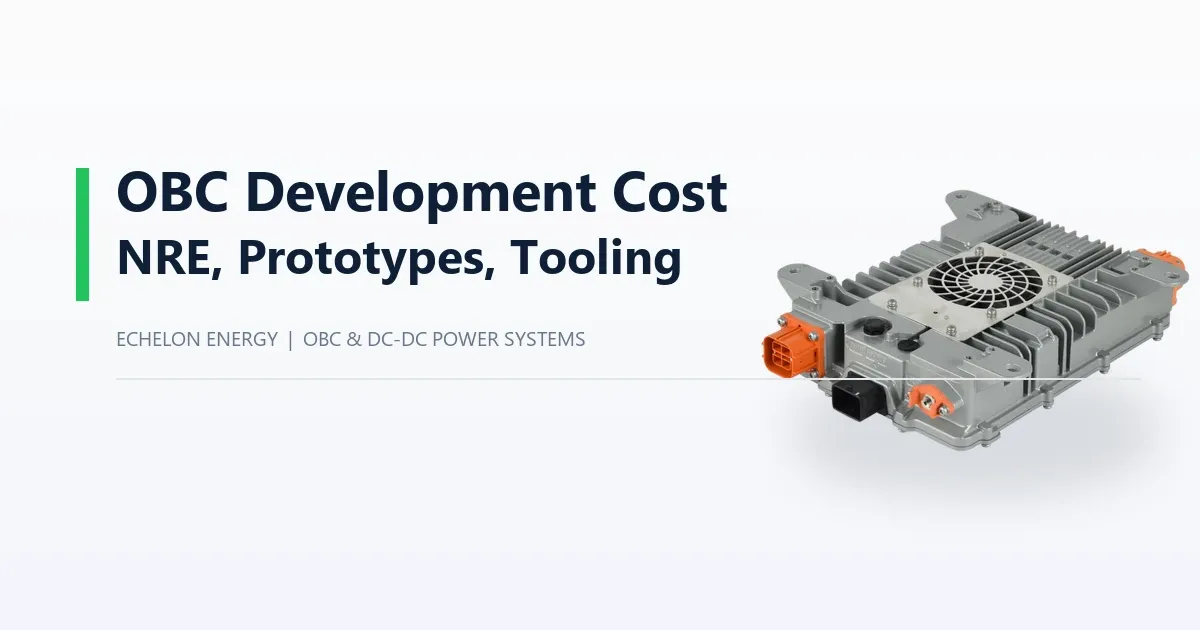
What Drives OBC Development Cost: NRE, Prototypes, Tooling and Validation
OBC development cost is driven by a small number of engineering variables. This guide explains what sits inside NRE, prototype, tooling and validation budgets.
A charger quotation for a vehicle program is rarely a single number. It usually splits into engineering (NRE), prototype hardware, software and calibration, validation testing, tooling, and then unit price at the requested volume. Buyers who understand what drives each line can compare quotes properly and avoid paying for development they do not need.
This guide explains the cost structure without quoting specific prices, because the same scope can differ by an order of magnitude depending on how much of the design already exists.
The five cost lines in an OBC program
Cost line | What it covers | Main cost driver |
Engineering / NRE | Requirements capture, schematic and layout changes, mechanical adaptation, firmware porting, documentation | How far the design departs from an existing platform |
Prototype hardware | Build and test of the first sample sets (P1 and subsequent samples) | Sample quantity and how many build iterations are needed |
Software and calibration | CAN matrix mapping, charging curve tuning, fault handling, diagnostic support | Whether the vehicle CAN matrix is standard or bespoke |
Validation and testing | Environmental, vibration, thermal, EMC and endurance testing | Which standards the target market requires and whether testing is in-house |
Tooling and fixtures | Housing tools, potting fixtures, test benches, end-of-line equipment | Whether existing tools can be reused and what the annual volume justifies |
What drives NRE up, and what keeps it down
NRE is mostly a function of design distance. Reusing a qualified power stage and changing only connectors, housing brackets and firmware is a small NRE. Changing the topology, the isolation design or the thermal path is a large one.
Keeps NRE low: pack voltage window inside an existing output range; auxiliary load inside an existing DC-DC rating; standard CAN messages; existing enclosure family; no change to cooling medium.
Drives NRE up: output voltage window outside existing ranges; new enclosure or connector family; liquid cooling where the platform is air-cooled; bidirectional export above standard rating; customer-specific diagnostics or cybersecurity requirements.
A useful test at quotation stage is to ask the supplier to separate NRE into "adaptation" and "new design". If most of the number is adaptation, the schedule and the technical risk are both smaller.
Prototype hardware cost: why quantity matters more than unit price
Prototype units are built in small batches with engineering oversight, extra inspection and often hand-assembled harnesses. Their cost per unit is far above the production price, and that is normal.
The number of prototype builds matters more than the number of units in each build. A program that needs three iterations to converge on the final design spends three times the prototype budget, regardless of how many units each iteration contains. Programs that freeze requirements early usually need one or two.
Minimum prototype quantity is typically set by the validation plan: units for functional testing, environmental testing, endurance testing and vehicle integration are consumed separately, because a unit that has been through a vibration test cannot be installed in a drivable vehicle.
Software and calibration: usually a separate line
Charging behaviour is software. The charger must follow the BMS's requested current, respect temperature derating, handle fault recovery and report status over CAN. If the vehicle's CAN matrix is already defined and matches the charger's message set, calibration is a short task. If messages must be remapped or new diagnostics added, it becomes a development task.
Bidirectional platforms add another layer: V2L and V2G modes need their own state machine, grid-interaction rules and protection logic, which is why bidirectional programs usually carry a larger software scope than unidirectional ones.
Validation and testing: scope follows the target market
Validation cost scales with the number of standards invoked and whether testing is done in-house or at an external laboratory. A program that only needs internal functional and endurance testing is cheaper than one that requires a full external test campaign for a regulated market.
Because the same charger can be qualified once and reused across several vehicle models, validation is often the line where a platform strategy pays back fastest: a second vehicle program on the same charger repeats only the integration-level tests.
Tooling: often the smallest line, sometimes the largest
If the charger reuses an existing housing and PCB, tooling may be limited to test fixtures and end-of-line equipment. If the housing changes, injection or die-cast tooling becomes a significant fixed cost, and it only makes sense against a volume forecast.
This is the line where 20-unit pilot volumes and 20,000-unit production volumes diverge most. For low-volume programs, reusing an existing enclosure family is usually the single biggest cost lever.
How to compare two OBC quotations fairly
A lower total often hides a narrower scope. Before comparing, confirm that both quotes cover the same items:
Number of prototype builds and units included
Whether software and calibration are in NRE or billed separately
Which validation tests are included and which are excluded
Whether tooling is charged once or amortised into unit price
What the unit price assumes about annual volume and payment terms
Our OEM/ODM page describes how a program is scoped, and the RFQ checklist lists the inputs that let a supplier produce an accurate quotation in one pass.
Where an existing platform changes the cost structure
NRE is driven by design distance, and design distance is easiest to see in the product range. If the output window already covers the pack, the DC-DC rating already covers the auxiliary load, and the housing already fits the envelope, the program is an adaptation rather than a new design.
Platform | DC output window | DC-DC stage | Fits best |
240-480 Vdc, 0-20 A | 9-16 Vdc, 1500 W, 110 A rated / 132 A peak | 400 V class vehicles on forced-air cooling | |
240-480 Vdc, 0-10 A | 14 V, 1000 W, 72 A | Cost-sensitive 400 V programs | |
200-470 Vdc, 0-32 A | 9-32 Vdc auxiliary rail | Three-phase sites, V2L/V2G, liquid cooling | |
64-128 Vdc / 240-480 Vdc | external DC-DC | Where the auxiliary supply already exists |
Compare these windows against your battery full charge range before estimating NRE. Where one row covers the requirement, most of the engineering line becomes configuration and validation rather than power-stage design.
FAQ
Is NRE always required for a custom OBC?
No. If the pack voltage window, auxiliary load and mounting envelope fit an existing platform and the CAN matrix can be mapped without new messages, the program can proceed with adaptation work rather than new design.
Why is prototype hardware priced per unit rather than per project?
Prototype builds are small, involve engineering supervision and often use hand-assembled subassemblies. Both the material cost and the labour content per unit are higher than in series production.
Should tooling be paid upfront or amortised?
Upfront payment keeps the unit price clean and is usual for low-volume programs. Amortising spreads the cost across units but ties the price to a volume commitment.
To scope a specific program, share the voltage window, auxiliary load, target volume and market requirements through our contact page.