Jun 26, 2026
What Size Onboard Charger Is Best for a 72V Battery?
we'll explore how to select the most suitable onboard charger for a 72V battery system.
A Practical Guide for Commercial EV Manufacturers
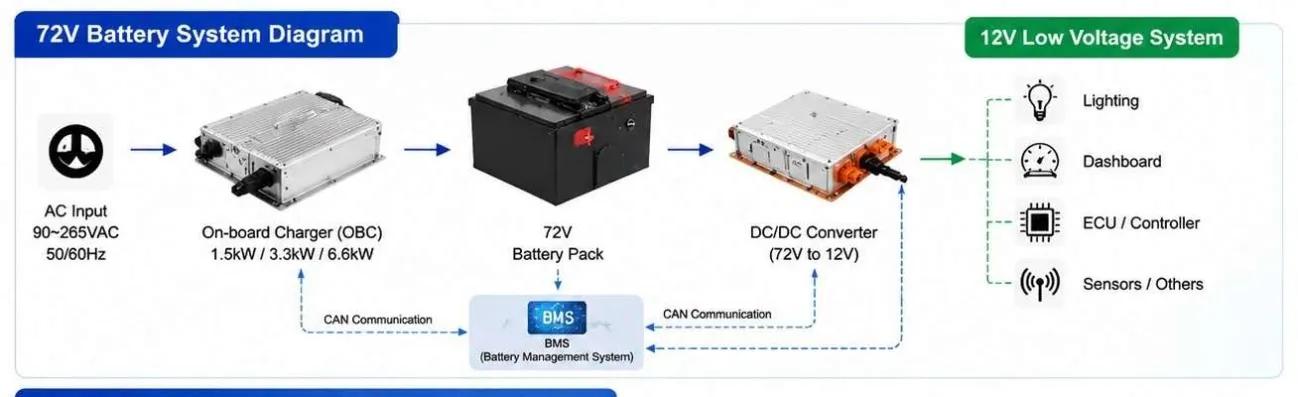
As 72V battery systems become increasingly common in commercial electric vehicles, one question is frequently asked by vehicle manufacturers and system integrators:
What size onboard charger (OBC) is best for a 72V battery?
The answer depends on several factors, including battery capacity, charging time requirements, vehicle application, and operating conditions. Choosing the right charger power can significantly improve vehicle uptime, charging efficiency, and overall user satisfaction.
In this article, we'll explore how to select the most suitable onboard charger for a 72V battery system.
Why 72V Battery Systems Are So Popular
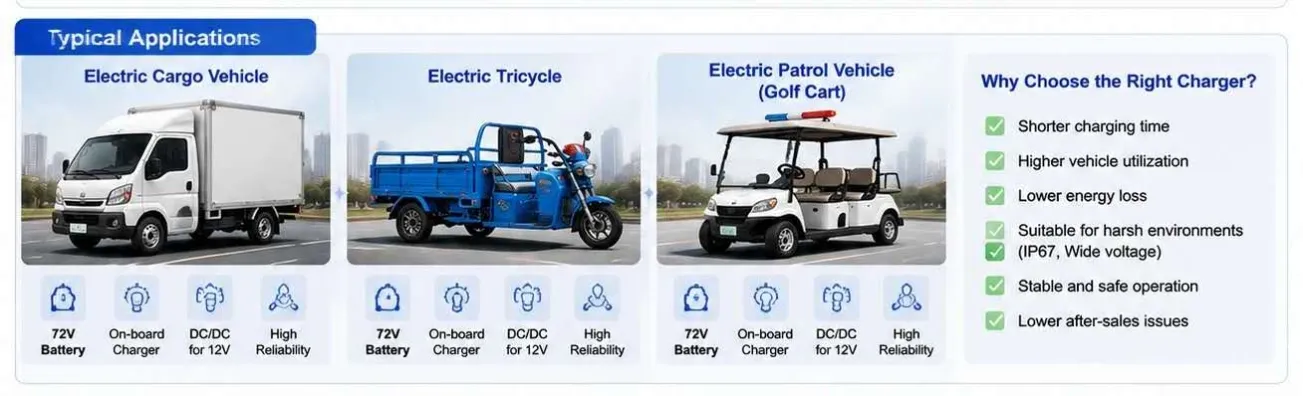
72V battery packs are widely used in:
- Last-mile delivery vehicles
- Electric cargo tricycles
- Electric utility vehicles
- Golf carts
- Electric ATVs
- Light commercial EVs
- Low-speed electric vehicles (LSEVs)
Compared with lower-voltage systems, 72V architectures provide a good balance between efficiency, cost, safety, and performance, making them a preferred choice for many commercial EV manufacturers.
The First Step: Know Your Battery Capacity
Battery voltage alone is not enough when selecting an onboard charger.
For example:
- 72V 60Ah Battery = 4.32 kWh
- 72V 100Ah Battery = 7.2 kWh
- 72V 150Ah Battery = 10.8 kWh
The larger the battery capacity, the more energy must be replenished during charging.
This directly affects the charger power required.
Common Onboard Charger Power Levels
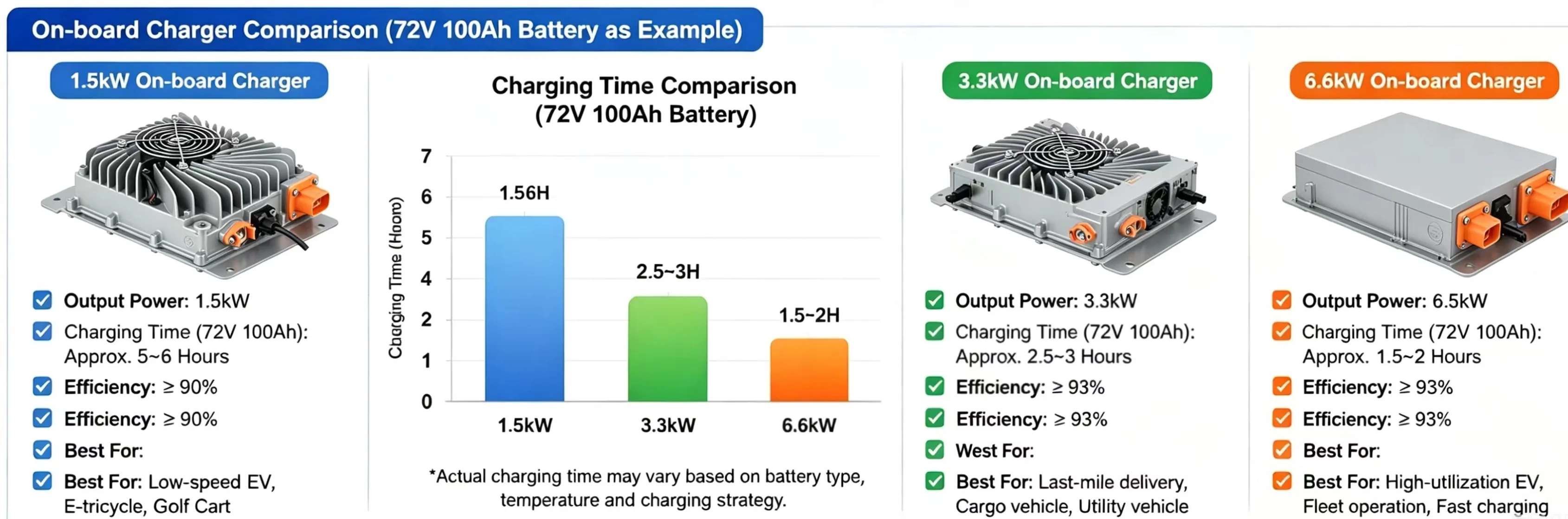
1.5kW Onboard Charger
Typical applications:
- Electric tricycles
- Small utility vehicles
- Low-speed EVs
Advantages:
- Lower cost
- Smaller size
- Easier installation
Limitations:
- Longer charging time
- Less suitable for larger battery packs
A 72V 100Ah battery may require approximately 5–6 hours to charge under normal conditions.
3.3kW Onboard Charger
Typical applications:
- Last-mile delivery vehicles
- Electric cargo vehicles
- Commercial EV fleets
- Golf carts
Advantages:
- Balanced charging speed
- Good cost-performance ratio
- Widely accepted by commercial EV manufacturers
A 72V 100Ah battery can typically be charged within approximately 2.5–3 hours.
For many vehicle manufacturers, 3.3kW has become the preferred option because it reduces charging downtime without significantly increasing system complexity.
6.6kW Onboard Charger
Typical applications:
- High-utilization commercial vehicles
- Larger battery systems
- Fleet vehicles requiring fast turnaround
Advantages:
- Faster charging
- Reduced vehicle downtime
- Improved operational efficiency
Limitations:
- Higher cost
- Larger installation space
- Greater thermal management requirements
A 72V 100Ah battery may be charged in approximately 1.5–2 hours under suitable conditions.
Charging Time vs. Vehicle Operation
When selecting charger power, charging time is often more important than charger cost.
For example, a delivery vehicle operating two shifts per day may need to recharge during breaks or between routes.
If charging takes six hours, vehicle utilization drops significantly.
In contrast, reducing charging time to three hours can dramatically improve fleet efficiency.
This is one reason why many commercial EV manufacturers are upgrading from 1.5kW chargers to 3.3kW solutions.
Environmental Conditions Matter
The charger must also match the operating environment.
Factors to consider include:
- Ambient temperature
- Humidity
- Dust exposure
- Water ingress risks
- Grid voltage stability
For vehicles operating in regions such as Southeast Asia, the Middle East, Africa, or India, high temperatures and unstable power grids can place additional stress on charging systems.
A reliable onboard charger should provide:
- Wide AC input voltage range
- High efficiency
- Over-voltage protection
- Under-voltage protection
- Over-temperature protection
- Robust waterproof performance
Recommended Charger Selection for 72V Batteries
Battery Capacity| Recommended OBC Power| Typical Charging Time
72V 60Ah| 1.5kW – 3.3kW| 2–4 Hours
72V 100Ah| 3.3kW| 2.5–3 Hours
72V 150Ah| 3.3kW – 6.6kW| 2–4 Hours
72V 200Ah+| 6.6kW| Fast Charging Required
Actual charging times vary depending on battery chemistry, battery management system (BMS), charging strategy, and environmental conditions.
Final Thoughts
There is no single onboard charger that fits every 72V battery application.
For most commercial EV projects, the optimal charger is the one that balances charging speed, reliability, cost, and installation requirements.
Today, many manufacturers of last-mile delivery vehicles and light commercial EVs are increasingly selecting 3.3kW onboard chargers because they offer a practical balance between performance and cost.
Before making a final decision, evaluate not only battery specifications but also how the vehicle is used in real-world operation.
The right onboard charger can help reduce downtime, improve fleet productivity, and enhance the overall user experience.