Jul 31, 2026Technical Articles & Engineering Insights
How CAN Communication Improves EV Charger Integration with Vehicle Systems
Learn how CAN communication enables better integration between onboard chargers, DC/DC converters, and electric vehicle control systems for reliable EV applications.
How CAN Communication Improves EV Charger Integration in Commercial Electric Vehicles
Introduction
In modern electric vehicles, an onboard charger (OBC) is no longer an independent charging device.
For commercial EV applications, the charger needs to communicate with other vehicle systems to achieve reliable charging control, fault monitoring and efficient energy management.
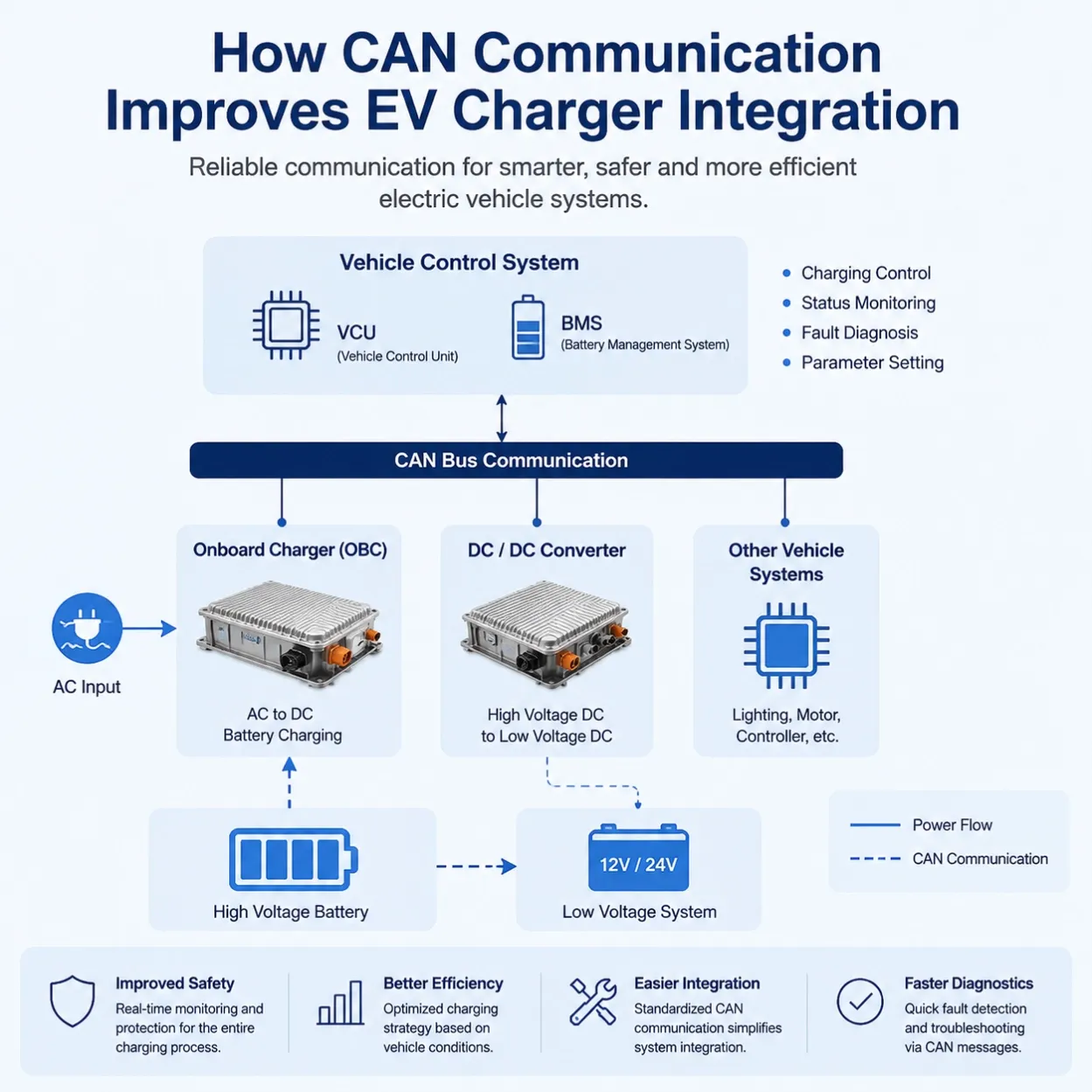
CAN (Controller Area Network) communication plays an important role in connecting the onboard charger, DC/DC converter, battery management system (BMS) and vehicle control unit (VCU).
Through reliable communication, EV manufacturers can achieve better integration between charging systems and vehicle platforms.
1. Why EV Chargers Need Communication with Vehicle Systems
A simple charging system only needs to convert electrical power.
However, commercial electric vehicles require more intelligent coordination between different components.
During charging, the vehicle system may need to exchange information such as:
- Battery status
- Charging request
- Charging current
- Voltage information
- Fault conditions
- System protection status
Without communication, the charger cannot fully understand the vehicle requirements, which may affect charging efficiency and system safety.
2. What CAN Communication Does in an EV Charger System
CAN communication allows different electronic components in an EV to exchange information efficiently.
In an onboard charging system, CAN can support functions including:
Charging Control
The vehicle controller can send charging commands to the OBC according to battery conditions and operating requirements.
Real-Time Monitoring
The vehicle system can monitor:
- Charging voltage
- Charging current
- Charging status
- Error information
Fault Diagnosis
When abnormal conditions occur, CAN communication helps transmit fault codes and system information for easier troubleshooting.
3. CAN Integration Between OBC, DC/DC Converter and Vehicle Systems
Commercial electric vehicles usually contain multiple power electronic components.
For example:
Onboard Charger (OBC)
The OBC converts AC power from the grid into DC power for battery charging.
DC/DC Converter
The DC/DC converter converts high-voltage battery power into low-voltage power for vehicle electrical systems.
Vehicle Control System
The VCU and BMS manage vehicle operation and battery conditions.
Through CAN communication, these components can work together as an integrated system.
This integration is especially important for commercial EVs that require stable operation over long working hours.
4. Benefits of CAN-Based EV Charger Integration
For EV manufacturers, proper communication between charging components and vehicle systems provides several advantages.
Improved System Coordination
The charger can respond according to real vehicle conditions instead of operating independently.
Easier Vehicle Development
CAN communication helps engineers integrate chargers into different vehicle platforms more efficiently.
Faster Troubleshooting
Diagnostic information through CAN can help identify issues during development and maintenance.
Better User Experience
Stable communication contributes to smoother charging operation and improved vehicle reliability.
5. Considerations When Selecting an EV Charger with CAN Capability
For commercial EV projects, CAN communication capability is an important consideration when selecting an onboard charger or DC/DC converter.
Manufacturers should consider:
- CAN protocol compatibility
- Communication requirements with BMS and VCU
- Diagnostic functions
- Software adaptability
- Supplier engineering support
A charger that can communicate effectively with the vehicle system can reduce integration challenges during vehicle development.
Conclusion
CAN communication has become an important part of modern EV charging systems.
For commercial electric vehicles, the onboard charger is not only a power conversion device but also an integrated component within the vehicle control system.
Reliable communication between OBC, DC/DC converter, BMS and VCU helps EV manufacturers achieve better system integration, easier development and more reliable vehicle operation.
When selecting an EV charging solution, communication capability should be considered as an important part of the overall vehicle design.