Jul 30, 2026Technical Articles & Engineering Insights
How EV Charger Manufacturers Build a Reliable Supply Chain for Commercial EV Projects
A reliable EV charger supply chain is essential for commercial EV projects.
How EV Charger Manufacturers Build a Reliable Supply Chain for Commercial EV Projects
For commercial electric vehicles, an EV charger is not just a single electronic component. It is a critical part of the vehicle power system, which requires stable performance, consistent quality and long-term reliability.
Behind every reliable EV charger is a well-managed supply chain, including component selection, supplier management, production coordination and quality verification.
For EV manufacturers, choosing a charger supplier is not only about product specifications. The supplier’s ability to manage the complete supply chain also affects project progress, production stability and future scalability.
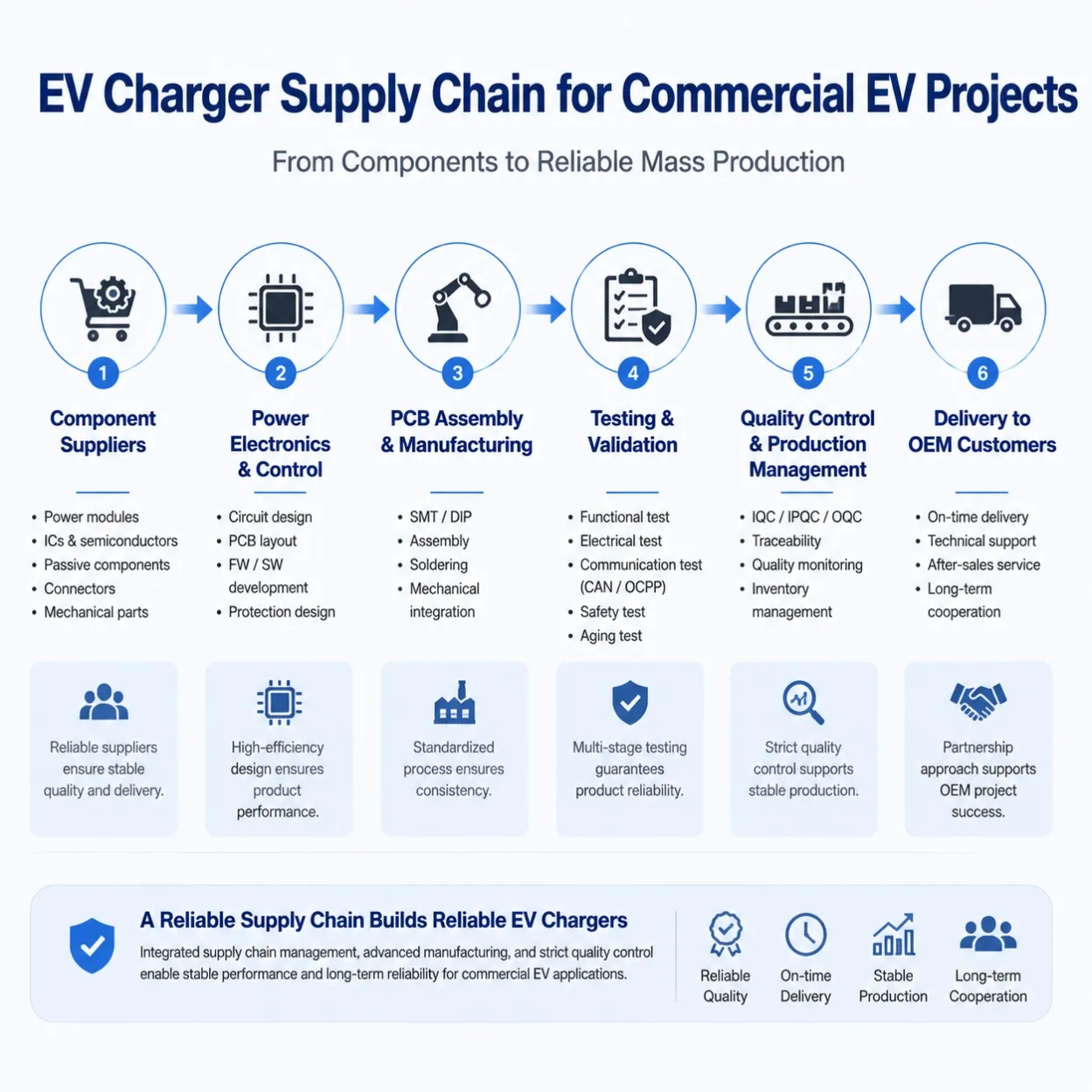
1. Selecting Reliable Components for EV Charger Production
An EV charger integrates multiple electronic components, including power modules, control boards, communication components and protection devices.
The quality consistency of these components directly influences charger reliability.
A professional EV charger manufacturer needs to evaluate:
- Component reliability
- Supplier consistency
- Material availability
- Long-term supply capability
Stable component sourcing helps reduce unexpected risks during mass production.
2. Managing Supplier Coordination and Production Planning
Commercial EV projects usually involve long development cycles and increasing production requirements.
A reliable charger supplier needs to coordinate:
- Component purchasing
- Production scheduling
- Inventory management
- Delivery planning
Good supply chain management allows manufacturers to respond faster when customers move from prototype validation to mass production.
3. Combining Manufacturing Capability with Supply Chain Control
A strong EV charger manufacturer does not only assemble products.
It needs to integrate:
- Electronic manufacturing capability
- Process management
- Quality inspection
- Production traceability
From PCB assembly to final product testing, each step requires effective coordination between suppliers and internal production teams.
This helps maintain consistent product quality across different production batches.
4. Quality Control Throughout the Supply Chain
Supply chain management is closely connected with product quality.
Before shipment, EV chargers typically require multiple inspection procedures, such as:
- Electrical performance testing
- Communication testing
- Protection function testing
- Aging testing
- Final inspection
These processes help identify potential issues before products are delivered to customers.
5. Supporting OEM Customers from Development to Mass Production
For commercial EV manufacturers, charger suppliers often need to support different vehicle platforms and application requirements.
A reliable supplier should be able to provide:
- Customized power solutions
- Technical communication support
- Prototype validation
- Stable mass production capability
This cooperation model helps OEM customers reduce development risks and improve project efficiency.
Conclusion
A reliable EV charger supply chain is an important foundation for successful commercial EV projects.
From component selection and supplier coordination to manufacturing and testing, every stage influences the final product quality.
For EV manufacturers, selecting a charger supplier with strong supply chain management capability can help create more stable and reliable vehicle solutions.