Aug 1, 2026Technical Articles & Engineering Insights
How Thermal Management Affects EV Charger Reliability in Commercial Electric Vehicles
Learn how thermal management affects EV charger reliability.
How Thermal Management Affects EV Charger Reliability in Commercial Electric Vehicles
Introduction
As electric vehicles become more widely used in commercial applications, EV chargers are required to operate reliably under different working conditions.
Charging power, efficiency and communication capability are important factors when selecting an EV charger. However, thermal management is also a key factor that directly affects charger performance and long-term reliability.
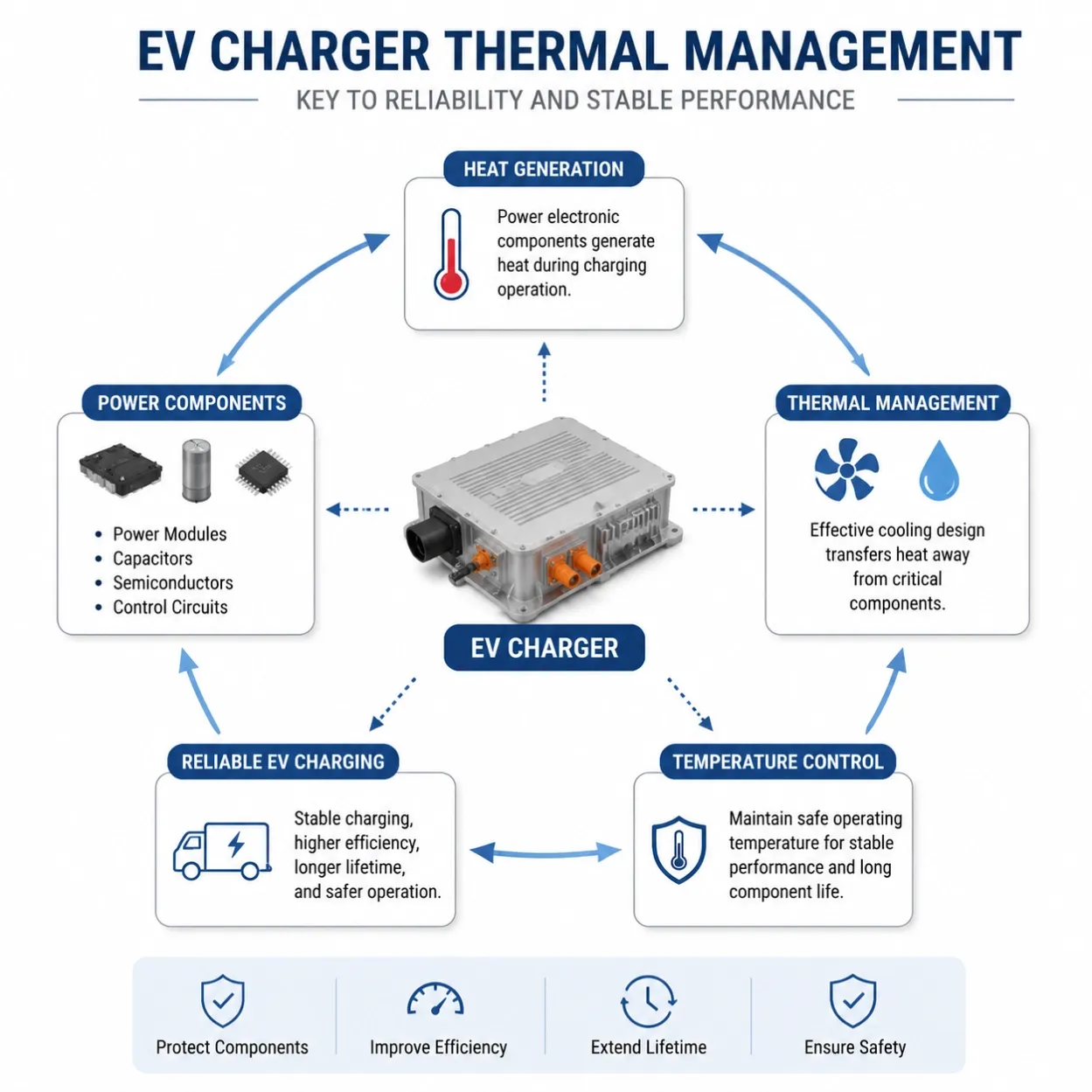
During operation, power electronic components inside an EV charger generate heat. Without effective heat management, high temperatures can influence efficiency, component lifetime and system stability.
1. Why Thermal Management Matters in EV Chargers
An EV charger contains multiple power electronic components, including:
- Power modules
- Capacitors
- Control circuits
- Semiconductor devices
During charging, these components generate heat continuously.
If the heat cannot be effectively transferred away, the internal temperature may increase and affect the charger’s performance.
Effective thermal management helps maintain stable operation and protect electronic components during long-term use.
2. How Temperature Affects EV Charger Performance
Temperature changes can influence several aspects of EV charger operation.
Charging Stability
High temperatures may cause power reduction or protective actions to prevent component damage.
Component Lifetime
Electronic components usually have different operating temperature limits. Continuous exposure to excessive heat can accelerate aging.
System Reliability
Stable temperature control helps maintain consistent performance during repeated charging cycles.
For commercial electric vehicles that operate many hours every day, thermal performance becomes especially important.
3. Thermal Challenges in Commercial EV Applications
Commercial electric vehicles often face more demanding operating environments compared with passenger vehicles.
Examples include:
- Electric delivery vehicles
- Utility vehicles
- Agricultural vehicles
- Electric three-wheelers
- Special-purpose vehicles
These vehicles may experience:
- Outdoor operation
- High ambient temperatures
- Long working hours
- Limited installation space
Therefore, EV charger thermal design needs to consider the actual vehicle application environment.
4. Cooling Methods Used in EV Chargers
Different EV charger designs may use different cooling solutions depending on power level and application requirements.
Air Cooling
Air cooling is commonly used for many onboard chargers.
Advantages include:
- Simple structure
- Easy maintenance
- Cost efficiency
Liquid Cooling
For higher power applications, liquid cooling can provide more effective heat dissipation.
Advantages include:
- Better thermal control
- Suitable for higher power density
- Improved temperature stability
The appropriate cooling method depends on charger power, vehicle design and operating conditions.
5. Thermal Design and Long-Term Reliability
A reliable EV charger requires more than just high output power.
Thermal design needs to work together with:
- Electrical design
- Mechanical structure
- Protection strategy
- Testing procedures
During development, manufacturers typically evaluate:
- Temperature rise
- Operating conditions
- Protection response
- Long-term performance
Good thermal management helps ensure that EV chargers can maintain stable operation throughout their service life.
Conclusion
Thermal management is an important part of EV charger design, especially for commercial electric vehicles that require frequent and long-term operation.
A well-designed cooling system helps improve charging stability, protect electronic components and support reliable vehicle performance.
When selecting an EV charging solution, vehicle manufacturers should consider not only charging power and efficiency, but also thermal design capability and application requirements.