EV System Integration & Architecture
REEV On-Board Charger: Sizing OBC and DC-DC for a 400 V Platform
A range-extended EV still needs a full AC charging path. This guide covers 400 V REEV architecture, OBC and DC-DC sizing, and which production platforms fit.
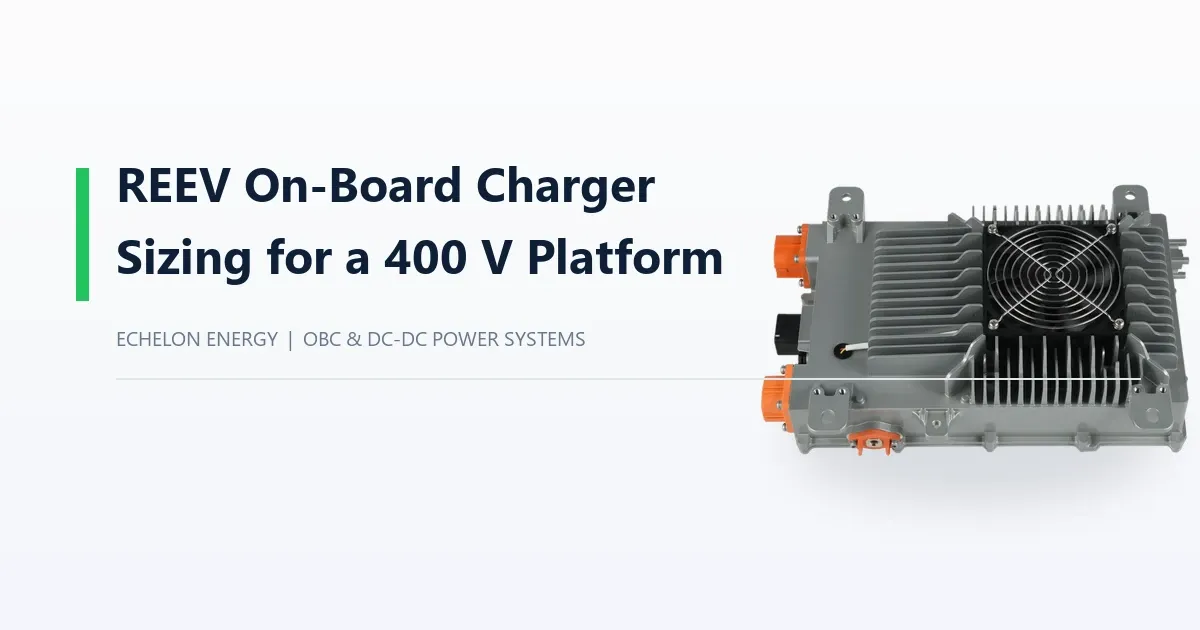
A range-extended electric vehicle (REEV) carries both a traction battery and an engine-driven generator. Engineers often assume the generator makes the on-board charger less important. In practice the opposite is true: the REEV still has to charge from grid power overnight, still has to power 12 V or 24 V auxiliaries continuously, and now has one more high-voltage node competing for space, cooling and CAN bandwidth.
This guide covers what a ~400 V REEV platform actually requires from the charging system, how to size the OBC and DC-DC stages, and which existing production platforms can be reused without new development.
What a 400 V REEV architecture demands from the charging system
A 400 V REEV typically uses a 350 V to 400 V nominal traction pack. That puts the charging voltage window roughly between 300 V and 460 V depending on cell chemistry and series count. The charger has to operate across that whole window, not just at nominal.
Battery-side voltage range, not just nominal voltage - a 400 V pack may need 330 V at low state of charge and 460 V at full.
Grid-side input flexibility - single-phase 90-264 Vac for depot or home charging, three-phase where the site provides it.
Auxiliary power - 12 V or 24 V rail for controllers, pumps, lighting and telematics, supplied by the DC-DC stage.
CAN communication with BMS and VCU so charging current is negotiated against pack temperature and state of charge.
Cooling that matches the engine bay, which is hotter and more cramped than a pure EV front end.
Why ~400 V remains the practical choice for a REEV
800 V architectures reduce cable mass and charge faster, but they raise isolation, creepage and component cost across the whole high-voltage system. For a REEV built on an existing 400 V supply base, staying at 400 V usually keeps the battery, inverter, generator and charger on one qualified component family.
That matters commercially: a 400 V program can often start from production-proven charger hardware, while an 800 V program almost always requires a new isolation design and a new validation cycle. If the vehicle targets 400 V, the fastest path to a drivable prototype is a charger that already covers the 400 V window. Our 6.6 kW OBC + 1.5 kW DC/DC 2-in-1 has a 320 V variant rated for 240-480 Vdc output, which covers a 400 V pack's full charge window without a new power stage.
Sizing the OBC: three checks before choosing 3.3, 6.6 or 11 kW
Charger power should follow the charging window and the pack energy, not the vehicle's top speed or the generator rating.
Pack energy divided by available charging time. A 20 kWh pack charged in 6 hours needs about 3.3 kW; a 40 kWh pack in the same window needs about 6.6 kW.
AC supply at the target site. 3.3 kW runs on a standard single-phase outlet. 6.6 kW needs a dedicated single-phase circuit. 11 kW generally assumes three-phase supply.
Continuous thermal margin. A charger rated at 6.6 kW at 220 Vac delivers 3.3 kW at 110 Vac. Confirm the actual grid voltage at the customer site before fixing the rating.
Charger class | Typical REEV use | Charge time for a 40 kWh pack (20-100%) | AC supply assumption |
3.3 kW | Light REEV, urban duty, overnight depot | about 10-11 hours | Single-phase 220 Vac |
6.6 kW | Standard passenger or light commercial REEV | about 6-7 hours | Dedicated single-phase 220 Vac |
11 kW bidirectional | Multi-shift fleets, V2L/V2G capability | about 4 hours | Three-phase 304-456 Vac |
Sizing the DC-DC stage for REEV auxiliary loads
A REEV adds generator control, engine management and often an electric coolant pump to the auxiliary load list. A pure EV might draw 800 W to 1.2 kW; a REEV can approach 1.5 kW to 2 kW with the engine running.
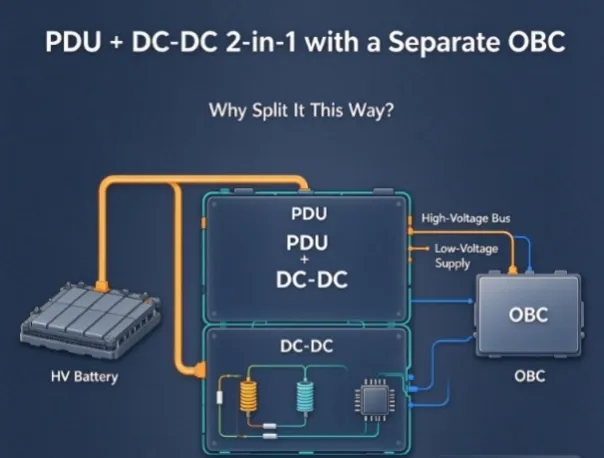
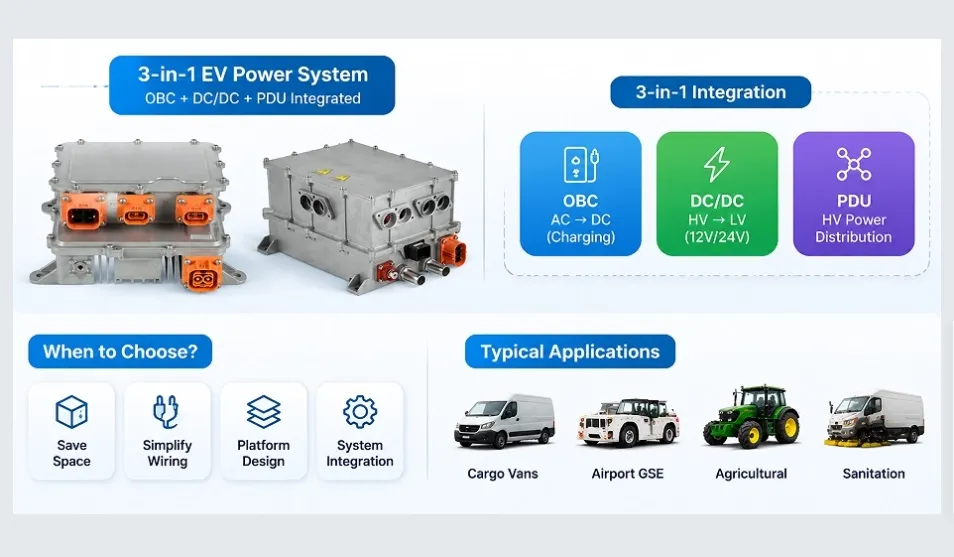
Two approaches work. An integrated 2-in-1 unit combines OBC and DC-DC in one housing, which removes a harness, a mounting bracket and one CAN node. A separate DC-DC keeps the two functions independently serviceable. For a low-volume prototype program the integrated unit is usually faster to install and easier to package.
1 kW DC-DC suits light REEV auxiliary loads with a small engine control system.
1.5 kW DC-DC with 110 A rated and 132 A peak covers most passenger REEV auxiliary demand, including electric coolant pumps.
3 kW DC-DC in the 11 kW bidirectional platform supports larger commercial REEV loads and V2L export.
Production-proven platforms that fit a ~400 V REEV
The table below maps Echelon's existing platforms to a 400 V REEV. Voltage windows are taken from published specifications; final selection depends on the pack's full charge range and the site's AC supply.
Platform | OBC output window | DC-DC | Cooling | Typical REEV role |
240-480 Vdc, 0-20 A | 9-16 Vdc, 110 A rated / 132 A peak, 1500 W | Forced air, IP67 | Main charging path plus auxiliary supply | |
240-480 Vdc, 0-10 A | 14 V, 72 A, 1000 W | Forced air, IP67 | Low-power REEV, cost-sensitive platforms | |
200-470 Vdc, 0-32 A | 9-32 Vdc auxiliary rail | Liquid, IP67, -40 to +85 C | Multi-shift fleet, V2L/V2G, engine-bay thermal load | |
195-450 Vdc, 0-12 A | 9-16 Vdc, 72 A, 1000 W (1200 W peak, 6 min) | Forced air | Where distribution protection must be integrated |
Reuse or new development for a REEV charger
Most 400 V REEV programs can start from an existing platform if four conditions hold: the pack's full charge window sits inside the charger's output range, the auxiliary load fits the DC-DC rating, the available mounting envelope accepts the housing, and the vehicle CAN matrix can be mapped to the charger's message set.
New development is usually justified when the charger must share a coolant loop with the engine, when the pack voltage window falls outside 240-480 Vdc, when enclosure ingress protection must exceed IP67, or when the vehicle requires bidirectional export above the standard 3.3 kVA. In those cases the power stage design changes, and with it the validation scope.
A practical way to scope this is to send the battery voltage window, auxiliary load list, mounting envelope and CAN matrix for review. Our engineering team will confirm whether an existing platform covers the application before any new development is discussed. See OEM/ODM cooperation for how a custom program is structured.
FAQ
Does a range-extended vehicle still need an on-board charger?
Yes. The generator extends range but does not replace grid charging. A REEV without an OBC cannot recharge from AC power, which removes overnight depot charging and most of the operating cost advantage.
Can a 400 V REEV use an 800 V charger platform?
Not directly. An 800 V charger's output window starts well above a 400 V pack's maximum voltage, so the pack would never reach its top charge level. The charger's output range must bracket the pack's full charge window.
What is the minimum information needed to size a REEV charger?
Battery nominal voltage and full charge voltage range, pack capacity in Ah or kWh, available AC supply, auxiliary load in watts, and the required charging time. Vehicle application and mounting envelope help confirm the mechanical fit.
For a specific REEV program, send the architecture summary and voltage window through our contact page and we will confirm which platform applies.