Air Cooling vs Liquid Cooling for OBC
Air cooling vs liquid cooling for onboard chargers: when forced air is enough, when liquid cooling is needed, and what to check for commercial EVs. Read more.
Cooling decides how much power an on-board charger (OBC) can deliver continuously, how long it lasts, and where it can be mounted. Two options dominate commercial EVs: forced-air cooling and liquid cooling. Both work, but they work in different conditions.
This guide compares them for OBCs in the 1.5 kW to 6.6 kW range, using Echelon's confirmed products as examples, and gives a checklist for choosing between them.
- Forced-air cooling is simpler, lighter, and cheaper, and it is sufficient for most 1.5-6.6 kW air-cooled OBCs in normal commercial use.
- Liquid cooling is needed when power density is high, ambient temperature is high, or the mounting location has no clean airflow.
- Cooling is not just about the OBC. It is about the air or coolant the vehicle can actually provide at the mounting location.
- Echelon's standard 6.6 kW OBC and 2-in-1 units are forced-air cooled, IP67, and rated -40°C to +55°C. The 6.6 kW Bidirectional OBC + 3 kW DC-DC is liquid cooled.
- Always check derating: what power can the unit deliver continuously at your highest expected temperature, not just at 25°C on a bench.
What Cooling Has to Do
An OBC is not 100% efficient. At ≥93% efficiency, a 6.6 kW OBC loses about 7% of its input power as heat — roughly 460 W at full power. A 3.3 kW OBC at the same efficiency loses about 230 W. That heat must go somewhere, or the internal temperature rises, components age faster, and the unit derates or shuts down.
Cooling has three jobs: remove heat from the power electronics, keep the temperature of the hottest component below its limit, and do it for the whole charging session, not just for the first few minutes. A unit that can deliver full power for 10 minutes and then derates is not a 6.6 kW charger for a 6-hour overnight charge.
Forced-Air Cooling: How It Works
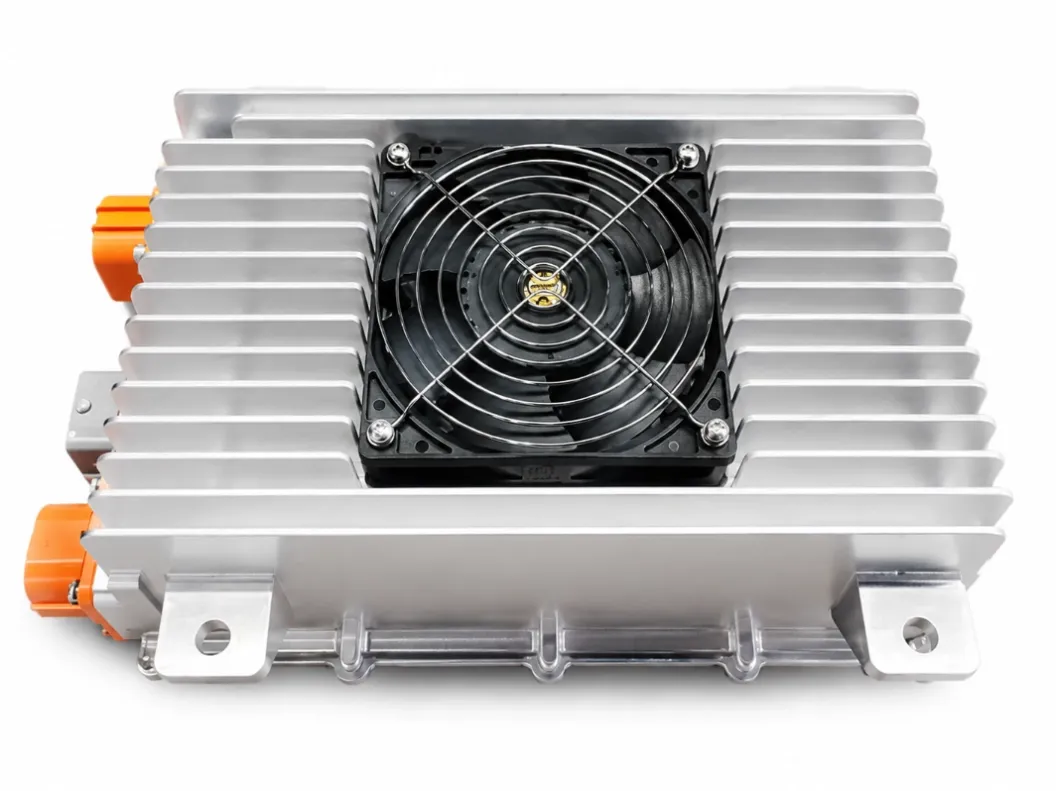
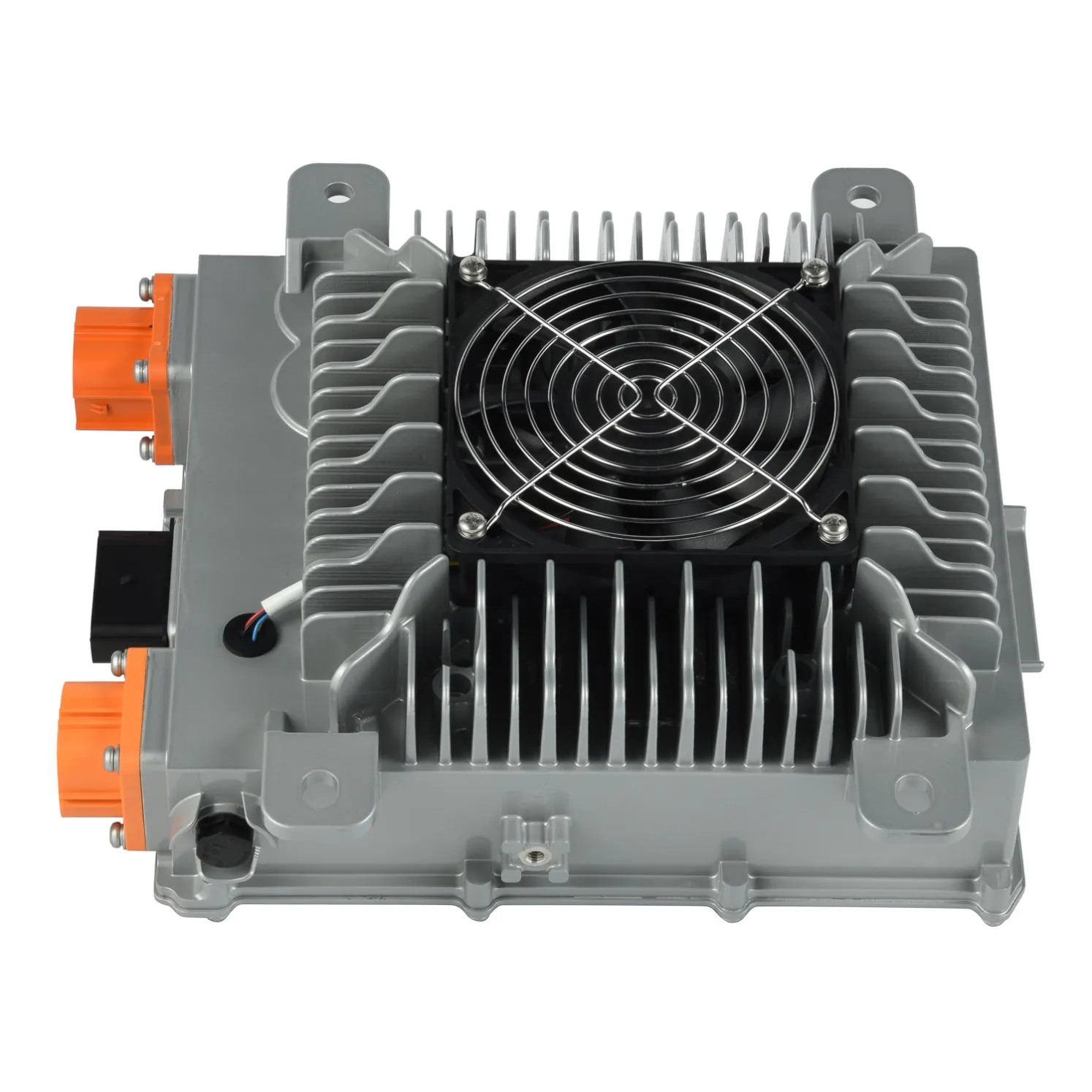
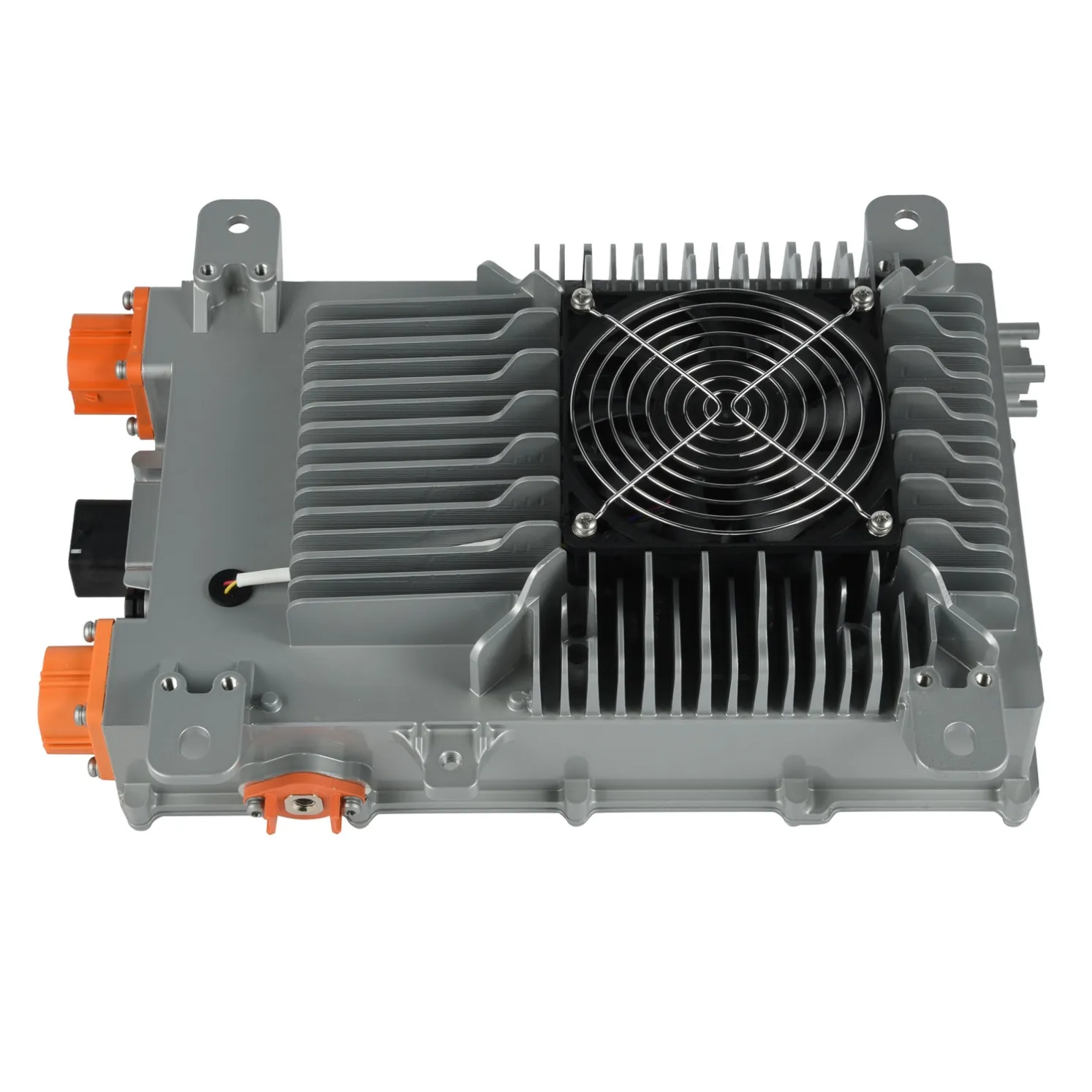
Forced-air cooling uses a fan to push air over heatsink fins on the OBC housing. Echelon's air-cooled OBCs use this method, with a fan integrated on top of the unit in the product images and descriptions.
Advantages:
- Simple system. No coolant, pump, hoses, or radiator. The vehicle does not need a liquid loop for the charger.
- Lighter and cheaper. Fewer parts, easier service, and lower cost than a liquid system.
- Easier to retrofit. Air cooling works if there is a clean air path and a place for hot air to exit.
Limitations:
- Needs airflow. If the OBC is mounted in a sealed compartment, behind a battery, or under a floor with no air path, forced air cannot work. The fan will recirculate hot air and the unit will derate.
- Dust and water. The housing may be IP67, but the fan intake can be blocked by mud, dust, or leaves. Check the intake location and whether it can be cleaned.
- Noise and fan life. A fan is a moving part. Ask about fan life, noise, and what happens if the fan fails — does the unit shut down safely, or continue at reduced power?
- High ambient temperature. At +55°C ambient, the temperature difference between the heatsink and the air is small, so the fan must move more air to remove the same heat. Derating is more likely.
Liquid Cooling: How It Works
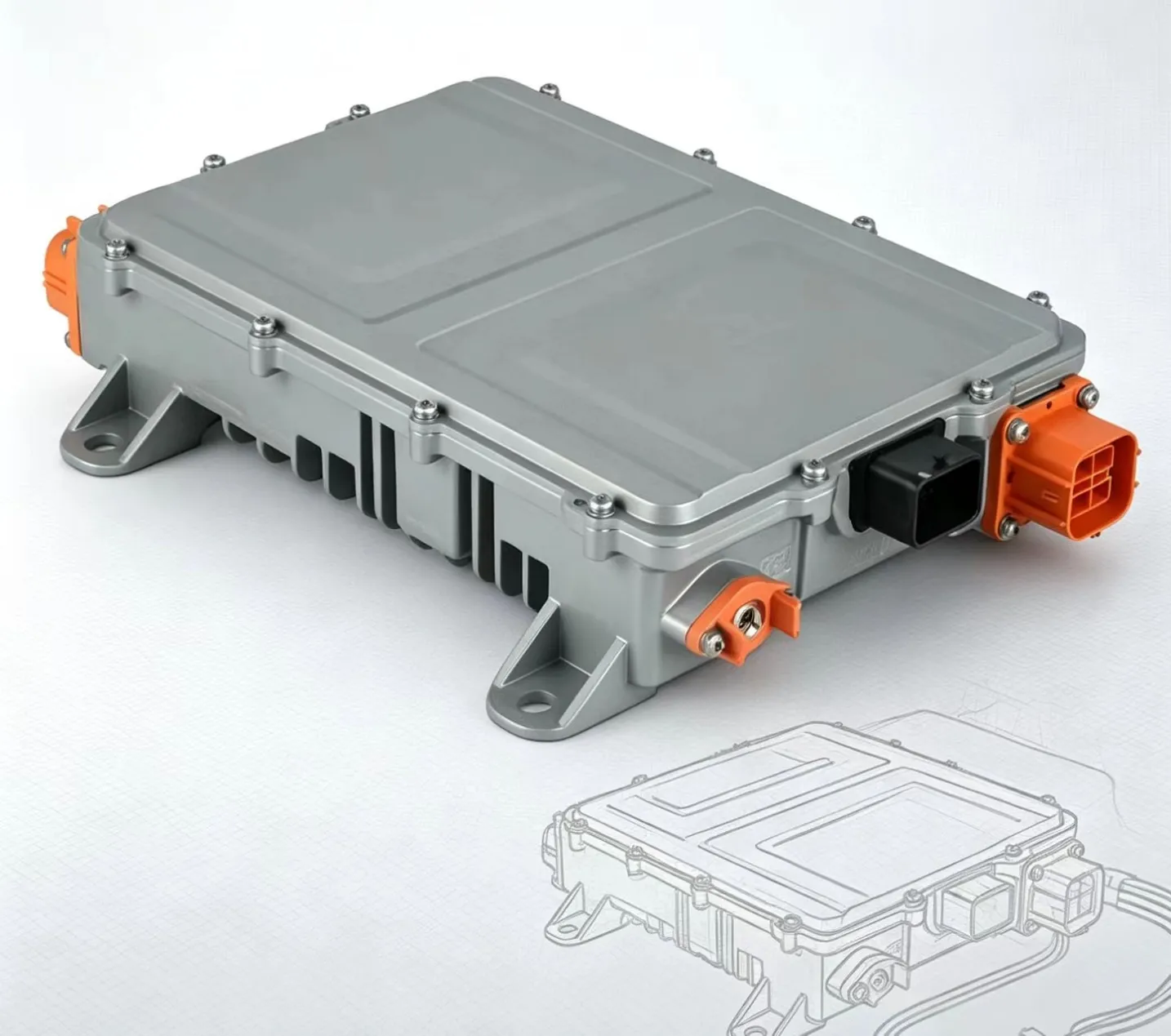
Liquid cooling circulates coolant through a cold plate or channels in the OBC housing, then to a radiator or to the vehicle cooling loop. Echelon's 6.6 kW Bidirectional OBC + 3 kW DC-DC uses liquid cooling.
Advantages:
- Higher power density. Liquid removes heat more effectively than air, so a liquid-cooled unit can be smaller for the same power, or deliver more power in the same size.
- Works in sealed locations. The OBC does not need an air path. It can be mounted in a compartment with no airflow, as long as coolant is available.
- More stable temperature. Coolant temperature is more controlled than air temperature, which helps in hot climates and in vehicles with high continuous loads.
- Quieter. No fan noise from the OBC itself, although the vehicle still needs a pump and radiator fan.
Limitations:
- More complex system. The vehicle needs a coolant loop, pump, hoses, fittings, and a radiator or heat exchanger. That adds cost, weight, leak risk, and service work.
- Coolant requirements. What coolant type, flow rate, inlet temperature, and pressure drop does the OBC need? The 10 kW and 13 kW liquid-cooled examples from competitors list flow rates such as ≥10 L/min. Confirm the exact requirement for the Echelon bidirectional unit with the engineering team — do not assume a standard vehicle loop will meet it.
- Cold-weather handling. Coolant can freeze or become viscous at -40°C. Ask how the system handles cold starts and whether coolant heating is needed.
Comparison Table
| Forced-air cooling | Liquid cooling | |
|---|---|---|
| Echelon example | 6.6 kW OBC, 6.6 kW OBC + 1.5 kW DC-DC 2-in-1, 3.3 kW / 2 kW / 1.5 kW 2-in-1 units | 6.6 kW Bidirectional OBC + 3 kW DC-DC |
| Power range in this guide | 1.5-6.6 kW, air-cooled | 6.6 kW bidirectional, plus higher-power cases |
| System complexity | Low — fan and air path only | High — pump, hoses, radiator, coolant |
| Mounting flexibility | Needs clean airflow and hot-air exit | Can be sealed, needs coolant connections |
| Performance at high ambient | Derating more likely above +40-55°C | More stable, if coolant temperature is controlled |
| Dust / water | Fan intake can be blocked; housing IP67 | No fan intake; check coolant fittings and seals |
| Service | Fan replacement, intake cleaning | Coolant checks, hose and fitting inspection, leak checks |
| Cost | Lower unit and system cost | Higher unit and system cost |
| Best fit | Standard commercial EVs with an air path, overnight charging | High power density, sealed mounting, hot climates, V2L / V2V with sustained load |
Worked Example: Heat to Remove
Heat to remove is approximately:
Heat (W) = Input power (W) × (1 − efficiency)
For a 6.6 kW OBC at 93% efficiency, input power is about 6,600 ÷ 0.93 = 7,097 W, and heat is about 497 W. For a 3.3 kW OBC at the same efficiency, heat is about 248 W.
That is the heat the cooling system must remove continuously at full power. A fan that can remove 500 W at 25°C ambient may remove far less at +55°C ambient, because the air is already hot. A liquid system with coolant at a controlled temperature can remove the same heat more reliably, but only if the coolant flow and inlet temperature meet the specification.
Use this number when you talk to the vehicle thermal team: ask for the continuous heat rejection at your highest ambient temperature, not just the peak rating.
Decision Framework
Choose forced air when:
- The OBC power is 6.6 kW or less, and the unit is offered as air-cooled for that power.
- The mounting location has a clean air path, with cool air in and hot air out, and the intake cannot be easily blocked.
- The vehicle has no liquid loop, or adding one would cost more than the benefit.
- The charging duty is overnight or intermittent, with time for the unit to cool between sessions.
Choose liquid cooling when:
- The OBC is the bidirectional 6.6 kW unit, which is specified as liquid cooled, or a higher-power unit that requires it.
- The mounting location is sealed, has no airflow, or is next to a hot component such as a motor or exhaust.
- The ambient temperature is regularly high, and the unit must deliver full power without derating.
- The vehicle already has a liquid loop with the required flow, temperature, and pressure drop, and the extra plumbing is acceptable.
If you are unsure, ask the supplier for the derating curve: power vs ambient temperature, for both air and liquid options, at the actual airflow or coolant flow your vehicle can provide. A derating curve is more useful than a single temperature rating.
Mounting and Airflow Checklist
For forced-air units, confirm:
- ☐ The fan intake and exhaust are not blocked by brackets, cables, or body panels.
- ☐ Hot air does not recirculate back to the intake.
- ☐ The intake can be inspected and cleaned without removing the unit.
- ☐ The unit is not mounted above a heat source that will raise its inlet air temperature.
- ☐ The operating temperature range is -40°C to +55°C for the specific model, and the derating above +55°C is known.
For liquid-cooled units, confirm:
- ☐ Coolant type, flow rate, inlet temperature, and pressure drop are specified.
- ☐ The vehicle loop can meet those values at the highest ambient temperature.
- ☐ Hose routing, fittings, and leak detection are agreed.
- ☐ Cold-start behaviour at -40°C is documented.
- ☐ The coolant loop is shared or dedicated, and what happens if the loop fails.
Common Mistakes
- Assuming IP67 means the fan is protected. IP67 applies to the housing. The fan intake and bearings can still be affected by dust, mud, or water spray. Check the fan rating and location separately.
- Mounting an air-cooled unit in a sealed box. The unit will overheat and derate, or fail early. If the location is sealed, you need liquid cooling or a different location.
- Specifying liquid cooling without a loop. A liquid-cooled OBC without a vehicle coolant loop is unusable. Confirm the loop exists, or budget for it, before choosing liquid cooling.
- Checking only peak power. Check continuous power at your highest temperature, for the full charging session. A unit that delivers 6.6 kW for 10 minutes and then derates to 3.3 kW is not a 6.6 kW charger for overnight use.
Related reading: What Is a Bidirectional OBC? V2L, V2V, and V2G Explained · IP67, -40°C, and Automotive Validation Explained · What Drives OBC Development Cost: NRE, Prototypes, Tooling and Validation
FAQ
Is liquid cooling always better than air cooling?
No. Liquid cooling removes heat more effectively, but it adds complexity, cost, and leak risk. For most 1.5-6.6 kW commercial OBCs with a clean air path, forced-air cooling is sufficient and simpler.
Can I convert an air-cooled OBC to liquid cooling?
No, not by adding a cold plate or a fan. Cooling is part of the unit design. If you need liquid cooling, select a liquid-cooled model, such as the Echelon 6.6 kW Bidirectional OBC + 3 kW DC-DC.
What happens if the fan fails on an air-cooled OBC?
Confirm this with the supplier for the specific model. In many designs, the unit derates or shuts down to protect itself. It should not continue at full power with no fan.
Does liquid cooling help in cold weather?
It can help stabilise temperature, but coolant can also freeze or become viscous at -40°C. Ask how the system handles a cold start at -40°C and whether coolant heating is required.
How do I know if my mounting location has enough airflow?
Ask the vehicle thermal team for the airflow and inlet temperature at the mounting location, at the highest expected ambient temperature. If that information is not available, measure it, or use a conservative mounting location with a clear air path.
Related Echelon Products
See the full range on the products page.

Next Step
Send the engineering team your mounting location, available airflow or coolant flow, and highest expected ambient temperature, and request the derating curve for the air-cooled and liquid-cooled options that fit your power and voltage. Choose on continuous power at your temperature, not on the headline rating.
To start, share your vehicle and battery requirements through our contact page, and see how a custom programme is scoped on our OEM/ODM page. Before requesting a quotation, the OBC RFQ checklist lists the inputs that let Echelon quote accurately in one pass.
About Echelon Charger
Echelon Energy Technology specializes in onboard chargers, DC/DC converters, and integrated EV power solutions for commercial and specialty electric vehicles.
For technical discussions, product selection, or OEM/ODM cooperation:
Email: nancy@tici-energy.com
WhatsApp: +86 18114665311