Sep 29, 2026Technical Articles & Engineering Insights
3.3kW vs 6.6kW On-Board Charger: Which Power Level Fits Your EV Project?
Compare 3.3kW and 6.6kW OBCs and learn how battery, AC input, charging time, thermal conditions and vehicle requirements affect charger power selection.
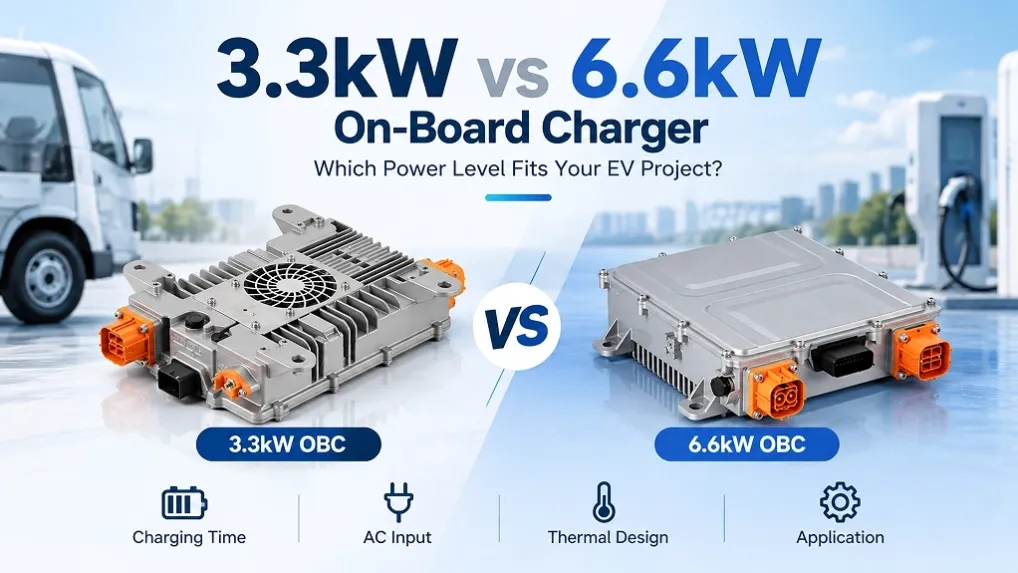
When EV manufacturers select an on-board charger, 3.3kW and 6.6kW are two common power levels.
At first, the difference may seem simple: a 6.6kW OBC provides twice the rated charging power of a 3.3kW unit.
But in a real vehicle project, choosing between them involves more than charging power alone.
Battery voltage, allowable charging current, AC input conditions, charging-time targets, thermal conditions and vehicle integration all affect whether a 3.3kW or 6.6kW OBC is suitable.
1. Start with the Battery, Not the OBC Power Rating
Before deciding between a 3.3kW and 6.6kW OBC, the first step is to understand the battery system.
Important information includes:
- Battery nominal voltage
- Charging voltage range
- Battery capacity
- Maximum allowable charging current
- Battery chemistry and BMS requirements
For example, simply specifying “96V battery” is not enough. The actual charging voltage range and allowable charging current need to be confirmed before the charger can be matched correctly.
A higher-power OBC only provides an advantage when the battery system can accept the corresponding charging power.
2. How Charging Power Affects Charging Time
For the same battery pack, higher available charging power can reduce charging time.
This is one reason EV manufacturers may consider moving from a 3.3kW OBC to a 6.6kW OBC.
However, the actual charging time does not depend on the OBC rated power alone.
The BMS charging strategy, battery state of charge, voltage and current limits, temperature and power derating can all influence the actual charging process.
Therefore, a 6.6kW label does not mean that the charger will operate at 6.6kW throughout the entire charging cycle.
3. AC Input Conditions Must Also Be Checked
The AC side is another important consideration.
A higher-power charger requires sufficient input power. The available AC voltage and current at the intended charging location therefore need to be considered during OBC selection.
This is particularly important for commercial and specialty EVs that may be charged in different operating environments.
Before confirming the OBC power, EV manufacturers should define:
- AC input voltage
- Frequency
- Available input current
- Charging infrastructure at the intended operating location
Selecting a higher-power charger without considering the AC-side limitation may prevent the vehicle from using the expected charging power.
4. Thermal Management Becomes More Important at Higher Power
The charger itself, cooling method, installation space and surrounding airflow all influence operating temperature.
A 6.6kW OBC installed in a restricted vehicle compartment may face different thermal conditions from the same charger installed in an open, well-ventilated location.
EV manufacturers should therefore evaluate charging power together with:
- Ambient temperature
- Installation space
- Airflow
- Cooling method
- Continuous operating conditions
This is especially important for commercial EVs, utility vehicles, GSE and other vehicles that may operate for long hours.
5. Vehicle Usage Determines How Valuable Faster Charging Is
Not every vehicle requires the highest available OBC power.
For some EV applications, overnight charging provides sufficient time to recharge the battery. In these projects, a 3.3kW OBC may meet the vehicle's operational requirements.
Other vehicles have shorter charging windows or higher daily utilization. In these cases, reducing charging time may be more important, making a 6.6kW OBC worth evaluating.
The correct decision therefore depends on the vehicle's real operating schedule rather than power rating alone.
6. Consider the Complete Vehicle Power Architecture
OBC selection is also related to the overall vehicle electrical architecture.
Some vehicle platforms require only a standalone on-board charger.
Others may benefit from an integrated solution combining multiple power functions.
Depending on the project, possible configurations include:
An integrated solution may reduce separate components and simplify system integration, but the correct architecture depends on the vehicle platform and project requirements.
Internal link: OBC + DC-DC 2-in-1
7. 3.3kW or 6.6kW: What Should EV Manufacturers Confirm?
Instead of asking only:
“Should we use a 3.3kW or 6.6kW charger?”
A more useful engineering discussion starts with:
What charging power does this vehicle actually need and support?
Before making the decision, confirm the battery voltage range, allowable charging current, AC input conditions, charging-time target, thermal environment, installation space and communication requirements.
Higher OBC power is not automatically the better choice.
The appropriate power level is the one that works correctly with the battery system, charging infrastructure and actual vehicle operating conditions.
Conclusion
3.3kW and 6.6kW OBCs can both be suitable for commercial and specialty electric vehicles, but they serve different project requirements.
For EV manufacturers, OBC power should be evaluated as part of the complete vehicle charging system rather than as an isolated specification.
At Echelon Charger, we provide standalone OBCs as well as integrated OBC + DC-DC and OBC + DC-DC + PDU solutions for different EV platforms.