Oct 27, 2026EV System Integration & Architecture
Can an EV Onboard Charger Work with European Type 2 AC Chargers?
Type 2 is not just an AC voltage question. What IEC 61851-1 adds at the vehicle side, who handles the Control Pilot signal, and what to check before releasing a European vehicle harness.
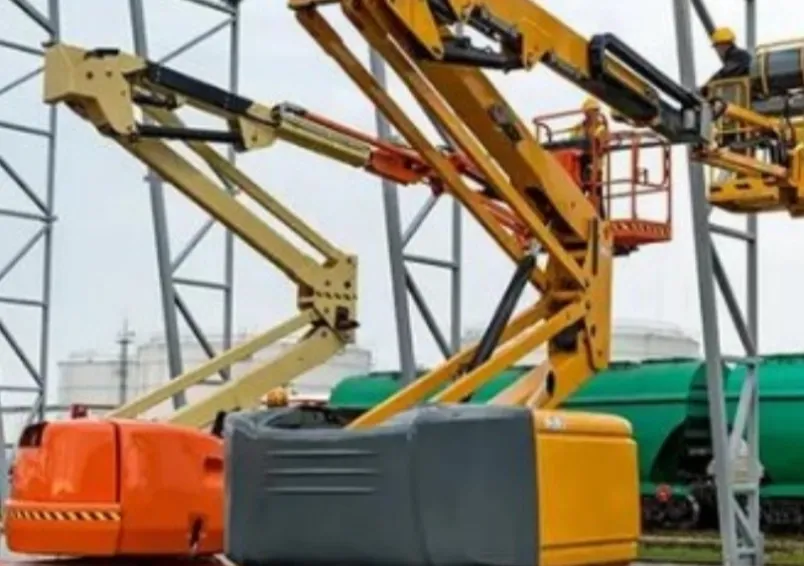
For manufacturers developing electric construction equipment, aerial work platforms and other specialty vehicles for European markets, charging compatibility is an important part of vehicle design. The question that comes up early in the program is usually the same one: can an onboard charger simply be connected to a European Type 2 AC charging station?
Short answer: yes — but only if the vehicle implements the Control Pilot interface defined in IEC 61851-1. A compatible AC input is necessary, not sufficient. What decides it is where CP handling lives in the vehicle architecture, not the charger's input voltage.
What does Type 2 actually add compared with an industrial AC supply?
Type 2 is commonly associated with AC charging infrastructure in Europe, and it is normally discussed together with IEC 61851-1, the standard covering conductive EV charging systems, including the control functions between the vehicle and the charging equipment.
For AC charging, the Control Pilot (CP) signal is the important part of that interface. The charging station uses CP signalling, including PWM duty-cycle information, to communicate the available charging current under the applicable operating conditions. The vehicle charging system must respect that available current limit.
This is the difference that matters in practice. An industrial 32 A supply gives the vehicle a fixed source and leaves current control entirely to the vehicle. A Type 2 station tells the vehicle how much current it may take, and expects the vehicle to stay within that limit and to hold the expected state on the pilot line.
Input type | What the vehicle sees | Current limit decided by |
Industrial AC supply | Fixed AC source, no pilot signalling | Vehicle charging system |
Type 2 AC station | AC source plus CP signalling and PWM duty cycle | Charging station, respected by vehicle |
Does the onboard charger have to read the CP signal itself?
Not necessarily, and this is where integration projects most often go wrong. There are different vehicle-level architectures, and both are legitimate:
OBC-side handling. The onboard charger or its associated controller handles the relevant charging interface functions directly, including the current limit received from the station.
Separate charging controller. A dedicated EV charging controller manages the Type 2 interface and communicates the permitted charging current to the OBC over CAN or another supported control interface.
The correct architecture depends on the charger design and on the vehicle's electrical system. What does not work is assuming one of them without checking: an OBC that accepts a compatible AC voltage does not automatically support the complete Type 2 charging interface, and a vehicle that relies on a separate controller still has to make sure the OBC honours the current limit it is given.
What should OEM engineers confirm before selecting a charger?
The five points below decide whether a given OBC can be integrated into a Type 2 vehicle. They are architecture questions, not datasheet questions, so they are best settled in writing with the charger supplier while the vehicle is still on paper.
Question | Why it decides the design | Who usually answers |
Which component handles CP signalling | Sets whether the OBC needs pilot-line hardware at all | Vehicle integrator |
How the permitted AC current is determined | Defines the interface between charging controller and OBC | Both sides jointly |
How the charger receives and applies the current limit | Determines if CAN or an analogue/discrete signal is needed | Charger supplier |
How charging enable and shutdown are controlled | Fixes the power-up sequence and the enable topology | Charger supplier |
How the system responds to station disconnection or faults | Defines safe state and restart behaviour | Both sides jointly |
Our own enable architecture is a useful reference point here. On the integrated platforms, the OBC enable is configurable between a hardware signal and a CAN command, while the DC-DC stage needs a 12 V hardware enable regardless. The reasoning is covered in OBC and DC-DC enable pin requirements, and it matters for Type 2 programs because the charging controller is often the node that asserts the enable.
How does the AC input rating interact with a Type 2 supply?
A standard industrial AC connection and a Type 2 charging station are not necessarily interchangeable. A charger connected to a suitable industrial AC supply may operate perfectly well without a Type 2 charging interface, depending on its design and on the vehicle's protection architecture. A Type 2 station adds the vehicle-to-charging-equipment control requirements described above.
Power level sets the practical limit. Our OBC platforms accept AC 90-264 Vac, so the input window covers European single-phase supplies without a voltage selection step. What still has to be checked is the current available at the station:
Charger | Typical AC draw at 230 Vac | Fits which station class | Notes |
About 14 A | 16 A single-phase | Most common choice for light specialty vehicles | |
About 29 A | 32 A single-phase | Leaves little headroom on a 32 A station | |
Depends on input configuration | To be confirmed per program | Confirm the AC input architecture before specifying |
The 6.6 kW row is the one worth pausing on. A 6.6 kW charger on a 32 A single-phase station runs close to the station's ceiling, so any de-rating the station applies is immediately visible in charging time. If the vehicle duty cycle assumes a full 6.6 kW, confirm what the target stations actually deliver. The same logic runs through choosing the right OBC power level for 1.5 kW, 3.3 kW and 6.6 kW platforms.
For a vehicle intended to use both connection types, the manufacturer should determine how each input will be safely connected, controlled and protected, rather than assuming that one input path covers the other. That usually means separate connector definitions, separate detection logic and a documented priority rule if both are present.
Which platforms suit European specialty vehicles?
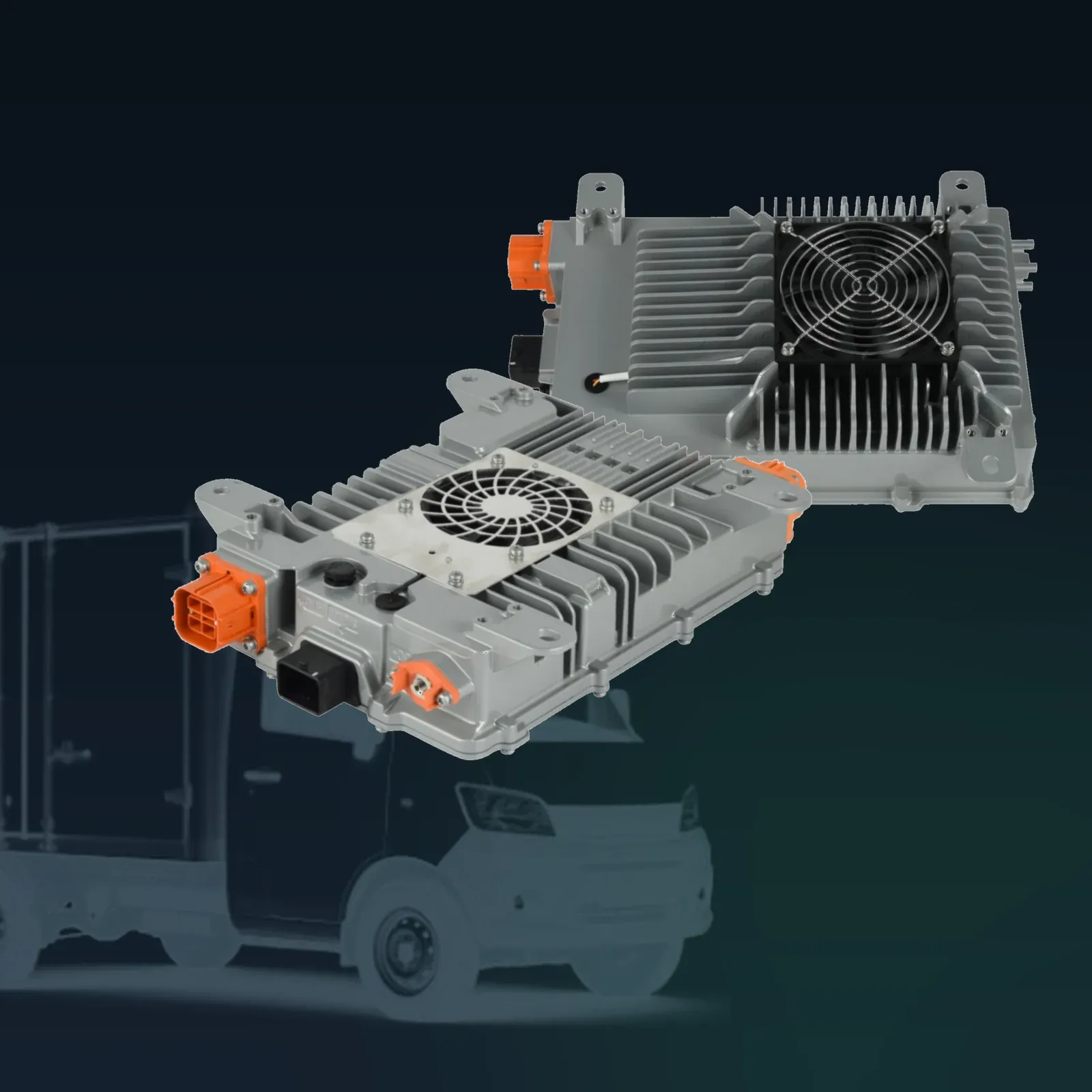
Construction machinery, aerial work platforms and other non-road specialty vehicles tend to sit in the 72 V to 400 V pack range with relatively modest charging power, which is where the integrated platforms fit best. All of them use CAN-bus communication and are rated IP67, which is relevant for equipment that is washed down or stored outdoors.
Platform | Voltage window | AC input | Typical fit |
72 V / 96 V / 320 V variants | AC 90-264 Vac | Compact specialty vehicles, L7 machines | |
96 V / 320 V variants | AC 90-264 Vac | Larger packs, shorter charge windows | |
200-470 Vdc | Confirm per program | Higher-voltage machines, V2L and V2G | |
96 V / 320 V variants | AC 90-264 Vac | Where on-board distribution protection is required | |
96 V to 12 V | Not applicable | Auxiliary rail alongside a separate OBC |
Efficiency is >=93% on the OBC stage and >=91% on the DC-DC stage on the 3.3 kW integrated platform, which matters on battery-electric construction equipment where the charger runs during short operational breaks. For equipment that sees dust, water and vibration, the reasoning behind the IP67 rating is covered in why IP67-rated onboard chargers matter.
What to ask before buying a prototype
Before purchasing a prototype, confirm the AC input rating, the Type 2 interface architecture, CP handling, charging current control, the wiring and protection approach, and the applicable compliance requirements for the target market. These details are particularly important when integrating chargers into construction machinery and other specialty electric vehicles, because the vehicle-level controller architecture varies more between OEMs in that segment than it does in passenger cars.
It also helps to be explicit about the intended charging scenarios. A machine that charges overnight from a depot wall box has different requirements from one that has to accept whatever station is available on a construction site, and the difference shows up in how much of the Type 2 interface the vehicle has to implement itself.
Discuss your vehicle charging requirements
Echelon Charger provides onboard charging solutions for commercial and specialty electric vehicle projects. If your vehicle requires European Type 2 AC charging, share your charging interface requirements, battery voltage range, AC supply details and control architecture with us.
Our engineering team can review the requirements and discuss the feasibility of a suitable configuration, including how the current limit is passed from the charging controller to the charger. The RFQ checklist lists the wider input set for a program, and the OEM/ODM page explains how variants are configured.
Explore Echelon onboard chargers or request technical support. For background on the control interface, see how CAN communication improves charger integration.
FAQ
Can a standard onboard charger be plugged into a Type 2 station directly?
Not as a rule. A compatible AC voltage is necessary but not sufficient. The vehicle also has to handle the Type 2 interface functions, either inside the charger or in a separate charging controller, and it must respect the current limit the station signals through the Control Pilot line.
Is IEC 61851-1 a certification the charger must hold?
IEC 61851-1 is the standard for conductive EV charging systems and describes the control functions between vehicle and charging equipment. Whether your program is assessed against it depends on the vehicle type and the market requirements. Confirm the applicable requirements for your application with your engineering and compliance teams, and tell us which ones apply so the integration can be reviewed against them.
Does the OBC need a dedicated Control Pilot input?
Only if the OBC is the component handling the Type 2 interface. In architectures where a separate EV charging controller manages the pilot line and sends the permitted current over CAN, the OBC does not need pilot-line hardware, but it does need to accept and apply the current limit it receives.
Can one charger support both industrial AC and Type 2 charging?
That depends on how each input is connected, controlled and protected, and it is decided at vehicle level rather than by the charger alone. Where both connection types are required, define separate detection logic and a documented priority rule instead of assuming one path covers the other.
What information do you need to assess a Type 2 application?
The charging interface requirements, the battery voltage range, the AC supply details, the control architecture, which component handles CP signalling, and the intended charging scenarios. With those we can review the configuration rather than answer from a generic datasheet.
About Echelon Charger
Echelon Energy Technology specializes in onboard chargers, DC/DC converters, and integrated EV power solutions for commercial and specialty electric vehicles.
For technical discussions, product selection, or OEM/ODM cooperation:
Email: nancy@tici-energy.com
WhatsApp: +86 18114665311
For charging interface requirements, power sequence descriptions or CAN matrix files, use our contact page.