L5 Electric Three-Wheeler Onboard Charger: What a Commercial Three-Wheeler Platform Demands from Its Power Unit
An L5 electric three-wheeler runs commercial duty on a 48V or 96V pack. Here is how to specify its onboard charger — power, overnight charge time, 12V auxiliaries, CAN, and sealing for Indian roads.
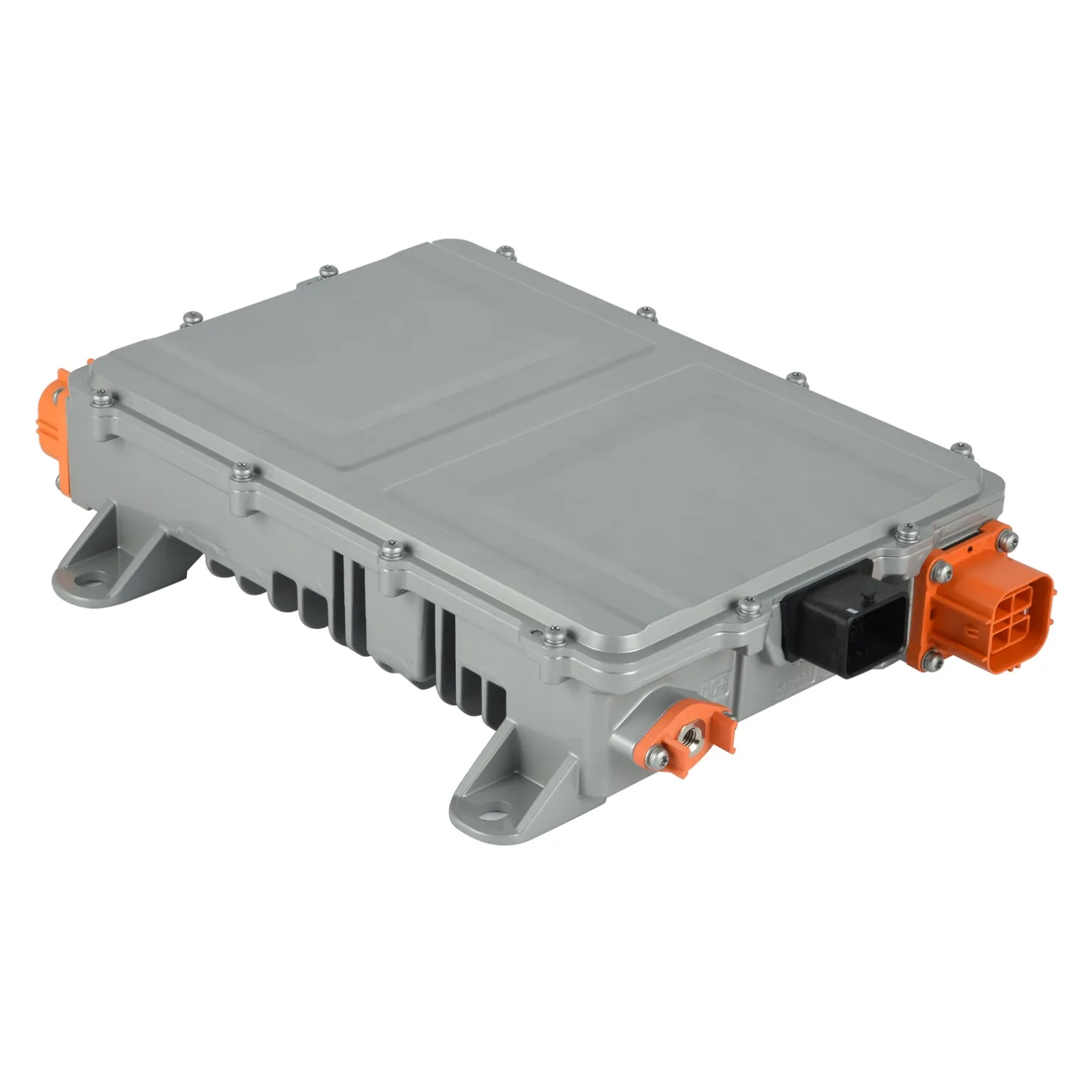
An L5 electric three-wheeler is a commercial vehicle under India's CMVR rules, and its onboard charger is specified like one. The 48V or 96V battery platform, the overnight charge window, the 12V auxiliary load, and the CAN interface decide the power unit — here is how to choose it, with the charge-time and power figures that decide the duty.
L5 is the Indian classification for heavy-duty electric three-wheelers built for commercial passenger or cargo work — above the lower-speed L3 e-rickshaw class, with higher performance, greater load capacity, and stricter regulatory and safety standards. The vehicles run fixed city routes and loaded cargo duty all day, then charge overnight from a socket or a depot supply. That duty cycle, not the headline power figure, is what the onboard charger has to match. This guide covers L5 electric three-wheeler charging: what the platform demands from the onboard charger, and how to specify the L5 electric three-wheeler onboard charger for a commercial duty cycle.
Key takeaways:
- L5 is India's CMVR category for heavy-duty commercial electric three-wheelers — passenger (L5M) and cargo (L5N) — above the L3 e-rickshaw class, and a commercial driving licence is legally required to operate one.
- 48V and 96V are the two common L5 platforms, with 60V and 72V also appearing; the charger must match the platform exactly, because a charger built for one platform cannot charge another.
- Overnight charging is the L5 duty cycle: a 7.2 kWh pack takes about 5 hours on a 1.5 kW charger and about 2.25 hours on a 3.3 kW charger, before charging losses.
- A 16A single-phase socket supplies about 3.7 kW at 230V, so a 3.3 kW onboard charger fits it and a 1.5 kW charger fits smaller supplies too.
- The DC-DC stage powers the 12V vehicle — lights, horn, dashboard, telematics — and its size, 500W, 1 kW, or 1.5 kW, is decided by the vehicle's simultaneous 12V loads.
- The charger and the BMS coordinate over CAN; charging voltage, current, and CAN are configurable for OEM projects, and the DBC file belongs to the exact model number.
- Rapid DC charging and onboard AC charging are two different decisions: an onboard charger cannot use a DC fast charger, and 15-minute charging needs a DC platform and a compatible battery.
An L5 three-wheeler is a commercial vehicle, and its charger is specified like one
L5 is the Central Motor Vehicles Rules (CMVR) category for heavy-duty electric three-wheelers in India, built for commercial passenger or cargo mobility. L5 vehicles are designed for higher performance and greater load capacity than lower-speed L3 e-rickshaws, and they are subject to stringent regulatory and safety standards. The category splits into passenger carriers (L5M) and cargo carriers (L5N). Because L5 vehicles are commercial transport vehicles with higher performance thresholds, a valid commercial driving licence is legally required to operate one.
The performance gap over L3 is not a small step. Reported figures for the L5 definition put L5 three-wheelers above 25 km/h, on motors above 0.25 kW, with a gross vehicle weight up to 1,500 kg excluding the battery. Those thresholds are what separate a commercial vehicle from a low-speed rickshaw — and they are what make the charger a commercial specification rather than a consumer accessory. A vehicle that earns its living all day cannot afford a charger that was designed for occasional use.
One confusion to clear up first: India's CMVR L5 category is not the same thing as the EU's L5e class for powered tricycles. They share a letter and nothing else — different regulations, different markets, different vehicles. This article is about the Indian L5 category and the charging decisions it creates.
| L3 e-rickshaw | L5 electric three-wheeler | |
|---|---|---|
| Category | Lower-speed electric rickshaw | Heavy-duty commercial three-wheeler (CMVR) |
| Use | Short-hop passenger trips | Commercial passenger (L5M) or cargo (L5N) duty |
| Performance | Lower speed and power | Higher performance — above 25 km/h, motors above 0.25 kW |
| Load | Light passenger load | Greater load capacity — gross vehicle weight up to 1,500 kg excluding the battery |
| Regulation | Lower-speed rules | Stringent CMVR regulatory and safety standards; commercial driving licence required |
| What it means for the charger | Occasional-use charging is enough | Daily commercial duty: the charger must hold full power, night after night, and its CAN interface must coordinate with the BMS |
The charging decisions below apply to any onboard charger for electric three-wheelers, whoever builds the vehicle.
The battery platform decides the charger: 48V and 96V are the two common L5 platforms
Every charger decision starts with the battery platform, because the charger must match it exactly. The L5 vehicles on sale in India run low-voltage packs: a 48V passenger auto with a 7.2 kWh pack, a 48V cargo loader with a 5.76 kWh pack, and a 60V cargo loader are typical examples. 72V versions exist, and 96V is the second common platform — the step-up for higher-power cargo loaders that need more charging power and a bigger DC-DC stage. The charger is bought for the platform the vehicle already has — the platform is not chosen to suit the charger.
The practical consequence of a low-voltage platform is current. The same charging power at 48V needs roughly 50% more current than at 72V, and roughly double the current of a 96V platform, so cabling, connectors, and the charger output stage all work harder on the lower-voltage platform. That is why the 48V/72V choice is a vehicle decision with charging consequences, and why the platform comparison in 48V or 72V: How to Choose the Battery Platform for a 1.5kW 2-in-1 Power Unit is the companion read to this section — it works through current, cabling, and DC-DC output for the two platforms, and this article does not repeat it.
One more platform point: a charger is specified against the pack's full charge voltage, not its nominal voltage. A 48V pack charges well above 48V, and a 72V pack well above 72V. The charger's output range must cover that top voltage with margin, and its charging voltage and current must be set for the exact pack. On the 1.5kW 2-in-1, charging voltage, charging current, and CAN are configurable for OEM projects — that configurability is what makes a standard unit fit a specific pack, and it is agreed before the first unit is ordered, not discovered at commissioning.
| Battery platform | Vehicle type | Pack | Charge time on the supplied charger | Echelon charger fit |
|---|---|---|---|---|
| 48V | Passenger auto | 7.2 kWh | About 5.5 hours on a standard socket | 1.5kW OBC + 500W DC-DC 2-in-1 (48V version) |
| 48V | Cargo loader | 5.76 kWh | About 7–8 hours on a standard socket | 1.5kW OBC + 500W DC-DC 2-in-1 (48V version) |
| 60V | Cargo loader | 80 Ah | About 6 hours | Confirm the exact pack voltage with the supplier — 60V sits between the 48V and 72V versions |
| 72V | Mid-power variants | Larger packs | Shorter, by the same arithmetic | 1.5kW OBC + 500W DC-DC 2-in-1 (72V version), 2kW OBC + 1kW DC-DC 2-in-1 (72V version), or 3.3kW standalone OBC (72V version) |
| 96V | Higher-power cargo loaders | Larger packs | Shortest of the common platforms, by the same arithmetic | 3.3kW OBC + 1.5kW DC-DC 2-in-1 (96V version, featured), 2kW OBC + 1kW DC-DC 2-in-1 (96V version), or 3.3kW standalone OBC (96V version) |
Note what the table does not show: the published L5 examples run 48V and 60V packs. Some charger design guides quote 144V three-wheeler platforms, but no published L5 example runs one. Specify the charger for the platform that exists, not for a voltage class from another market.
Overnight charging is the L5 duty cycle, and charger power decides how long the night must be
Most L5 vehicles run a single shift and charge overnight — at home on a standard socket or at a depot. The question that decides charger power is therefore a simple one: how many hours does the vehicle sit still, and how much energy must go back into the pack in that time? A passenger auto that returns at 9 pm and leaves at 6 am has a 9-hour window; a cargo loader that returns at 8 pm and leaves at 5 am has the same. The charger has to finish inside that window, every night, with margin for a late return. The method for weighing those factors is the selection guide How to Choose an On-Board Charger (OBC) for Commercial EVs.
The arithmetic is energy divided by power. The table below gives the ideal time — pack energy divided by charger power, before charging losses. Real charging runs longer, because efficiency losses take their share and the CC/CV charge tapers current near the top of the pack. Treat the table as the floor, not the promise: if the ideal time already fills the night, the charger is too small.
| Pack energy | 1.5 kW charger (ideal) | 3.3 kW charger (ideal) |
|---|---|---|
| 5.76 kWh | About 4 hours | About 1.75 hours |
| 7.2 kWh | About 5 hours | About 2.25 hours |
| 10.2 kWh | About 7 hours | About 3 hours |
For comparison, supplied chargers typically take a 7.2 kWh pack to about 5.5 hours and a 5.76 kWh pack to 7–8 hours. A 1.5 kW charger brings the 7.2 kWh pack to about 5 hours, and a 3.3 kW charger brings it to about 2.25 hours. The upgrade from 1.5 kW to 3.3 kW is not about speed for its own sake; it is about buying back the evening — a vehicle that finishes charging by midnight can leave at 4 am, and a vehicle that needs the whole night cannot.
The supply side is equally simple. A 16A single-phase socket supplies about 3.7 kW at 230V, so a 3.3 kW onboard charger fits it and a 1.5 kW charger fits smaller supplies too. Echelon's standalone OBCs take 90–264Vac input, which covers India's 230V single-phase supply. The 3.3kW standalone OBC delivers 3300W at 220Vac and 1650W at 110Vac, the 3.3kW 2-in-1 delivers 3.3 kW at 220Vac and 1.65 kW at 110Vac, and the 2kW 2-in-1 delivers 2000W at 220Vac and 1000W at 110Vac — the wide input range is what lets one unit charge wherever the vehicle ends its day. For the full wide-input reasoning, see 110V or 220V, One Onboard Charger Covers Both: What APEC Shenzhen Proves About Wide AC Input — though that article is about 110V/220V fleet duty, the derating logic is the same: a charger on a lower-voltage supply delivers less power, and the night must be planned for it. The power-class comparison behind the 1.5 kW versus 3.3 kW choice is 3.3kW vs 6.6kW vs 11kW OBC.
The DC-DC stage runs the 12V vehicle, and its size is a specification, not an afterthought
A three-wheeler is a 12V vehicle on top of a 48V or 72V traction pack. Lights, horn, indicators, dashboard, wipers, telematics, and USB charging all run on 12V, and they run while the vehicle drives — not only while it charges. The DC-DC stage is the part of the power unit that feeds them, stepping the traction voltage down to 9–16V. Its size is decided by the vehicle's simultaneous 12V loads: everything that can be on at once, on the longest and hottest day, with the headlights, the horn, and the telematics all drawing together.
That load list is a vehicle document, and it belongs in the specification before the power unit is chosen. A DC-DC stage that is too small does not fail loudly — it sags, it overheats, or it forces the vehicle to shed loads. The three DC-DC stages in Echelon's 2-in-1 range cover the spread: 500W in the 1.5kW 2-in-1, 1 kW in the 2kW 2-in-1, and 1.5 kW in the 3.3kW 2-in-1. The right one is the one that covers the load list with margin, not the one that matches the charger power.
| DC-DC stage | Where it lives | Output | Peak | What it fits |
|---|---|---|---|---|
| 500W | 1.5kW OBC + 500W DC-DC 2-in-1 | 500W | Not stated | Light 12V loads — the default L5 fit |
| 1 kW | 2kW OBC + 1kW DC-DC 2-in-1 | 1000W, 72A rated | 1200W, 86A peak (6 min) | Heavier 12V loads on a 72V or 96V platform |
| 1.5 kW | 3.3kW OBC + 1.5kW DC-DC 2-in-1 | 1.5 kW, 110A rated | 1800W, 132A peak (6 min) | The heaviest 12V loads, on a 96V or 320V platform |
There is also a separate-unit option. The standalone 500W DC-DC converter (PD-BA-0F-96Y, 1.35 kg, 203.8 × 118 × 57 mm, natural cooling, CC/CV output, reverse polarity protection) is the answer when the charger has no DC-DC stage — for example, beside a standalone OBC. It does not support CAN: it is enabled by a +12V line on a 9-wire harness, not by the vehicle controller. That is a real difference, not a detail — a CAN-controlled DC-DC stage reports and is commanded through the vehicle network, and a +12V-enabled one is not. The architecture choice behind integrated versus separate stages is OBC vs DC-DC Converter vs 2-in-1 Integrated Power Unit.
CAN coordination between the charger and the BMS decides whether the pack charges safely
The charger does not decide how the pack is charged. The battery management system does — it knows the cell voltages, the temperatures, and the state of charge, and it sets the voltage and current the pack will accept at each moment. The charger follows those limits, and the two talk over CAN. If the charger and the BMS disagree about the platform, the protocol, or the limits, the vehicle reports faults that belong to the configuration, not to the charger.
That is why CAN is a specification item, not a checkbox. Before the first unit is ordered, the vehicle side must hand the charger supplier three things: the battery platform and its full voltage range, the maximum charge current the BMS will allow, and the CAN protocol with the DBC file for the exact model number. On Echelon's integrated units, every unit carries a CAN bus defined by the DBC file and CAN matrix of its exact model number, and on the 1.5kW 2-in-1 the charging voltage, charging current, and CAN are configurable for OEM projects. The message-level checklist — what to confirm, what to test, and what to ask for — is CAN Communication and BMS Integration Checklist for OBC, and this article does not repeat it.
| What the vehicle side must give the charger supplier | Why it matters |
|---|---|
| Battery platform and full voltage range | The charger output range must cover the pack's top charge voltage, not just its nominal voltage |
| Maximum charge current the BMS allows | Sets the charger's current limit — and whether a 1.5 kW or 3.3 kW charger is even usable on this pack |
| CAN protocol and DBC file for the exact model number | The charger and the BMS must speak the same messages, or the vehicle reports configuration faults |
| 12V load list | Decides the DC-DC stage size — 500W, 1 kW, or 1.5 kW |
| Mounting position and cooling path | Decides whether the charger holds full power in summer heat — see the next section |
| AC supply at the depot or home | Decides whether the overnight window is long enough at the charger's real input power |
One exception to the CAN rule: the standalone 500W DC-DC converter has no CAN at all. If the vehicle design relies on CAN for every power stage, that unit does not belong in it — use a 2-in-1 with a CAN-controlled DC-DC stage instead. When a charger stops charging in the field, the diagnostic sequence starts where this section ends: Onboard Charger Failure: How to Tell a Dead Charger from a Protection Trip, a Derating Event, or a Vehicle Fault.
Heat, dust, and water decide whether the charger holds full power on Indian roads
An L5 three-wheeler does not charge in a clean room. The charger sits under a seat or a load bed, in dust, in monsoon rain, and in summer heat that pushes the inside of a parked vehicle far above the air temperature. The mounting position decides how much of that the charger actually sees, and the charger's sealing and cooling decide what it does about it. This is an installation decision as much as a product decision — the mounting, cooling-path, and sealing reasoning is Onboard Charger Installation: Mounting, Cooling, Sealing, and CAN Wiring for Commercial EVs, and it applies here in full.
Sealing is stated per unit, not per family. Only two Echelon units carry a stated IP67 rating: the 6.6kW OBC + 1.5kW DC-DC 2-in-1 and the 1.5kW OBC + 500W DC-DC 2-in-1. Every other unit's sealing is not stated, and a buyer should not assume it. For the depth behind IP67 and automotive validation, see IP67 and −40°C Automotive Validation for OBC.
Heat is the quieter limit. Every watt the charger loses becomes heat inside the vehicle, and the cooling path has to move it. The table below gives the waste heat at full power, derived from the verified efficiency of each stage — loss equals output times (1 ÷ efficiency − 1), shown as "about". The featured 3.3kW 2-in-1 moves about 210W of heat from its OBC stage and about 100W from its DC-DC stage through one forced-air cooling path, and it protects itself by derating: the OBC derates at 85°C internal and shuts down at 90°C, and the DC-DC stage derates at 90°C and shuts down at 105°C. A charger that derates on a hot afternoon is not defective; it is installed where its cooling path cannot do its job.
| Stage | Output power | Efficiency | Waste heat at full power |
|---|---|---|---|
| 6.6 kW OBC stage | 6.6 kW | 93% or more | About 500W |
| 3.3 kW OBC stage | 3.3 kW | 94% or more | About 210W |
| 1.5 kW DC-DC stage | 1.5 kW | 94% or more | About 100W |
| 1 kW DC-DC stage | 1 kW | 94% or more | About 60W |
No efficiency figure is published for the 1.5kW 2-in-1's OBC stage, so no waste-heat figure is given for it here — that is an open question for the specification, not a number to guess. The same honesty applies to the whole section: if a sealing or temperature figure is not stated for a unit, ask for it by model number before the vehicle is built around it.
Rapid DC charging and onboard AC charging are two different decisions
The fastest charging news in the L5 segment is not about onboard chargers at all. Some operators in India now offer 15-minute DC top-ups for three-wheelers at dedicated DC stations — while the same vehicles still take several hours on a standard socket in normal mode. Those are DC charging platforms: the charging power lives in the station, the battery is built to take it, and the station network is part of the product.
An onboard charger cannot use any of that. An OBC converts grid AC into battery DC inside the vehicle; a DC fast charger delivers DC straight to the battery and bypasses the onboard charger entirely. The two paths need different batteries, different vehicle inlets, and different infrastructure, and a vehicle is built for one or the other — or for both, at the cost of carrying both systems. The choice is a duty decision: a single-shift vehicle that charges overnight needs only a socket and an onboard charger, and it can charge anywhere a socket exists; a multi-shift vehicle that must top up in short breaks needs a DC platform, a DC-capable battery, and stations on its routes.
Echelon makes onboard chargers and integrated power units, not DC fast chargers and not DC charging platforms. The honest way to read the 15-minute headlines is as a question for the vehicle programme, not for the charger supplier: which duty does this vehicle run, and which charging path does that duty need? If the answer is overnight AC charging, the L5 three-wheeler charger specification in this article is the whole job. If the answer is rapid DC top-ups, the onboard charger is still needed for the overnight full charge — and the DC capability is a separate vehicle decision, agreed with the battery and vehicle makers.
Related Echelon Products
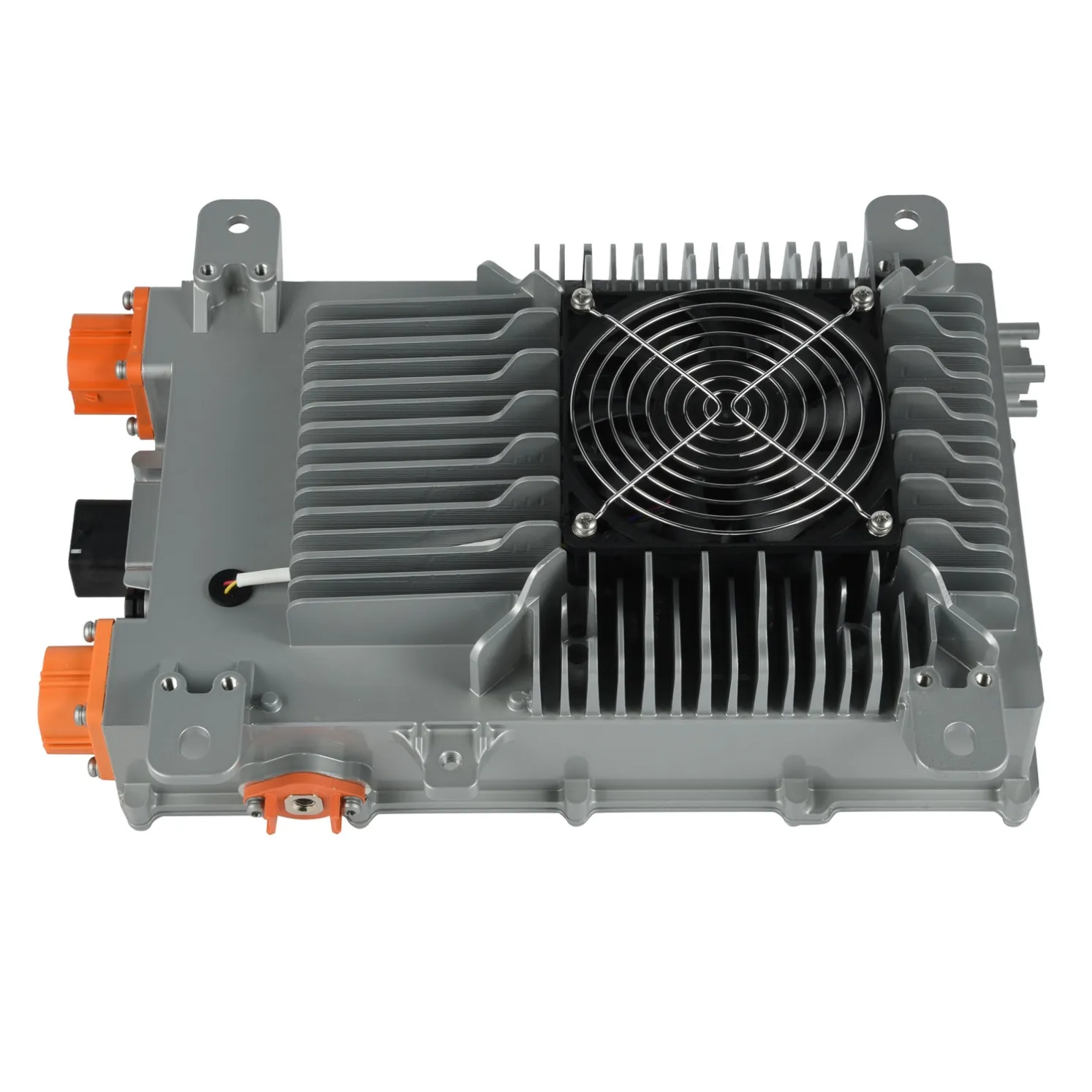
Featured for 96V cargo loaders: 3.3kW OBC (64–128V DC, 0–34A, 1.65kW at 110Vac, 94% or more) with a 1.5kW DC-DC stage (1.5kW / 1800W peak, 9–16V, 110A / 132A peak) in one forced-air unit, 6 kg or less, with CAN and derating protection (OBC derates at 85°C, shuts down at 90°C).
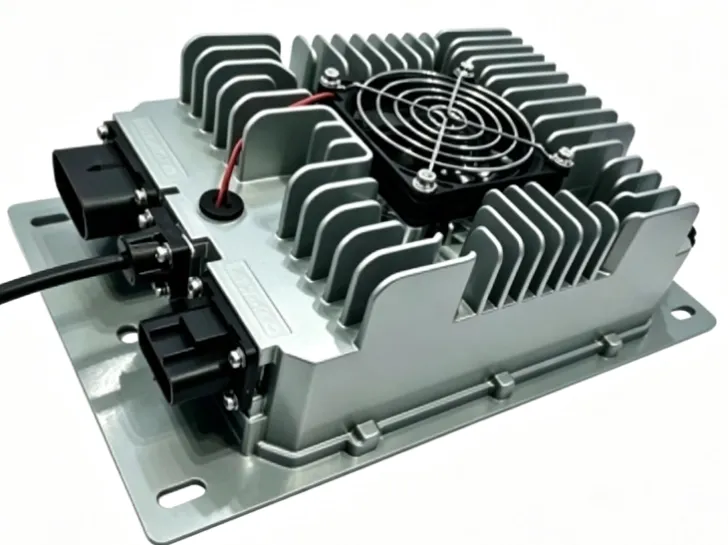
The default L5 fit for 48V and 72V platforms: 1.5kW OBC with a 500W DC-DC stage, CAN, CC/CV charging, IP67 sealing, and air cooling. Charging voltage, charging current, and CAN are configurable for OEM projects.
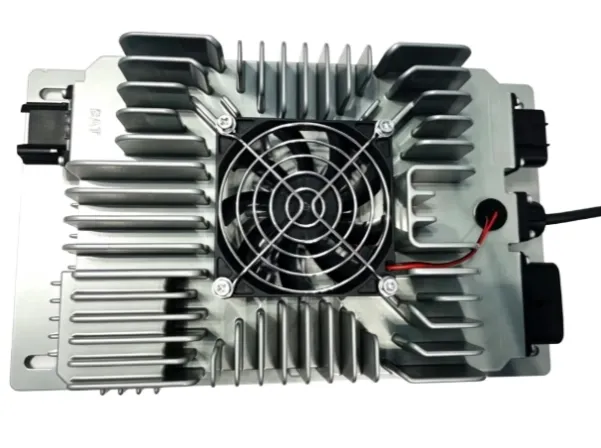
The mid option for 72V and 96V platforms: 2kW OBC (2000W at 220Vac, 1000W at 110Vac, 94% or more, 4.5 kg or less) with a 1kW DC-DC stage (1000W / 1200W peak, 72A rated / 86A peak), air cooling, and CAN.
Frequently Asked Questions
what is an L5 electric vehicle
An L5 electric vehicle is a heavy-duty electric three-wheeler under India's Central Motor Vehicles Rules (CMVR), built for commercial passenger or cargo mobility. It sits above the lower-speed L3 e-rickshaw class, with higher performance, greater load capacity, and stricter regulatory and safety standards. The category splits into passenger carriers (L5M) and cargo carriers (L5N).
what size onboard charger does an L5 three-wheeler need
It depends on the pack and the overnight window. A 1.5 kW charger suits a 48V single-shift vehicle — about 5 hours for a 7.2 kWh pack before losses. A 3.3 kW charger suits a larger pack or a shorter night — about 2.25 hours for the same pack. On a 96V cargo loader that also needs a 1.5 kW DC-DC stage, the featured unit is the 3.3kW OBC + 1.5kW DC-DC 2-in-1.
how long does it take to charge an L5 electric three-wheeler
Supplied chargers typically take 5.5 to 8 hours. With a 1.5 kW onboard charger, a 7.2 kWh pack takes about 5 hours; with a 3.3 kW charger, about 2.25 hours — both before charging losses, which make the real time longer. The overnight window, not the charger label, decides whether the vehicle is ready in the morning.
does an L5 electric three-wheeler need a commercial driving licence
Yes. Because L5 vehicles are classified as commercial transport vehicles with higher performance thresholds, a valid commercial driving licence is legally required to operate one in India. Check the applicable CMVR rules and state EV policy before buying.
can an L5 three-wheeler use DC fast charging
The vehicle can, if it is built on a DC charging platform — some operators offer 15-minute top-ups at dedicated DC stations. But the onboard charger itself cannot use a DC fast charger: the OBC converts AC inside the vehicle, and DC fast charging bypasses it entirely. Rapid DC charging and onboard AC charging are two different vehicle decisions.
is an L5 electric vehicle the same as an L5e
No. India's L5 is a CMVR category for heavy-duty commercial electric three-wheelers. The EU's L5e is a separate class for powered tricycles under European type approval. They share a letter and nothing else — different regulations, different markets, different vehicles.
Next Step
Send Echelon's team your programme data — the battery platform and pack voltage range, the overnight charge window, the 12V load list, the CAN protocol and DBC file, and the mounting position and cooling path — and ask which power unit fits, what the installation plan provides for it, and what validation evidence comes with it.
Contact Echelon directly: Email nancy@tici-energy.com · WhatsApp +86 18114665311.
Use the contact form on the contact page to start the discussion, and see how a custom programme is defined on the OEM/ODM page.